


realme 16 5G India Launch: Key Highlights Ahead of April 2 Reveal
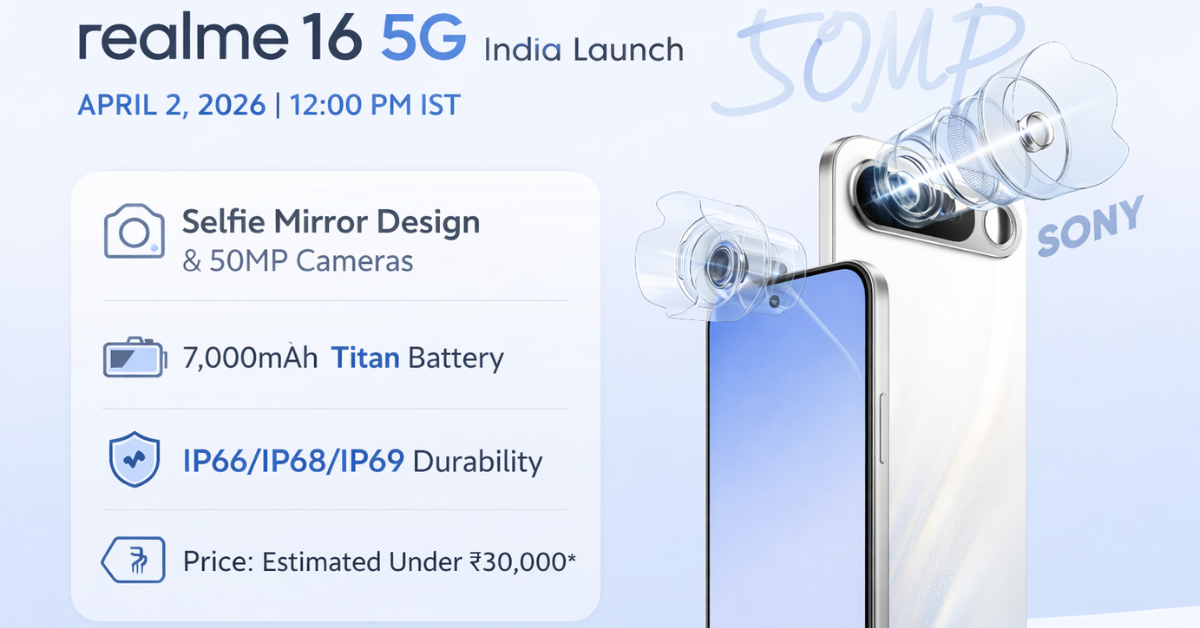
- Launch timing: realme 16 5G to debut in India on April 2, 2026 at 12 PM IST.
- Creator focus: Introduces “Selfie Mirror” for rear-camera selfies and gesture-based capture.
- Battery claim: 7,000mAh unit packed into a slim 8.1mm, 183g body.
- Durability: IP66, IP68, and IP69 ratings with high-temperature resistance claims.
- Expected price: Likely to start under ₹30,000; sales via Flipkart and retail stores.
The realme 16 5G is set for its official India launch on April 2, 2026, at 12:00 PM IST, marking the brand’s next push in the upper mid-range smartphone segment. Positioned with a clear emphasis on content creation and battery endurance, the device introduces a mix of hardware experimentation and software-led imaging features that attempt to differentiate it in a crowded price bracket.
realme 16 5G: Full Specifications at a Glance
The table below provides a consolidated view of the confirmed and claimed specifications of the realme 16 5G ahead of its official launch in India.
| Category | Feature | Details |
|---|---|---|
| Launch | Launch Date | April 2, 2026 (12:00 PM IST) |
| Display | Screen Size | 6.57-inch AMOLED |
| Display | Refresh Rate | 120Hz |
| Display | Peak Brightness | Up to 4,200 nits (claimed) |
| Display | Dimming | 2,160Hz PWM dimming |
| Performance | Processor | MediaTek Dimensity 6400 Turbo (6nm) |
| Performance | Cooling System | 6,050mm² Vapour Chamber cooling |
| Rear Camera | Primary Sensor | 50MP Sony IMX852 |
| Rear Camera | Secondary Sensor | 2MP portrait/monochrome |
| Rear Camera | Flash | Ring Flash (soft lighting) |
| Front Camera | Selfie Camera | 50MP front camera |
| Battery | Capacity | 7,000mAh |
| Battery | Charging | 60W fast charging |
| Battery | Battery Tech | High-density graphite cells |
| Software | Operating System | realme UI 7.0 (Android 16) |
| Software | Updates | 3 years OS + 4 years security updates |
| Durability | IP Rating | IP66, IP68, IP69 |
| Durability | Water Resistance | High-pressure water jets + immersion support |
| Durability | Temperature Resistance | Up to 80°C (claimed) |
| Design | Thickness | 8.1mm |
| Design | Weight | 183g |
| Design | Build | Flat-edge, reinforced plastic frame |
| Design | Colors | Air Black, Air White |
| Special Features | Selfie Mirror | Rear reflective module for framing selfies |
| Special Features | Gesture Control | “Say Hi” hands-free shutter |
| Special Features | LumaColor | AI-based skin tone and color optimization |
| AI Features | AI Edit Genie | Edit photos with prompts (background, styling) |
| AI Features | AI Vibe Master | Preset video color grading modes |
| AI Features | AI Instant Clip | Auto-generated video montages |
| Availability | Platforms | Flipkart, realme store, offline retail |
| Pricing | Expected Price | Under ₹30,000 (estimated) |
Pricing and Availability
The official pricing of the realme 16 5G will be announced during the launch event on April 2, 2026. As of now, the company has not confirmed any variant-wise pricing or storage configurations for the Indian market.
Early industry expectations suggest that the device will be positioned in the mid-range segment, likely below the ₹30,000 mark. However, these figures are indicative and should not be treated as final pricing.
Expected Market Position
| Aspect | Details |
|---|---|
| Official Price | To be announced on April 2, 2026 |
| Expected Segment | Upper mid-range smartphone category |
| Indicative Range | Likely under ₹30,000 (unofficial estimate) |
| Availability | Flipkart, realme online store, and offline retail outlets |
A Creator-Centric Pitch with “Selfie Mirror” Design
Realme is marketing the device as a “Portrait Star,” and the central idea behind this positioning lies in its unusual “Selfie Mirror” implementation. This is a small reflective surface integrated into the rear camera module, allowing users to frame selfies using the primary 50MP rear sensor instead of relying solely on the front camera.
While reflective back elements are not entirely new, realme’s approach ties this hardware feature to a broader software ecosystem. The mirror works alongside gesture-based capture, branded as the “Say Hi” feature, which allows users to trigger the shutter without physically touching the device. Combined with a ring-style flash module, the setup aims to offer more even lighting for portraits, avoiding the harsh shadows often associated with conventional LED flashes.
The company is also introducing “LumaColor” imaging, an in-house algorithm designed specifically to ensure accurate skin tones and color balance regardless of the lighting environment. While such claims are common in smartphone launches, the actual effectiveness will depend on real-world performance testing.
Large Battery in a Slim Form Factor
One of the more notable claims around the realme 16 5G is its 7,000mAh battery, which is unusually large for a device that measures just 8.1mm in thickness and weighs 183 grams. This balance between battery capacity and physical design is being achieved through the use of high-density graphite battery cells, which allow more energy storage within a smaller footprint.
The phone supports 60W fast charging and includes what realme calls “AI Smart Charging,” a system intended to manage charging speeds and battery health based on usage patterns. While large batteries are increasingly common in budget segments, integrating one into a relatively slim and lightweight device remains a technical challenge, and this is where realme is attempting to stand out.
To manage thermal output, especially during charging and gaming, the device includes a 6,050mm² vapour chamber cooling system. Realme refers to this as an “AirFlow” solution, though the terminology appears to be more branding than a fundamentally new cooling approach.
Display and Performance Specifications
The realme 16 5G features a 6.57-inch AMOLED display with a 120Hz refresh rate, placing it in line with current expectations in the segment. The panel is claimed to reach a peak brightness of 4,200 nits, which, if accurate, would position it among the brighter displays available in this category. It also supports 2,160Hz PWM dimming, aimed at reducing eye strain during prolonged use in low-light environments.
Powering the device is the MediaTek Dimensity 6400 Turbo chipset, manufactured on a 6nm process. MediaTek has steadily expanded its presence in mid-range devices, and this processor is expected to handle everyday tasks, moderate gaming, and AI workloads efficiently, though it is not positioned as a flagship-tier chipset.
The phone runs on realme UI 7.0, based on Android 16, with a confirmed update policy of three years of major OS updates and four years of security patches. This aligns with evolving industry standards, where longer software support is becoming a key purchase factor.
Camera System and Imaging Tools
The rear camera setup includes a 50MP primary sensor, identified as the Sony IMX852, alongside a secondary 2MP sensor used for portrait or monochrome data. Sony sensors are widely used across the industry, and their inclusion generally indicates a baseline level of imaging reliability.
Interestingly, the front camera is also a 50MP unit, suggesting that realme is not relying solely on the rear camera for high-resolution selfies despite the presence of the Selfie Mirror.
The device’s imaging software suite is built around what realme calls “Next AI.” This includes:
- AI Edit Genie: Allows users to change clothing, hairstyles, or background elements in photos through simple prompts.
- AI Vibe Master Mode: Offers three specific mood-based presets—Lively, Festival, and Ceremony—to instantly color-grade videos for social media.
- AI Instant Clip: Automatically scans your gallery to create ready-to-share video montages from your recent photos and videos.
These features reflect a broader trend across smartphone brands to integrate generative AI tools directly into the camera and gallery experience. However, the practical value of these tools will depend on processing speed, accuracy, and ease of use.
Durability and Environmental Resistance
One of the more unusual aspects of the realme 16 5G is its multiple IP ratings. The device is listed with IP66, IP68, and IP69 certifications, indicating resistance to dust, heavy rain, full water immersion, and even high-pressure water jets.
The inclusion of IP69, typically associated with industrial-grade equipment, is relatively rare in consumer smartphones, particularly in the mid-range segment. Realme also claims the device can withstand temperatures up to 80°C, though such figures usually reflect controlled testing conditions rather than everyday usage scenarios.
While these specifications suggest a highly durable build, real-world resilience will depend on factors such as sealing quality and long-term wear.
Design Language and Build Choices
The realme 16 5G adopts what the company calls a “Gleaming Wings” design, featuring a layered gradient finish with a blue-gold visual effect. It will be available in two primary color options: Air Black and Air White.
The device uses a flat-edge frame with narrow bezels and an “Air-Compact” form factor, which appears to be branding for its attempt to combine a large battery with a relatively lightweight build. The use of reinforced plastic rather than metal helps reduce weight while maintaining structural integrity.
Internally, realme refers to its layout as an “AirCraft” structure, which focuses on minimizing unused space to accommodate larger components without increasing device thickness.
Pricing Expectations and Market Position
While official pricing will be revealed at launch, current estimates place the starting price under ₹30,000, with some projections ranging between ₹27,990 and ₹38,000 depending on storage variants.
The device will be available through Flipkart, the realme online store, and offline retail channels across India.
Assessing the Claims and Market Context
Most of the information surrounding the realme 16 5G comes from official teasers and launch materials, which means certain claims, particularly around durability, brightness levels, and AI capabilities, should be treated as provisional until independent testing is available.
That said, the specifications themselves are consistent with current industry trends. Large batteries, AI-assisted photography, and extended software support are becoming standard expectations rather than differentiators. What makes the realme 16 5G notable is the attempt to combine all these elements while introducing small but distinct hardware ideas like the Selfie Mirror.
The success of the device will likely depend less on individual features and more on how well these elements work together in daily use. Performance stability, camera consistency, and battery efficiency over time will be key factors in determining whether the phone delivers on its positioning.
What to Watch at Launch
The April 2 launch event will clarify final pricing, variant configurations, and any pre-order offers. It will also provide a clearer picture of how realme intends to position the device against competitors in the same segment.
For now, the realme 16 5G presents itself as a feature-heavy mid-range device with a clear focus on content creators and battery-focused users. Whether these claims translate into practical advantages will become evident once the device reaches consumers and undergoes detailed reviews.