


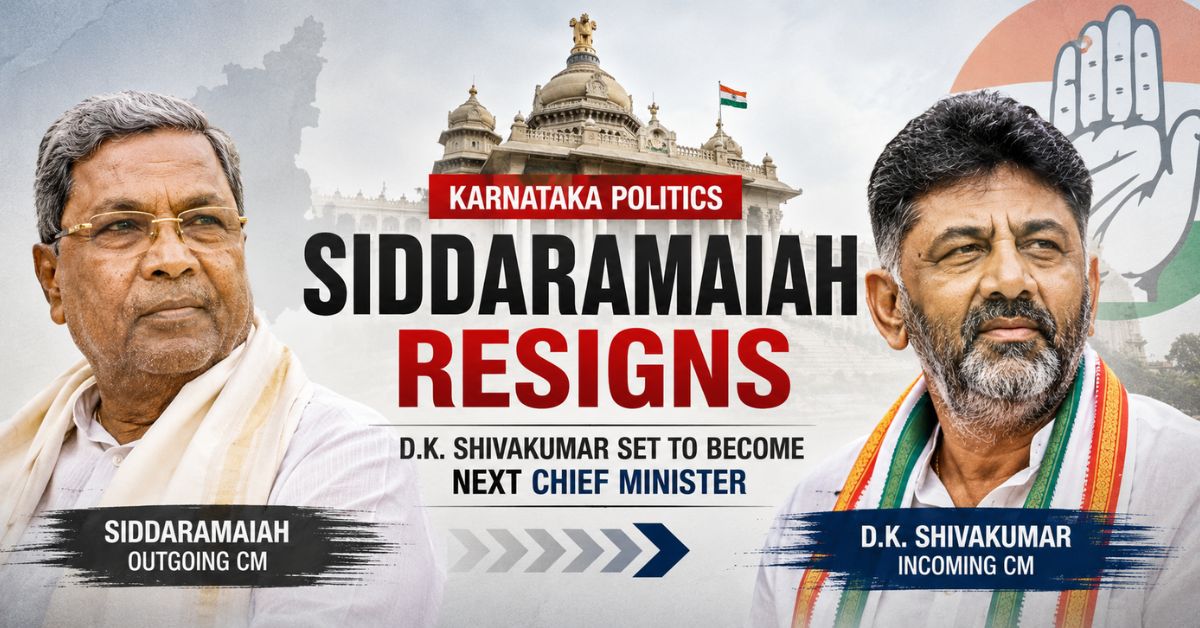
Karnataka Leadership Change
- Siddaramaiah resigned as Karnataka Chief Minister after months of speculation over a leadership transition.
- Deputy Chief Minister D.K. Shivakumar is expected to become the next Chief Minister.
- The Congress leadership reportedly managed the transition through internal discussions in Delhi.
- AHINDA groups expressed concern over Siddaramaiah stepping down from the top post.
- A cabinet reshuffle is expected under the new leadership in Karnataka.
Karnataka Chief Minister Siddaramaiah resigned on Thursday, bringing an end to months of political speculation over a possible leadership change in the Congress government. Deputy Chief Minister D.K. Shivakumar is now expected to take over as the next Chief Minister, marking a major shift in Karnataka politics nearly three years after the Congress party returned to power in the 2023 Assembly elections.
The resignation follows long-running discussions inside the Congress over a reported power-sharing arrangement between Siddaramaiah and Shivakumar. While the Congress leadership had never officially confirmed such a deal in public, leaders from both camps had repeatedly hinted at an understanding reached after the 2023 election victory.
Siddaramaiah submitted his resignation to the Governor’s office in Bengaluru earlier in the day. Officials said Governor Thaawarchand Gehlot was outside Karnataka at the time and was expected to complete the constitutional process after returning to Bengaluru. The Congress leadership in Delhi was closely involved in the transition process, with senior leaders Rahul Gandhi and Mallikarjun Kharge holding several rounds of discussions over the past few weeks.
Before the resignation announcement, Siddaramaiah hosted a breakfast meeting for cabinet colleagues and senior Congress leaders at his residence. The meeting drew attention after photographs showed Siddaramaiah and Shivakumar greeting each other warmly. In one widely circulated image, Shivakumar was seen touching Siddaramaiah’s feet to seek blessings, a gesture interpreted by many party workers as a sign of unity during the transition.
The change in leadership comes at a politically important time for the Congress party. Karnataka remains one of the Congress party’s strongest states after its victory in the 2023 Assembly elections. Any internal conflict in the state government could have affected the party’s national political plans ahead of future elections. The Congress leadership therefore appeared focused on ensuring a smooth transfer of power without creating open divisions inside the state unit.
Siddaramaiah’s Political Legacy in Karnataka
Siddaramaiah’s resignation also marks the end of a major phase in Karnataka politics. During his time in office, he became one of the longest-serving Chief Ministers in the state’s history and remained one of the Congress party’s most influential leaders in southern India. Known for his welfare-focused politics and strong support among backward classes, minorities, and Dalits, Siddaramaiah built a wide political base through the AHINDA social coalition.
AHINDA, a Kannada political term representing minorities, backward classes, and Dalits, became a key political strategy during Siddaramaiah’s leadership. Many supporters viewed him as the strongest political voice for these communities in Karnataka. Following news of his resignation, protests and demonstrations were reported in some districts by groups associated with the AHINDA movement. Protesters expressed concern that Siddaramaiah’s exit from the top post could reduce their political influence within the government.
Despite stepping down as Chief Minister, Siddaramaiah made it clear that he is not leaving Karnataka politics. According to party sources and media reports, the Congress high command had explored the possibility of moving him to national politics through a Rajya Sabha position or an organisational role in Delhi. However, Siddaramaiah reportedly declined the offer and decided to remain active in Karnataka.
In his public remarks after the resignation, Siddaramaiah described the transition as part of the democratic process. He said he remained grateful to the people of Karnataka for giving him the opportunity to serve as Chief Minister twice. He also stressed that he would continue working for the state and remain involved in public life as an MLA.
How the Congress Leadership Transition Developed
The leadership transition has once again brought attention to the internal balance of power within the Karnataka Congress. After the Congress won the 2023 Assembly election with a strong majority, both Siddaramaiah and D.K. Shivakumar emerged as major contenders for the Chief Minister’s post. Siddaramaiah was eventually chosen as Chief Minister, while Shivakumar became Deputy Chief Minister and Karnataka Pradesh Congress Committee president.
At the time, reports suggested that the Congress leadership had worked out a power-sharing formula to balance both leaders and their supporters. Although the party never officially announced a rotational chief minister arrangement, speculation over such a deal continued throughout the government’s term. Every few months, rumours about a possible leadership change resurfaced, often leading to political tension inside the party.
In recent weeks, the Congress leadership in Delhi reportedly held several meetings to finalise the transition process. Senior leaders including Rahul Gandhi, Mallikarjun Kharge, K.C. Venugopal, and Randeep Surjewala were involved in discussions aimed at preventing internal divisions during the transfer of power.
D.K. Shivakumar Faces Major Political Challenges
For D.K. Shivakumar, the transition represents the most important moment of his political career. Known as a powerful organiser and one of the Congress party’s key strategists in Karnataka, Shivakumar played a major role in rebuilding the party before the 2023 election victory. He is often described by Congress leaders as a “troubleshooter” because of his ability to manage political negotiations and difficult situations.
However, Shivakumar’s expected elevation also brings major challenges. He will have to maintain unity among different Congress factions while also balancing regional, caste, and community interests within the cabinet. Political observers believe the new administration may see a major cabinet reshuffle in the coming days as Shivakumar attempts to strengthen his control over the government.
Several ministers loyal to Shivakumar are expected to seek stronger portfolios in the new cabinet. At the same time, the Congress leadership may also try to retain leaders close to Siddaramaiah in order to avoid dissatisfaction among AHINDA communities and senior legislators. Managing this balance will be one of the first political tests for the new leadership.
Opposition Reaction and Political Impact
The Bharatiya Janata Party and Janata Dal (Secular) also reacted to the development, with opposition leaders claiming that the Congress government had spent months dealing with internal political issues instead of governance. BJP leaders said the Congress leadership transition showed instability inside the ruling party. Congress leaders, however, defended the change and described it as a planned democratic process carried out with mutual understanding.
Political analysts say the coming weeks will be important for Karnataka politics. While the Congress leadership has attempted to project unity between Siddaramaiah and Shivakumar, the real challenge may lie in managing party workers and legislators aligned with both camps. Any signs of dissatisfaction could affect the functioning of the government.
At the same time, Congress leaders appear aware that Siddaramaiah continues to hold significant influence in the state. Even after stepping down as Chief Minister, he remains one of the party’s tallest leaders in Karnataka. Many political observers believe he will continue to shape important decisions within the government and the organisation.
What Comes Next for Karnataka Politics
The leadership transition also carries wider national significance for the Congress party. Karnataka is currently one of the few large states governed by Congress on its own strength. Stability in the state government is therefore considered politically important for the party’s national image. Senior Congress leaders reportedly worked carefully to avoid open conflict during the transition process.
For ordinary citizens in Karnataka, attention will now shift toward governance and administration under the new leadership. Welfare schemes introduced during Siddaramaiah’s tenure, including guarantee programmes promised during the election campaign, remain politically important for the Congress government. D.K. Shivakumar will face pressure to continue these programmes while also introducing his own administrative priorities.
The expected cabinet expansion and portfolio distribution may also influence the future political direction of the state. Leaders from different communities and regions are likely to seek stronger representation in the new government. Congress strategists will therefore need to carefully manage caste equations and factional interests while maintaining stability.
As Karnataka prepares for a new phase under D.K. Shivakumar’s leadership, Siddaramaiah’s political influence is unlikely to disappear from the state’s political landscape. His resignation may have ended one chapter in Karnataka politics, but his continued presence inside the Congress organisation means he is expected to remain a central figure in the state for years to come.
The transfer of power between Siddaramaiah and Shivakumar now becomes one of the most closely watched political developments in the country, with both Congress supporters and opposition parties watching how the new government handles the transition in the days ahead.