


Key Highlights
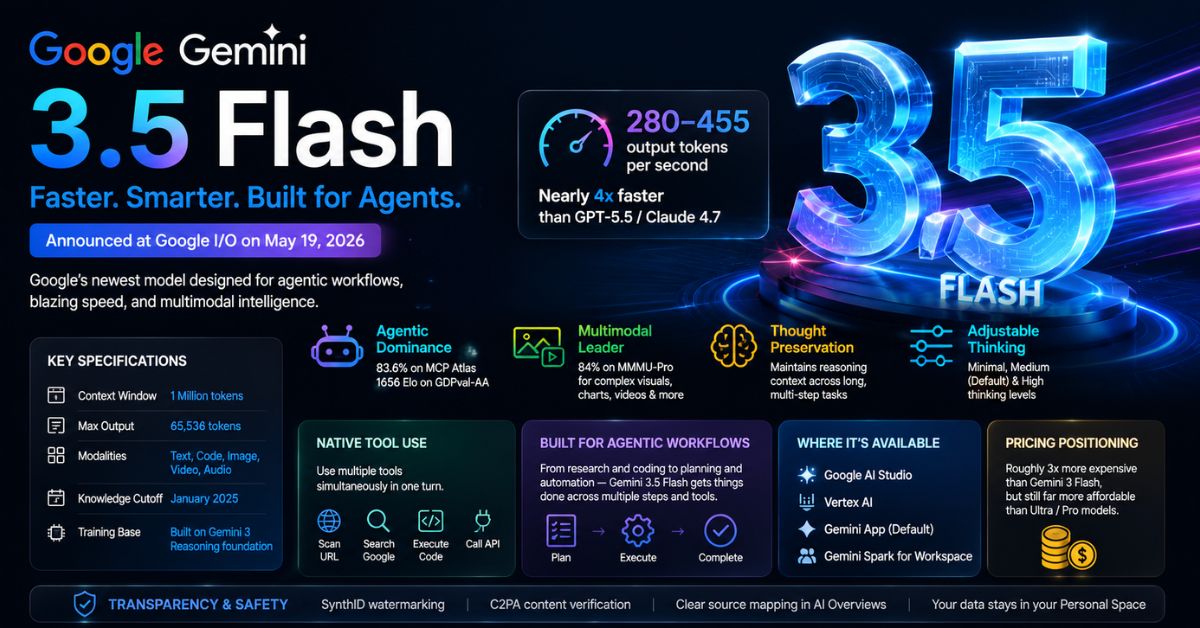
- Google officially introduced Gemini 3.5 Flash during Google I/O 2026.
- The model focuses heavily on agentic AI workflows and high-speed task execution.
- Gemini 3.5 Flash supports multimodal inputs including text, image, video, audio, and code.
- Google claims the model delivers significantly faster output generation than competing AI systems.
- The new model now powers Google Search AI experiences and the Gemini app ecosystem.
Google has officially unveiled Gemini 3.5 Flash, its newest high-speed AI model designed to power the company’s expanding ecosystem of agentic tools, AI Search upgrades, and autonomous workflows. Announced during Google I/O 2026 on May 19, the model represents one of the company’s most aggressive pushes toward making AI systems faster, more responsive, and capable of handling multi-step tasks without constant user intervention.
Unlike earlier “Flash” models that mainly focused on lightweight performance and quick responses, Gemini 3.5 Flash appears designed to close the gap between speed-focused AI and advanced reasoning systems. Google says the model is specifically optimized for agentic workflows, where AI systems can plan, execute, and manage complex sequences of actions across tools and services.
The launch arrives at a time when nearly every major AI company is competing around two key areas: reasoning quality and execution speed. Google’s approach with Gemini 3.5 Flash attempts to combine both.
What Is Gemini 3.5 Flash?
Gemini 3.5 Flash is Google’s newest multimodal AI model built on the Gemini 3 reasoning foundation. It is designed to handle text, code, images, video, and audio while maintaining significantly faster output generation compared to larger flagship models.
According to details shared during Google I/O 2026, the model is intended to become the default engine behind several consumer-facing Google AI experiences, including the Gemini app and the upgraded AI Search interface.
Google is increasingly positioning the “Flash” branding around throughput and responsiveness rather than simply labeling it as a smaller or cheaper model.
The company claims Gemini 3.5 Flash can generate roughly 280 to 455 output tokens per second depending on workload complexity. That would place it among the fastest large-scale AI models currently available publicly.
While benchmark claims from AI companies should always be viewed carefully until independently validated, Google repeatedly emphasized speed as one of the model’s defining characteristics.
Built for Agentic AI Workflows
The biggest strategic focus behind Gemini 3.5 Flash is agentic execution.
Instead of functioning only as a chatbot, the model is optimized for workflows where AI systems can:
- analyze information,
- make decisions,
- use external tools,
- maintain context,
- and complete multi-step tasks automatically.
This is the same broader direction Google highlighted across multiple announcements during I/O 2026.
For example, Gemini 3.5 Flash can reportedly:
- scan web pages,
- search Google simultaneously,
- execute Python workflows,
- process uploaded documents,
- and interact with APIs within a single reasoning chain.
The company believes these agentic capabilities will become central to future versions of Search, Workspace, Android, and productivity software.
Gemini 3.5 Flash Introduces Thought Preservation
One of the most notable upgrades announced with Gemini 3.5 Flash is something Google describes as “thought preservation.”
This feature allows the model to maintain intermediate reasoning context during long-running conversations and tasks.
In simpler terms, the AI is less likely to lose track of why it made earlier decisions while solving complex problems.
For users, this could improve performance in areas like:
- coding assistance,
- research tasks,
- travel planning,
- spreadsheet analysis,
- and multi-turn workflow automation.
Traditional chatbots often struggle when tasks become too long or require multiple layers of reasoning. Google says Gemini 3.5 Flash was specifically trained to handle extended chains of thought more effectively.
Adjustable Thinking Levels Add New Control
Google is also introducing configurable reasoning intensity inside Gemini 3.5 Flash.
Users and developers can reportedly choose between different “thinking levels” depending on the task.
Minimal Mode
This mode prioritizes speed and lightweight responses. It is designed for:
- quick chats,
- simple factual requests,
- or lightweight summaries.
Medium Mode
Google describes this as the default balance between speed and reasoning depth.
It is expected to handle:
- most coding workflows,
- general productivity tasks,
- and standard AI agent operations.
High Mode
This setting allocates additional reasoning resources for difficult tasks.
Google says it is intended for:
- advanced mathematics,
- deep research,
- long-horizon planning,
- and complex multi-tool coordination.
The introduction of adjustable reasoning modes reflects a broader industry trend where AI systems dynamically balance speed, compute usage, and intelligence.
Gemini 3.5 Flash Supports Massive Context Windows
Google confirmed that Gemini 3.5 Flash supports a context window of up to 1 million tokens.
This allows the AI to process extremely large inputs during a single session.
In practical use, this means users can potentially upload:
- long documents,
- research archives,
- large codebases,
- full transcripts,
- or extended datasets
without constantly splitting information into smaller sections.
The model also supports maximum outputs of up to 65,536 tokens, placing it among the largest publicly discussed output capacities in the AI industry.
Multimodal Capabilities Continue Expanding
Gemini 3.5 Flash continues Google’s push toward fully multimodal AI systems.
The model supports:
- text understanding,
- image analysis,
- video interpretation,
- audio processing,
- and code generation.
Google highlighted benchmark performance on MMMU-Pro, a multimodal evaluation system designed to measure how well AI models understand charts, diagrams, images, and mixed-media content.
The company claims Gemini 3.5 Flash currently leads several multimodal performance categories.
As with all benchmark announcements, broader third-party testing will likely determine how these claims compare against competing systems from OpenAI, Anthropic, and other AI labs.
Gemini 3.5 Flash Powers the New Google Search Experience
One of the most important parts of the launch is Google’s integration strategy.
Gemini 3.5 Flash is not being positioned as a standalone experimental model. Instead, it is becoming infrastructure for multiple Google products.
The upgraded AI Search interface announced during Google I/O 2026 heavily relies on Gemini 3.5 Flash for:
- AI-generated summaries,
- Information Agents,
- context-aware search,
- multimodal interactions,
- and conversational queries.
Google is effectively transforming Search from a link-retrieval system into an AI-powered assistant capable of handling ongoing tasks and contextual reasoning.
This shift represents one of the largest redesigns in Google Search history.
Developers and Enterprise Users Get Early Access
Google confirmed that Gemini 3.5 Flash is now available through:
- Google AI Studio,
- Vertex AI,
- the Gemini app ecosystem,
- and enterprise-focused Gemini Spark services.
For enterprise customers, Google appears particularly focused on automation and workflow orchestration.
Gemini Spark, for example, is designed to allow AI agents to operate across productivity tools, documents, scheduling systems, and communication platforms.
This positions Gemini 3.5 Flash as both a consumer AI model and an enterprise infrastructure layer.
Pricing Reflects Google’s Shift Toward Higher-End AI
Google has also adjusted pricing around Gemini 3.5 Flash compared to previous Flash models.
The company says the model is more expensive than earlier lightweight variants because of its stronger reasoning capabilities and larger operational scale.
However, Google still positions it as significantly cheaper than premium flagship systems like Gemini Ultra or future Pro-tier reasoning models.
This pricing strategy suggests Google is attempting to create a middle category between ultra-fast lightweight AI and expensive frontier reasoning systems.
Computer Use Features Are Still Limited
Despite major improvements in automation and tool usage, Gemini 3.5 Flash currently does not support full computer-use functionality.
That means the model cannot directly control a user’s keyboard, mouse, or operating system in the same way some experimental agent systems are beginning to demonstrate.
Google indicated that deeper computer-control capabilities may arrive later through Gemini 3.5 Pro or future agentic systems.
For now, Gemini 3.5 Flash focuses more on coordinated reasoning and tool orchestration rather than direct operating system control.
Google’s AI Strategy Is Becoming Increasingly Agent-Centered
The launch of Gemini 3.5 Flash makes one thing very clear: Google’s future AI ecosystem is increasingly centered around autonomous agents.
Rather than treating AI as only a conversational assistant, the company is building systems that can:
- monitor information continuously,
- perform tasks in the background,
- coordinate across applications,
- and proactively assist users.
Features like Information Agents, Personal Intelligence, AI Search, and Gemini Spark all rely heavily on the same underlying direction.
Gemini 3.5 Flash appears designed to become the operational engine powering much of that ecosystem.
Final Thoughts
Gemini 3.5 Flash is not simply another incremental AI model update. It reflects Google’s broader transition toward fast, multimodal, agentic AI systems integrated deeply into Search, Android, Workspace, and enterprise software.
The model focuses heavily on balancing speed, reasoning, context retention, and tool usage inside a single architecture.
While many benchmark claims and advanced capabilities will require broader real-world testing over time, the launch clearly signals Google’s intention to compete aggressively in the next phase of AI infrastructure.
As AI systems move beyond chatbots and toward autonomous execution, Gemini 3.5 Flash may become one of the most important foundation models inside Google’s expanding AI ecosystem.