


Skyroot Aerospace Becomes India’s First Space-Tech Unicorn Ahead of Vikram-1 Launch
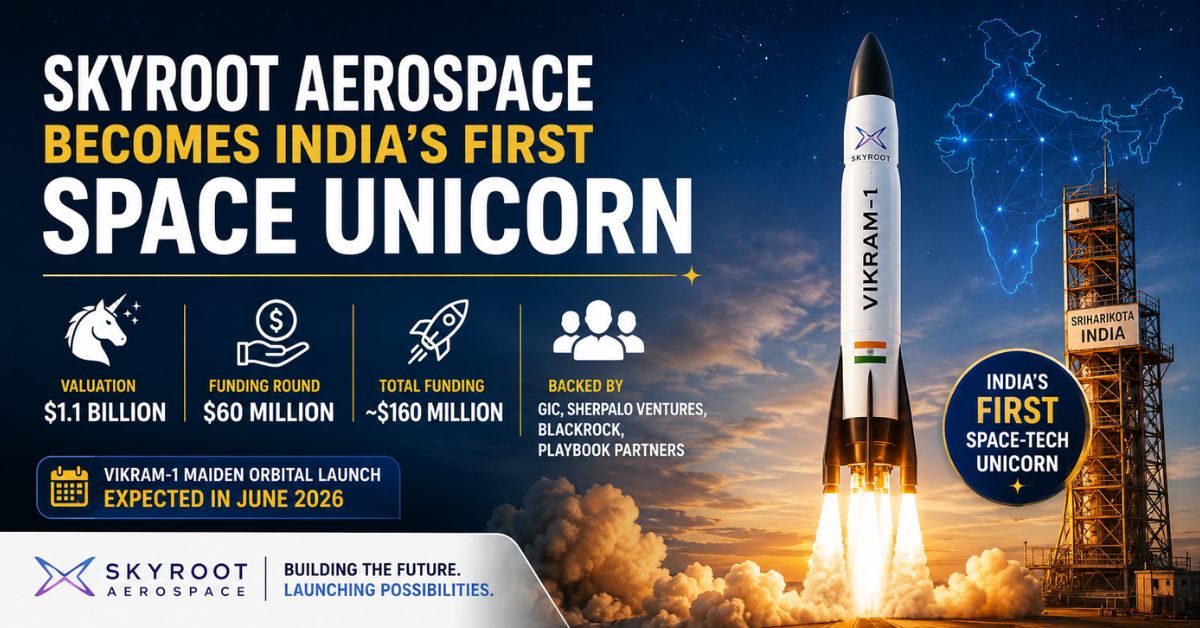
- Skyroot Aerospace officially became India’s first space-tech unicorn on May 7, 2026, after raising $60 million in a fresh funding round.
- The Hyderabad-based company reached a valuation of $1.1 billion with backing from global investors including GIC, Sherpalo Ventures, BlackRock, and Playbook Partners.
- Founded in 2018 by former ISRO scientists Pawan Kumar Chandana and Naga Bharath Daka, Skyroot is focused on small satellite launch vehicles.
- The company is preparing for the maiden orbital launch of its Vikram-1 rocket from Sriharikota, with the launch window expected to open in June 2026.
- Skyroot Aerospace previously made history in 2022 when its Vikram-S mission became the first privately developed Indian rocket to reach space.
India’s private space industry entered a new phase on May 7, 2026, after Hyderabad-based Skyroot Aerospace officially became the country’s first space-tech unicorn. The company crossed the $1 billion valuation mark after raising $60 million in a fresh funding round backed by global investors including GIC, Sherpalo Ventures, BlackRock, and Playbook Partners.
The milestone places Skyroot Aerospace at the center of India’s fast-growing private space race, just weeks before the expected maiden orbital launch of its Vikram-1 rocket from Sriharikota. For many observers, this is not only a startup funding story. It is a sign that India’s space sector is moving beyond government-led missions into a commercially competitive era driven by private companies.
Skyroot Aerospace now carries a valuation of around $1.1 billion, more than double its earlier valuation from 2023. The company has raised roughly $160 million in total funding since its founding in 2018.
How Skyroot Aerospace Started
Skyroot Aerospace was founded in 2018 by former ISRO scientists Pawan Kumar Chandana and Naga Bharath Daka. Both founders previously worked at ISRO before deciding to build a private launch company focused on small satellite missions.
At the time, India’s private participation in the space sector was still extremely limited. ISRO handled nearly all launch activity, while private firms mostly worked as suppliers and manufacturing vendors.
That changed after the Indian government opened parts of the space sector to private players in 2020 through reforms and the creation of IN-SPACe, the regulatory body for private space activities. Skyroot became one of the earliest startups to benefit from that opening and was also among the first private firms to gain access to ISRO facilities for testing and launch support.
From the beginning, the company focused on small satellite launch vehicles, a market that has expanded rapidly worldwide because of rising demand for communication satellites, Earth observation systems, and defense-related payloads.
Why Skyroot Aerospace Is Important for India
For decades, India’s space achievements were identified almost entirely with ISRO missions such as Chandrayaan, Mangalyaan, and PSLV launches. Private companies rarely occupied the spotlight.
Skyroot Aerospace changed that perception in 2022 when it launched Vikram-S, the first privately developed Indian rocket to reach space. The suborbital mission demonstrated that a non-government Indian company could independently design, build, and launch a rocket.
That launch became a symbolic moment for India’s “NewSpace” movement, a term used globally for private-sector-led space innovation.
Since then, Skyroot has steadily expanded its infrastructure, testing capabilities, and launch ambitions. The company now employs more than 1,000 people and operates from Hyderabad, which is increasingly emerging as a major aerospace and deep-tech hub in India.
Its recently developed “Infinity Campus” is a 200,000-square-foot integrated manufacturing and design facility aimed at increasing rocket production speed and launch frequency.
The Vikram Rocket Series Explained
Skyroot Aerospace has named its rockets after Dr. Vikram Sarabhai, the founder of India’s space program.
The company’s launch vehicle roadmap currently includes three major variants: Vikram-S, Vikram-1, and future heavy-lift versions such as Vikram-2 and Vikram-3.
Vikram-S
Vikram-S was the company’s first breakthrough mission in 2022. The rocket completed a successful suborbital flight and demonstrated key technologies needed for future orbital launches.
The mission proved Skyroot’s propulsion systems, avionics, and lightweight structures under real launch conditions.
Vikram-1
Vikram-1 is currently the company’s most important project. It is designed as a small satellite orbital launch vehicle capable of carrying payloads of up to 350 kilograms to Low Earth Orbit (LEO).
The rocket uses carbon composite structures and 3D-printed engines, two technologies that significantly reduce manufacturing time and launch costs.
Skyroot says Vikram-1 is designed for dedicated launches, allowing satellite operators to avoid delays associated with ride-share missions on larger rockets.
This matters because many small satellite operators want precise orbital placement rather than waiting for available slots on bigger missions.
Vikram-2 and Vikram-3
The company has already begun development planning for Vikram-2, which is expected to become a one-tonne-class launch vehicle with advanced cryogenic technology.
If successful, Vikram-2 would move Skyroot into direct competition with global small-launch companies such as Rocket Lab.
Future versions may allow Skyroot to support larger commercial and defense payloads while also increasing launch frequency.
Vikram-1 Launch Expected in June 2026
One of the biggest reasons investors are closely watching Skyroot Aerospace is the upcoming Vikram-1 mission.
The company recently flagged off the flight hardware to Sriharikota in Andhra Pradesh, where the launch is expected to take place under the supervision of IN-SPACe and ISRO.
The launch window is currently expected to open in June 2026.
If successful, Vikram-1 will become India’s first privately developed orbital rocket launch from Indian soil. That achievement would place Skyroot among a very small group of private companies globally capable of independently conducting orbital launches.
Industry experts see the mission as a defining moment not only for Skyroot but also for India’s broader commercial space ambitions.
How 3D Printing Gives Skyroot an Edge
One major reason Skyroot Aerospace has attracted global attention is its aggressive use of 3D printing in rocket manufacturing.
The company’s Dhawan engine series is built using additive manufacturing techniques that allow complex engine components to be produced faster and with fewer individual parts.
Traditional rocket manufacturing often involves assembling thousands of components over long production cycles. Skyroot claims its approach sharply reduces production timelines and costs.
This strategy mirrors trends seen globally among modern aerospace startups trying to compete with legacy manufacturers.
Reducing launch costs is especially important in the small satellite market, where price sensitivity is high and launch competition is increasing.
Global Investors Back India’s Private Space Sector
The latest funding round has drawn attention because of the investors involved.
Singapore sovereign wealth fund GIC participated in the round alongside Sherpalo Ventures, the investment firm led by Ram Shriram. BlackRock, one of the world’s largest asset managers, also joined the funding round.
Ram Shriram is also joining Skyroot’s board, a development many analysts see as strategically important because of his Silicon Valley connections and history as an early Google investor.
The participation of global investors signals growing confidence in India’s commercial space industry, which until recently remained relatively underfunded compared to American and Chinese private space ecosystems.
According to industry observers, India’s lower engineering costs and strong talent base could make the country highly competitive in small satellite launch services over the next decade.
India’s NewSpace Ecosystem Is Expanding
Skyroot’s rise is happening alongside broader growth in India’s private space sector.
Several startups are now building satellites, propulsion systems, launch vehicles, and defense technologies. One recent example is GalaxEye, which recently launched its hybrid OptoSAR satellite mission called Mission Drishti. The satellite combines optical and radar imaging capabilities for Earth observation applications.
Companies such as Agnikul Cosmos, Dhruva Space, and Pixxel are also expanding rapidly in different segments of the space economy.
This broader ecosystem matters because space businesses rarely grow in isolation. Launch providers, satellite manufacturers, imaging firms, and data companies often depend on each other.
Skyroot Aerospace is currently positioned as one of the leading infrastructure players within that ecosystem.
Why Skyroot Aerospace Could Become a Major Global Player
The commercial space market is shifting toward smaller satellites, faster deployment cycles, and dedicated launch services.
Governments, telecom firms, defense agencies, and Earth observation companies increasingly require rapid and flexible access to orbit.
That demand creates opportunities for companies capable of offering lower-cost and more frequent launches.
Skyroot’s business model is designed around exactly that market.
Its leadership has repeatedly emphasized that global demand, not only Indian demand, will drive future growth.
The company also benefits from India’s relatively lower manufacturing costs compared to Western launch providers.
If Vikram-1 succeeds and launch reliability improves over multiple missions, Skyroot could eventually secure international commercial contracts from satellite operators worldwide.
What Comes Next for Skyroot Aerospace
The next few months will likely define the company’s future trajectory.
A successful Vikram-1 orbital mission could dramatically strengthen investor confidence and accelerate commercial partnerships. It may also push India’s government to further expand support for private launch infrastructure and regulatory reforms.
At the same time, the company faces strong international competition from established private launch providers and emerging startups in Europe, China, and the United States.
Rocket launches remain high-risk operations where even a single failure can affect timelines, funding, and customer trust.
Still, Skyroot Aerospace has already achieved something no Indian private space company managed before. It has moved India’s space startup sector from experimentation into the global investment conversation.
With unicorn status now secured and its first orbital mission approaching, Skyroot Aerospace is no longer just an Indian startup story. It has become one of the most closely watched private space companies emerging from Asia.