


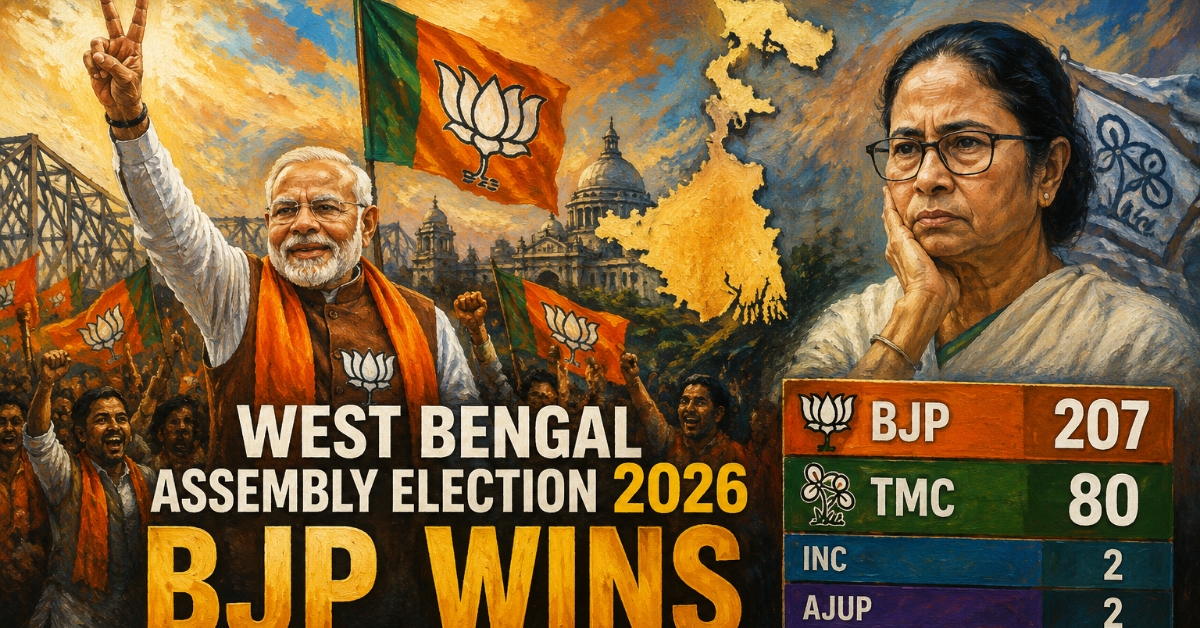
West Bengal Election 2026: BJP Sweeps State, TMC Rule Ends After 15 Years
- BJP secured 207 seats in the 2026 West Bengal Assembly Election
- TMC was reduced to 80 seats after ruling the state since 2011
- Record voter turnout of 92.93% made this one of Bengal’s biggest elections
- Minority vote split and anti-incumbency heavily impacted the TMC
- The result marks a major political shift in eastern India
The 2026 West Bengal Assembly Election has become one of the most important political events in recent Indian history. After ruling the state continuously since 2011, the All India Trinamool Congress (AITC or TMC) led by Mamata Banerjee lost power as the Bharatiya Janata Party (BJP) secured a massive victory across the state.
The result has changed the political direction of West Bengal and has also strengthened the BJP’s presence in eastern India. For the first time in modern electoral history, a right-of-centre political party has won a clear mandate in Bengal. The scale of the BJP’s victory surprised both political observers and opposition parties.
According to the Election Commission of India, the BJP won 207 seats out of 293 declared results, while the TMC was reduced to 80 seats. One constituency, Falta, is scheduled for repolling later in May following allegations of electoral irregularities.
West Bengal Election 2026 Result Overview
The election was conducted in two phases on April 23 and April 29, 2026. Counting of votes took place on May 4. The voter turnout reached an extraordinary 92.93%, the highest ever recorded in the state’s Assembly election history.
| Party | Won | Leading | Total |
|---|---|---|---|
| Bharatiya Janata Party (BJP) | 207 | 0 | 207 |
| All India Trinamool Congress (AITC) | 80 | 0 | 80 |
| Indian National Congress (INC) | 2 | 0 | 2 |
| Aam Janata Unnayan Party (AJUP) | 2 | 0 | 2 |
| Communist Party of India (Marxist) | 1 | 0 | 1 |
| All India Secular Front (AISF) | 1 | 0 | 1 |
| Total | 293 | 0 | 293 |
The BJP crossed the majority mark comfortably and delivered one of the biggest electoral victories in Bengal’s history. The result is even more dramatic when compared to the 2021 Assembly Election, where the BJP had won 77 seats while the TMC secured 215.
How BJP Changed the Political Map of Bengal
The BJP’s rise in West Bengal did not happen overnight. The party had slowly expanded its presence in the state over the past decade through Lok Sabha elections, local body campaigns, and organizational growth at the booth level.
In 2026, that groundwork converted into a full-scale electoral wave.
Large parts of North Bengal, Junglemahal, urban Kolkata regions, border districts, and several minority-influenced constituencies witnessed significant swings away from the TMC. The BJP performed strongly among first-time voters, sections of women voters, urban middle-class families, and unemployed youth.
Political analysts believe the BJP’s campaign focused less on ideological confrontation and more on governance issues. Employment opportunities, industrial development, corruption allegations, law and order concerns, and recruitment scams became major discussion points during the campaign.
The BJP repeatedly promised “double-engine growth,” arguing that having the same party in power at both the Centre and the state would help Bengal receive faster investment and infrastructure support.
The strategy appears to have worked effectively across districts where economic frustration had been building over several years.
Minority Vote Split Hurt the TMC
One of the most decisive developments in the election was the fragmentation of minority votes.
For years, the TMC benefited from a consolidated Muslim vote in many districts, especially in Murshidabad, Malda, Uttar Dinajpur, and parts of South Bengal. In 2026, that pattern changed sharply.
The Congress, smaller regional outfits, Left-linked groups, and the newly emerging Aam Janata Unnayan Party (AJUP) led by Humayun Kabir cut into the TMC’s traditional support base. This division reduced the TMC’s winning margins in several constituencies and directly helped BJP candidates in close contests.
The BJP managed to win or strongly compete in areas that had historically been difficult for the party. This marked a major shift in Bengal’s electoral mathematics.
Reports after the election suggested that dissatisfaction over local leadership, candidate selection, and allegations of favoritism weakened the TMC’s grip in several districts.
Mamata Banerjee Faces Her Toughest Political Setback
For Mamata Banerjee, the result represents the most serious political setback of her career.
She had come to power in 2011 by ending the Left Front’s 34-year rule and remained one of India’s strongest regional leaders for over a decade. Under her leadership, the TMC dominated Bengal politics and repeatedly defeated both the Left and the BJP.
But the 2026 election produced a different mood among voters.
The anti-incumbency sentiment appeared stronger than previous elections. Allegations related to teacher recruitment scams, municipal corruption, political violence, and unemployment continued to damage the image of the government during the campaign period.
After the results, Mamata Banerjee alleged irregularities in the electoral process and questioned parts of the counting procedure. However, the BJP rejected those accusations and called the verdict a clear public mandate.
Controversy Around the Voter Roll Revision
Another major issue during the election was the controversy surrounding the Special Intensive Revision (SIR) of voter rolls.
The process reportedly removed millions of names from electoral lists, triggering political outrage and legal scrutiny. Opposition parties accused authorities of targeting minority-heavy regions and migrant voters.
The matter reached the Supreme Court, and judicial monitoring was introduced during parts of the process. The issue remained one of the most heated topics throughout the campaign season.
Critics argued that the revision created confusion among voters and influenced electoral dynamics in sensitive constituencies. Supporters of the process claimed it was necessary to clean outdated and duplicate entries from voter lists.
The controversy added another layer of tension to an already high-stakes election.
BJP’s Organizational Expansion Played a Major Role
The BJP’s performance also reflected a significant improvement in organizational strength.
Unlike earlier elections where the party depended heavily on national leaders, the 2026 campaign combined central leadership with aggressive local-level mobilization. BJP workers maintained strong booth management systems in both urban and rural areas.
Leaders like Suvendu Adhikari played a central role in consolidating anti-TMC votes. Several former TMC leaders who joined the BJP over the past few years helped the party establish local networks in districts where it previously lacked strong presence.
The BJP also benefited from the weakening of the Left Front. Many anti-TMC voters who earlier supported Left parties appear to have shifted directly toward the BJP.
This transfer of opposition votes became especially visible in districts where the Left once held strong influence.
Economic Expectations After BJP Victory
The business community and market observers reacted positively after the election result.
Many industrial groups believe that political alignment between the Centre and the state government may improve infrastructure investment, manufacturing projects, logistics development, and industrial clearances in West Bengal.
For years, Bengal struggled to attract large-scale industrial investment compared to states like Gujarat, Maharashtra, Karnataka, and Tamil Nadu. BJP leaders argued during the campaign that Bengal had fallen behind economically despite its strategic location and skilled workforce.
The new government is now expected to focus heavily on infrastructure, job creation, port modernization, industrial corridors, and urban expansion projects.
However, economists have also warned that expectations are extremely high and the BJP government will face pressure to deliver visible employment growth quickly.
What the Result Means for National Politics
The Bengal victory is politically important beyond the state itself.
West Bengal had long remained one of the few major states where the BJP struggled to form a government despite strong performances in parliamentary elections. Winning the Assembly election now gives the BJP greater influence in eastern India and strengthens its national political position ahead of future elections.
For opposition parties, the result raises serious concerns about strategy, alliances, and leadership.
The Congress remained weak in the state, while the Left Front failed to recover despite attempting a comeback. Regional parties across India are likely to closely study the Bengal outcome because it demonstrates how quickly voter sentiment can shift after long periods of single-party dominance.
The election has also changed discussions around coalition politics and opposition unity at the national level.
Bengal Enters a New Political Era
The 2026 West Bengal Assembly Election will likely be remembered as one of the most transformative elections in the state’s modern history.
The BJP’s rise from a marginal force to the dominant political party in Bengal marks a complete restructuring of the state’s electoral landscape. At the same time, the defeat of the TMC ends a political era built around Mamata Banerjee’s leadership.
The coming months will determine whether the BJP can convert electoral success into long-term governance credibility. Bengal voters have delivered a powerful mandate, but they will also expect visible improvements in employment, infrastructure, administration, and public safety.
For now, the 2026 result stands as a watershed moment that has permanently altered the balance of power in West Bengal politics.