


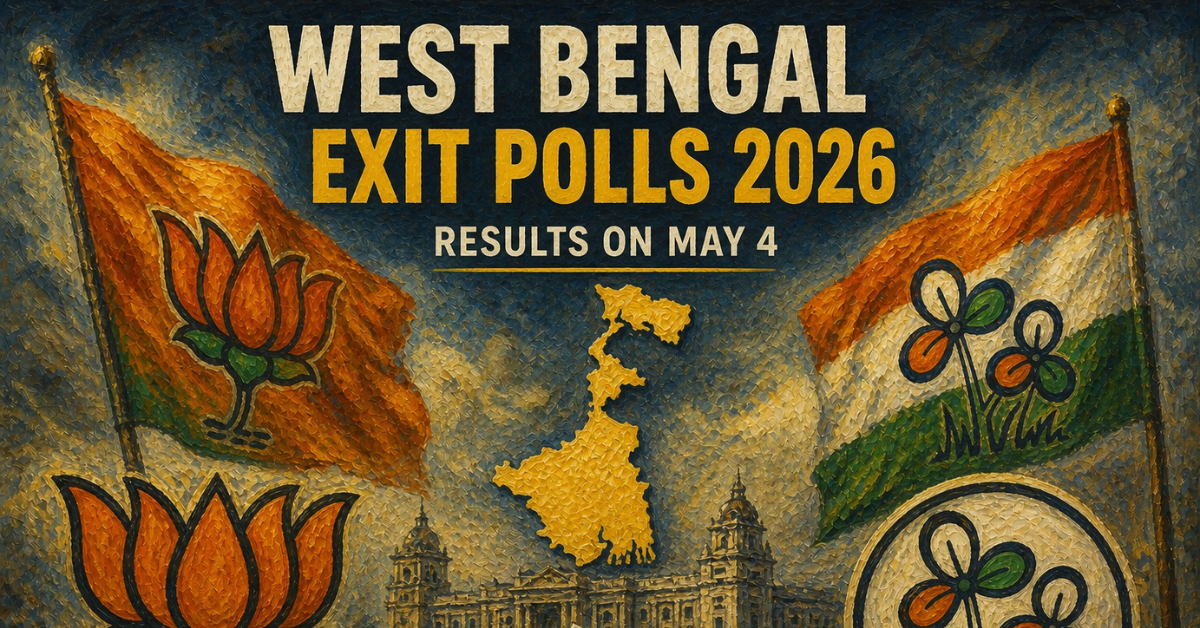
Conflicting exit polls leave Bengal in suspense ahead of counting day
- Exit polls for the 2026 West Bengal Assembly elections show sharply divided projections
- Most agencies indicate gains for BJP, though estimates vary widely
- One major poll projects a clear TMC victory, contradicting broader trends
- Analysts question reliability citing recent polling misses and structural issues
- Final results will be declared on May 4
Exit polls for the 2026 West Bengal Assembly elections have produced sharply conflicting projections, leaving the political outcome uncertain ahead of the official counting on May 4. With voting across all 294 constituencies completed on April 29, the state has entered a period of heightened speculation, driven by wide variations in poll estimates.
Most agencies suggest a competitive contest between the ruling Trinamool Congress and the Bharatiya Janata Party, though their projections differ significantly in scale. Some surveys indicate that the BJP could cross the majority mark of 148 seats, while others show the TMC retaining a strong position.
Among the projections, Today’s Chanakya has forecast the BJP securing around 192 seats, with the TMC at approximately 100. Praja Poll has placed the BJP in a range of 178 to 208 seats, while Matrize and Chanakya Strategies have projected narrower margins, indicating a closer contest. In contrast, People’s Pulse has projected a decisive lead for the TMC, placing it well above the majority threshold while limiting the BJP to under 110 seats.
An aggregated “poll of polls” estimate suggests an evenly balanced contest, with both the BJP and TMC projected at around 145 seats each, highlighting the absence of a clear consensus among polling agencies.
| Agency | BJP | TMC | Others |
|---|---|---|---|
| Today’s Chanakya | 192 ± 11 | 100 ± 11 | 2 ± 2 |
| Praja Poll | 178–208 | 80–110 | 2–6 |
| Matrize | 146–161 | 125–140 | 1–5 |
| Chanakya Strategies | 150–160 | 130–140 | 2–5 |
| People’s Pulse | 95–110 | 177–187 | 2–3 |
| Poll of Polls | 145 | 145 | 4 |
The divergence in projections has renewed scrutiny of exit poll methodologies and their reliability. Analysts note that recent elections have exposed limitations in forecasting models. In the Haryana Assembly elections of 2024, most exit polls predicted a clear victory for the Congress, but the Bharatiya Janata Party secured a majority. Similarly, projections during the 2024 Lok Sabha elections overestimated the scale of support for the ruling alliance at the national level.
In West Bengal, polling accuracy is further complicated by what analysts describe as the “silent voter” phenomenon. In regions with a history of political contestation, respondents may be reluctant to disclose their true voting preference, instead providing socially acceptable responses. This tendency can distort sampling outcomes, particularly in rural constituencies.
Structural challenges also persist. Exit polls typically rely on samples ranging from 20,000 to 50,000 respondents to represent an electorate exceeding seven crore voters. Even minor deviations in demographic representation can significantly alter projected outcomes. Additionally, converting vote share into seat share remains a persistent difficulty. In closely contested states, small shifts in vote percentage can produce disproportionately large changes in seat allocation.
The wide spread in projections—from estimates placing the BJP near 200 seats to others limiting it below 110—underscores the uncertainty surrounding the election outcome. The variation suggests that no single narrative has emerged as dominant, despite a broader indication of a competitive contest.
With electronic voting machines secured and counting set for May 4, the final outcome will determine whether the state sees a shift in political leadership or a continuation of the incumbent government. Until then, exit polls remain indicative rather than definitive, reflecting trends that may or may not align with the actual results.