


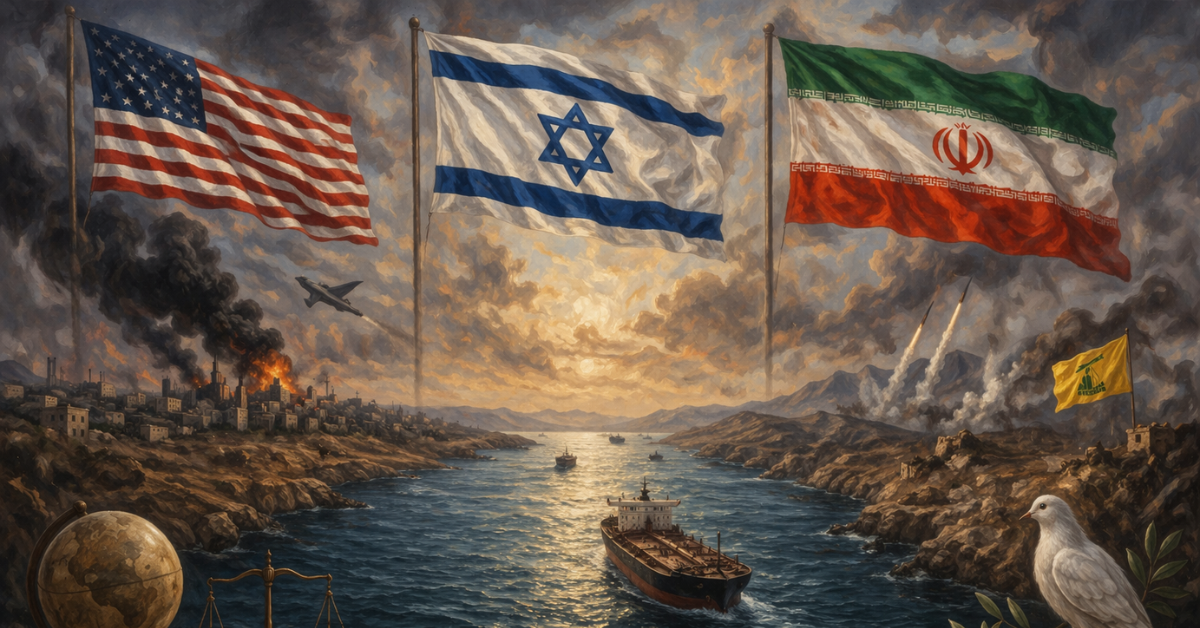
Ceasefire Overview: US–Israel–Iran Tensions
- A two-week ceasefire has been agreed between the United States, Israel, and Iran to pause escalation.
- Pakistan has emerged as a key mediator, with negotiations currently underway in Islamabad.
- The reopening of the Strait of Hormuz remains the central condition of the agreement.
- Disputes over Iran’s regional influence, especially via Hezbollah, continue to threaten stability.
- The ceasefire is widely viewed as a temporary pause rather than a long-term resolution.
The ceasefire arrangement involving the United States, Israel, and Iran in April 2026 represents a pause in escalation rather than a resolution. The framework, shaped by urgent diplomatic intervention and competing strategic goals, reflects a narrow window to prevent a broader regional war. Developments remain fluid, and the structure of the agreement reveals as many points of tension as it does areas of cooperation.
The Immediate Trigger and Diplomatic Window
The ceasefire emerged under time pressure. US President Donald Trump announced a two-week halt to hostilities shortly before a planned escalation involving direct US military action. The timing suggests that the agreement was less a negotiated settlement and more a calculated pause to reassess risks.
A key intermediary role was played by Pakistan, which facilitated communication between Washington and Tehran at a moment when direct channels were limited. Subsequent negotiations have shifted to Islamabad, where delegations are engaged in closed-door discussions. Reports indicate that JD Vance is leading the American side, signaling the high political stakes attached to the talks.
Strategic Core: Control of the Strait of Hormuz
At the center of the ceasefire lies the Strait of Hormuz, one of the most critical chokepoints in global energy supply. The United States has made the full reopening of the passage a non-negotiable condition. This reflects both economic priorities and a broader objective to maintain freedom of navigation.
Iran’s position is more calibrated. Its publicly circulated proposal accepts the reopening of the strait but insists that operations remain coordinated under Iranian military oversight. This formulation attempts to balance de-escalation with continued leverage over a vital global artery.
The divergence here is structural. For Washington, unrestricted access is essential. For Tehran, conditional access preserves influence. The disagreement is not procedural but strategic, and it remains unresolved in public terms.
The Question of Terms and Secrecy
Iranian state media outlined a ten-point proposal as a basis for peace. However, the White House has rejected this framework in its public form, emphasizing that any viable agreement must emerge from confidential negotiations.
This gap between public messaging and private negotiation introduces uncertainty. It suggests that neither side is willing to commit politically to terms that could be perceived as concessions. As a result, the ceasefire operates without a clearly defined, mutually acknowledged structure.
Lebanon: The Most Volatile Fault Line
The most immediate threat to the ceasefire lies outside its formal scope. Iran considers its regional allies, particularly Hezbollah, as part of the broader deterrence framework covered by the pause. Israel rejects this interpretation and continues military operations in Lebanon.
This creates a dual-track conflict. While direct confrontation between states is paused, proxy engagements persist. Israeli strikes aimed at degrading Hezbollah’s capabilities are viewed by Iran and its allies as violations in spirit, if not in formal terms.
The result is a structural loophole. The ceasefire does not encompass all active fronts, allowing conflict to continue in a way that could rapidly escalate back into direct engagement.
Escalation Risks After Khamenei’s Death
Tensions have been further heightened by the reported killing of Iranian Supreme Leader Ayatollah Ali Khamenei during the early phase of the conflict. This event has altered the political and emotional landscape within Iran and across allied groups.
Hezbollah has explicitly framed renewed rocket attacks on Israeli territory as retaliation. These actions blur the line between independent response and coordinated escalation, increasing the risk that localized violence could undermine the broader ceasefire.
The symbolic weight of Khamenei’s death complicates diplomacy. It limits Tehran’s room for compromise and raises expectations among allied groups for continued resistance.
Incompatible Strategic Objectives
The fragility of the ceasefire ultimately stems from incompatible end goals.
The United States seeks controlled de-escalation, aiming to stabilize the region without committing to a prolonged conflict. Iran is focused on preserving its regional influence and maintaining a network of allied forces that act as deterrence. Israel prioritizes long-term security, particularly the neutralization of threats along its borders.
These objectives are not easily reconciled. Measures that satisfy one actor often undermine another. For example, limiting Hezbollah strengthens Israeli security but weakens Iran’s regional posture. Ensuring Iranian oversight in the Strait of Hormuz preserves Tehran’s leverage but conflicts with US strategic doctrine.
A Pause Without Resolution
The current ceasefire functions as a tactical pause rather than a pathway to peace. Its durability depends on progress in negotiations that remain opaque and politically sensitive.
The continuation of proxy conflict, unresolved disagreements over critical infrastructure, and the absence of a shared framework all point to a temporary equilibrium. Without substantive alignment on core issues, the agreement is likely to remain fragile, with the potential for rapid breakdown under renewed pressure.