

Tamil Nadu Election 2026: Key Developments
- Tamil Nadu will vote in a single phase on April 23, 2026, with results on May 4.
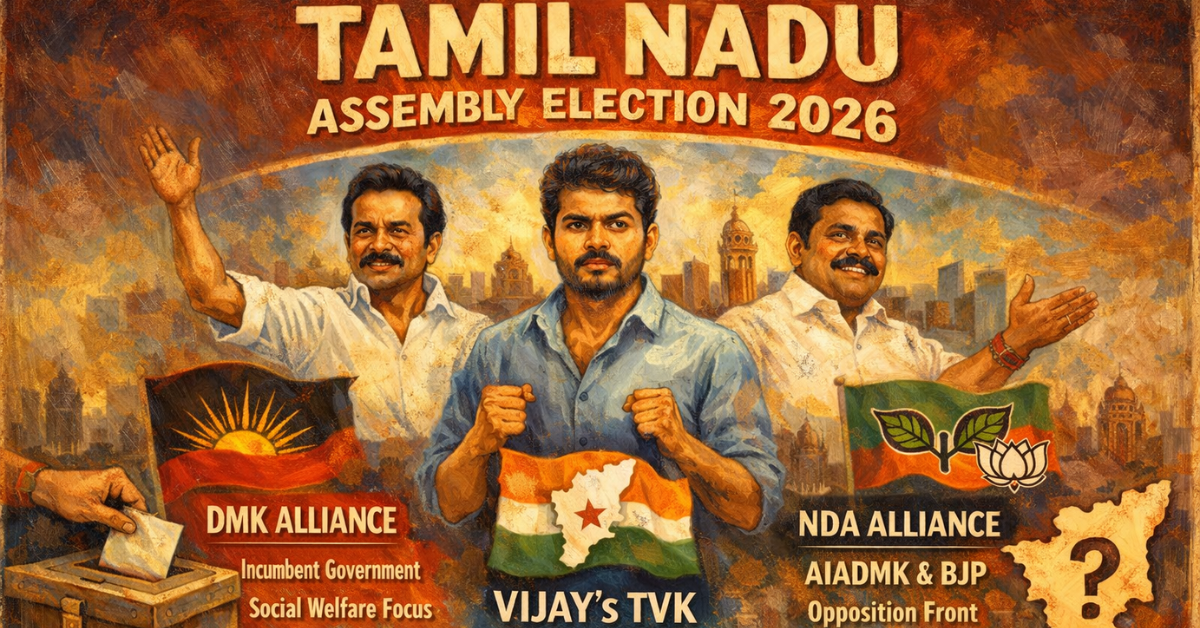
- The contest is primarily between the DMK-led alliance and the AIADMK-led NDA.
- Actor Vijay’s Tamilaga Vettri Kazhagam (TVK) has emerged as a third force.
- Seat-sharing in the NDA is largely finalised, while DMK alliance numbers remain flexible.
- High-profile candidates include M.K. Stalin, Udhayanidhi Stalin, and Vijay contesting key urban seats.
The 2026 Tamil Nadu Legislative Assembly election is approaching a decisive moment, with political alignments largely in place and campaigning intensifying across the state. The election will determine the composition of the 234-member assembly and is being closely watched for signs of both continuity and disruption in Tamil Nadu’s long-established political structure.
Election Schedule and Process
The Election Commission of India has scheduled the election as a single-phase poll. Voting will take place on April 23, 2026, with counting of votes set for May 4, 2026. The nomination process began on March 30 and will conclude in early April, followed by scrutiny and a short withdrawal window. This compressed timeline requires parties to finalise candidates quickly while maintaining statewide campaign coverage.
DMK-Led Alliance: Continuity and Governance Focus
The ruling Dravida Munnetra Kazhagam (DMK), led by Chief Minister M. K. Stalin, is seeking a second consecutive term in office. The party’s campaign is centred on its governance record, often described as the “Dravidian Model,” which combines welfare schemes, public service delivery, and a strong emphasis on social justice.
The DMK is contesting the majority of seats within its Secular Progressive Alliance. Its principal ally, the Indian National Congress, has been allocated around 28 seats as per current announcements, though final adjustments may occur at the constituency level. Other alliance partners include the Communist Party of India (CPI), the Communist Party of India (Marxist), and the Viduthalai Chiruthaigal Katchi (VCK).
This alliance is relying on incumbency advantage, administrative continuity, and a relatively stable coalition structure. Its electoral strategy is focused on consolidating urban welfare beneficiaries, rural support bases, and traditional Dravidian vote banks.
AIADMK-Led NDA: Consolidation and Comeback Attempt
The principal opposition bloc is led by the All India Anna Dravida Munnetra Kazhagam (AIADMK) under Edappadi K. Palaniswami. The party has entered into a structured alliance with the Bharatiya Janata Party (BJP) and several regional partners, forming the National Democratic Alliance (NDA) in Tamil Nadu.
As per the current seat-sharing agreement, the AIADMK is contesting approximately 166 to 169 constituencies. The BJP has been allotted 27 seats, marking a strategic expansion compared to previous elections. Other partners include the Pattali Makkal Katchi (PMK), the Amma Makkal Munnetra Kazhagam (AMMK) led by T. T. V. Dhinakaran, and the Tamil Maanila Congress (Moopanar).
The NDA’s campaign is structured around anti-incumbency messaging, governance criticism, and attempts to unify fragmented opposition votes. The alliance’s effectiveness will depend on its ability to maintain cohesion across regions with differing political dynamics.
TVK and Vijay: A New Political Variable
A major development in this election is the entry of Tamilaga Vettri Kazhagam (TVK), founded by actor Vijay. This marks one of the most significant political debuts in recent Tamil Nadu history.
The party has fielded candidates across the state and is positioning itself as an alternative to both the DMK and AIADMK. Its campaign messaging is directed largely at first-time voters, urban youth, and sections of the electorate seeking a shift away from traditional party structures.
While its organisational depth is still being tested, TVK is expected to influence vote shares in multiple constituencies, particularly in urban and semi-urban regions where margins are often narrow.
Key Constituencies and Candidates
Several constituencies have drawn attention due to the presence of senior leaders and high-profile candidates. Chief Minister M. K. Stalin is contesting from Kolathur in Chennai, a seat he has held for multiple terms. Deputy Chief Minister Udhayanidhi Stalin is defending Chepauk-Thiruvallikeni.
Vijay is contesting from two constituencies—Perambur in Chennai and Tiruchi East—indicating a strategy to establish political relevance across different regions of the state.
Within the NDA, Union Minister L. Murugan is contesting from Avanashi. Tamilisai Soundararajan is in the fray from Mylapore, while Vanathi Srinivasan is contesting from Coimbatore North. BJP state president K. Annamalai is not contesting and is instead overseeing the party’s campaign across Tamil Nadu.
From the Congress, state president K. Selvaperunthagai is contesting from the reserved Sriperumbudur constituency, representing the party’s effort to retain relevance within the alliance framework.
What Will Decide the Outcome
The election outcome will depend on a combination of factors, including the DMK’s ability to retain voter trust, the NDA’s capacity to consolidate opposition votes, and the extent to which TVK can convert visibility into measurable electoral gains.
Urban voting patterns, youth participation, and constituency-level margins are likely to play a decisive role. Even small shifts in vote share could influence outcomes in tightly contested seats.
As Tamil Nadu moves toward polling day, the election presents a layered contest between continuity, opposition consolidation, and the uncertain impact of a new political entrant. The results on May 4, 2026, will provide a clear indication of whether the state’s political structure is evolving or holding its traditional shape.