

Condensed Polls, Intensified Contest
- Election Commission announced a two-phase election, marking a drastic consolidation from the eight-phase marathon of 2021.
- Electorate finalized at 7.04 crore after deletion of over 62 lakh names during Special Intensive Revision.
- Campaigning has entered peak phase with a direct TMC vs BJP contest.
- Polling scheduled for April 23 and April 29, counting on May 4.
- High-profile battles such as Bhabanipur shaping the electoral narrative.
The 2026 West Bengal Legislative Assembly election marks a significant structural shift in the state’s poll management. Unlike the arduous eight-phase election in 2021, this cycle has been condensed into just two phases. This shift reflects an evolved security deployment strategy and a logistical recalibration by the Election Commission of India.
As of April 5, 2026, the electoral process is immersed in the most intensive phase of campaigning. What follows is a consolidated, fact-aligned timeline with political context, campaign developments, and voter data for all 294 constituencies.
Phase 1: Pre-Election Framework and Notification
The formal process initiated when Chief Election Commissioner Gyanesh Kumar announced the two-phase schedule, bringing the Model Code of Conduct into immediate effect across the state.
Political maneuvering that had been underway since late 2025 took final shape. The ruling TMC, led by Chief Minister Mamata Banerjee, moved to counter anti-incumbency by replacing 74 sitting Members of the Legislative Assembly with fresh faces.
On the opposition side, the BJP positioned itself as the primary challenger. The Left Front and the Indian National Congress, having been pushed to the electoral margins in recent years, largely opted to contest without broad state-wide alliances, focusing instead on select strongholds where they aim to influence vote margins.
Phase 2: Electorate Scrutiny and Candidate Finalization
A defining element of the pre-polling phase was the Special Intensive Revision (SIR) of the electoral rolls. Published in late February 2026, the final roll revealed significant demographic shifts:
| Electorate Metric | 2021 Election | 2026 Election | Change |
|---|---|---|---|
| Total Registered Voters | 7.66 crore | 7.04 crore | -62 lakh (Deleted) |
| Pending Adjudication | N/A | ~60 lakh | N/A |
The deletion of over 62 lakh names has been highly contentious. The TMC has alleged that voters—particularly minority demographics and TMC supporters—were unfairly targeted, pointing to data from the State’s Chief Electoral Officer indicating that Muslim-dominated districts like Murshidabad and Malda have the highest number of cases awaiting adjudication. Chief Minister Mamata Banerjee organized a dharna (sit-in protest) against the Election Commission over this issue on March 6, 2026. Conversely, the BJP insists it was a necessary purge of illegal infiltrators and duplicate entries.
Phase 3: Campaign Period and Political Mobilisation
The active campaign window represents a clash of two very different visions for West Bengal.
TMC’s Campaign: Anchored in regional identity and welfare continuity. The TMC has actively rallied against the SIR voter deletions, highlighting cases like women’s cricket star Richa Ghosh being placed “under adjudication”. They continue to emphasize the state’s ongoing direct-benefit programs, framing the opposition as hostile to Bengal’s culture.
BJP’s Campaign: Focused on anti-incumbency, governance reforms, and law and order. State leaders like Suvendu Adhikari have heavily spotlighted the 2024 Kolkata medical trainee case to argue that the current administration has failed in ensuring women’s safety and institutional integrity.
National Leaders: Prime Minister Narendra Modi and Union Home Minister Amit Shah have led massive rallies, emphasizing national integration, border security, and challenging the TMC on corruption allegations.
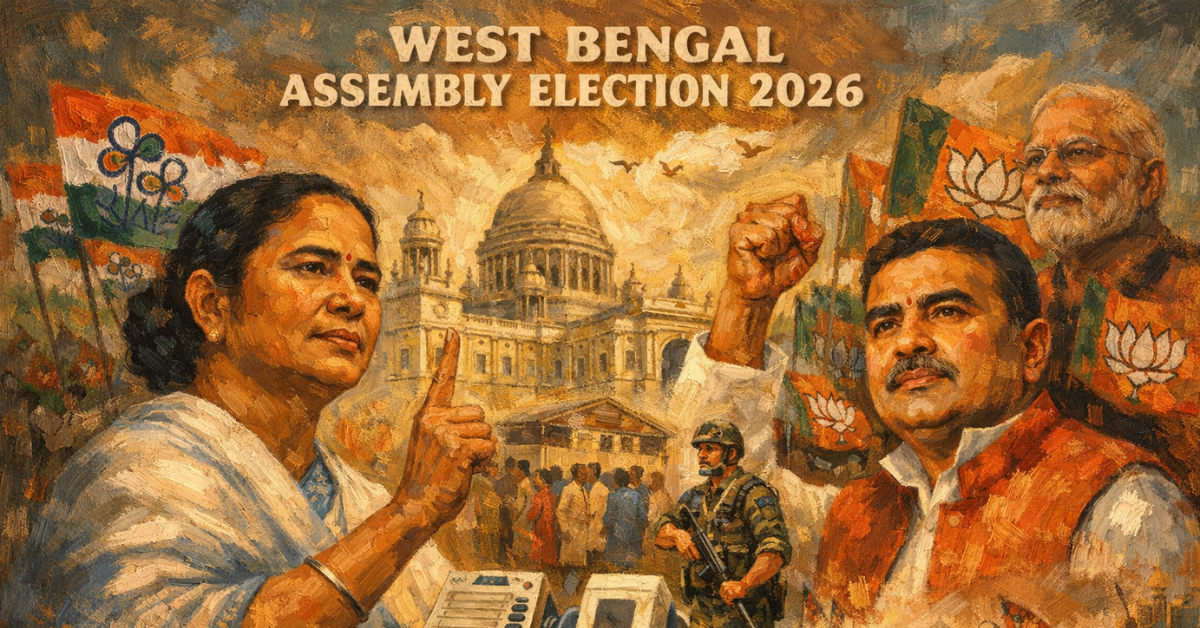
High-profile seat battles are dictating media coverage. In Bhabanipur, Mamata Banerjee faces off against Suvendu Adhikari—a direct rematch of their bitter 2021 contest in Nandigram, where Banerjee narrowly lost by 1,956 votes despite her party’s overall victory.
Phase 4: Polling, Security, and Counting
Polling is split across two major geographical phases to manage the state’s 294 seats:
Phase 1 (April 23): Covering 152 constituencies across districts like Purulia, Bankura, Jhargram, Birbhum, East and West Midnapore, Jalpaiguri, Maldaha, Murshidabad, North and South Dinajpur, West Bardhaman, Darjeeling, Cooch Behar, Alipurduar, and Kalimpong.
Phase 2 (April 29): Covering 142 constituencies in East Bardhaman, Nadia, North and South 24 Parganas, Howrah, Hooghly, and Kolkata.
Following polling, Electronic Voting Machines (EVMs) and VVPAT units will be stored under heavy Central Armed Police Forces (CAPF) surveillance. Counting for all seats will take place concurrently on May 4, 2026.
Political Narrative and Strategic Positioning
The election is fundamentally structured as a two-party contest between continuity and change:
TMC (Continuity): Relies on the proven success of welfare schemes and the formidable local presence of its grassroots workers.
BJP (Change): Campaigns on the promise of “double-engine” growth, tapping into fatigue with local corruption and demanding stricter administration.
The Left/Congress: While not in direct contention for power, the Congress holds pockets of influence in places like Murshidabad, and the CPI(M) remains a factor in traditional urban strongholds.
Opinion Poll Trends and Electoral Forecast
Pre-poll sentiment suggests a highly polarized and competitive landscape. The TMC hopes to maintain its structural stronghold, having secured 215 seats (with a 48.02% vote share) in 2021. Meanwhile, the BJP aims to build upon and surpass its 2021 tally of 77 seats (38% vote share).
Early indicators point to an electorate weighing the tangible benefits of state welfare schemes against growing demands for clean governance. The deciding factor may lie in the roughly 60 lakh voters whose roll status remains under adjudication and the shifting loyalties in closely contested semi-urban and rural constituencies.
Key Battlegrounds Across West Bengal
Based on the latest electoral data and campaign strategies for the 2026 West Bengal Assembly Election, several regions and specific constituencies have emerged as the defining battlegrounds. The contest is heavily shaped by shifting demographic allegiances, high-profile prestige fights, and the controversy surrounding the recent Special Intensive Revision (SIR) of voter rolls.
Here is a detailed breakdown of the key battlegrounds:
1. The Prestige Fights: Bhabanipur and Nandigram
These constituencies represent the most direct and high-stakes political contests in the state and are expected to dominate media attention throughout the election cycle.
Bhabanipur: This is the most closely watched seat in 2026. In a direct rematch of their 2021 Nandigram contest, Chief Minister Mamata Banerjee is facing BJP leader Suvendu Adhikari. Bhabanipur has traditionally been a stronghold for Banerjee, which makes the BJP’s aggressive challenge here a significant political risk and a symbolic attempt to breach the TMC’s urban base.
Nandigram: This constituency continues to carry strong political significance after the 2021 result, where Mamata Banerjee narrowly lost. Suvendu Adhikari is contesting from both Nandigram and Bhabanipur, aiming to reinforce his influence in his home region while simultaneously challenging the Chief Minister on her own turf.
2. North Bengal: The Demographic Battle
North Bengal remains one of the most complex electoral zones in the state, with shifting alliances and evolving voter behaviour.
Darjeeling and the Hills: The BJP had previously established dominance here with support from Gorkha leadership. However, the situation has changed in 2026. The TMC has strategically left Darjeeling seats to its ally, Anit Thapa’s Bharatiya Gorkha Prajatantrik Morcha (BGPM), which currently governs the Gorkhaland Territorial Administration. This alliance creates a significant challenge for the BJP in retaining its earlier advantage.
Cooch Behar, Alipurduar and Jalpaiguri: These districts, particularly the Scheduled Tribe belts, were swept by the BJP in 2021. In the current cycle, there is uncertainty around key voting blocs such as the Rajbanshi and Matua communities. Any shift in these communities’ preferences could directly affect the BJP’s hold over North Bengal.
3. Minority Strongholds: Malda and Murshidabad
These districts have long been strongholds of the TMC and, earlier, the Congress, largely due to consolidated minority voting patterns. In 2026, they have become central to the voter roll controversy.
The “Under Adjudication” Factor: Malda, Murshidabad, and North Dinajpur are at the center of the SIR-related dispute. A large share of the nearly 60 lakh voters under adjudication comes from these districts. The TMC is actively campaigning on this issue, alleging targeted exclusions and raising concerns about voter suppression.
The Left and Congress Presence: While the TMC continues to dominate these regions, the Left Front and Congress are attempting to regain influence in select constituencies. Their presence, even if limited, could split votes and influence final margins.
4. Urban and Industrial Belts: Kolkata and Asansol
Urban and semi-urban regions are expected to respond strongly to governance, infrastructure, and public safety issues.
Kolkata Urban Seats: Constituencies such as Shyampukur, Beleghata, and Kolkata Port are important for shaping the broader political narrative. The BJP is focusing on these areas by highlighting urban governance concerns, including law and order issues and institutional accountability.
Asansol Region: This industrial belt remains a key battleground for working-class voters. The BJP has fielded prominent candidates such as Agnimitra Paul in Asansol Dakshin, positioning its campaign around industrial revival and employment, in contrast to the TMC’s welfare-oriented approach.
Structural Shift: Why the Two-Phase Model Matters
Reducing the election from eight phases to two is not merely an administrative footnote. In 2021, the drawn-out schedule allowed for localized narrative shifts and extended periods of political friction. A condensed two-phase model restricts the window for momentum changes, meaning early narrative dominance—and the ability to mobilize ground cadre simultaneously across vast swathes of the state—will be decisively critical.
The final outcome of the 2026 election is likely to depend on two parallel developments. The first is whether the TMC can regain ground in North Bengal and weaken the BJP’s earlier gains. The second is whether the BJP can consolidate urban dissatisfaction in Kolkata and maintain its support base in rural and semi-urban regions.
These battlegrounds, taken together, reflect a closely contested election where regional dynamics, community voting patterns, and candidate-level contests will play a decisive role.