


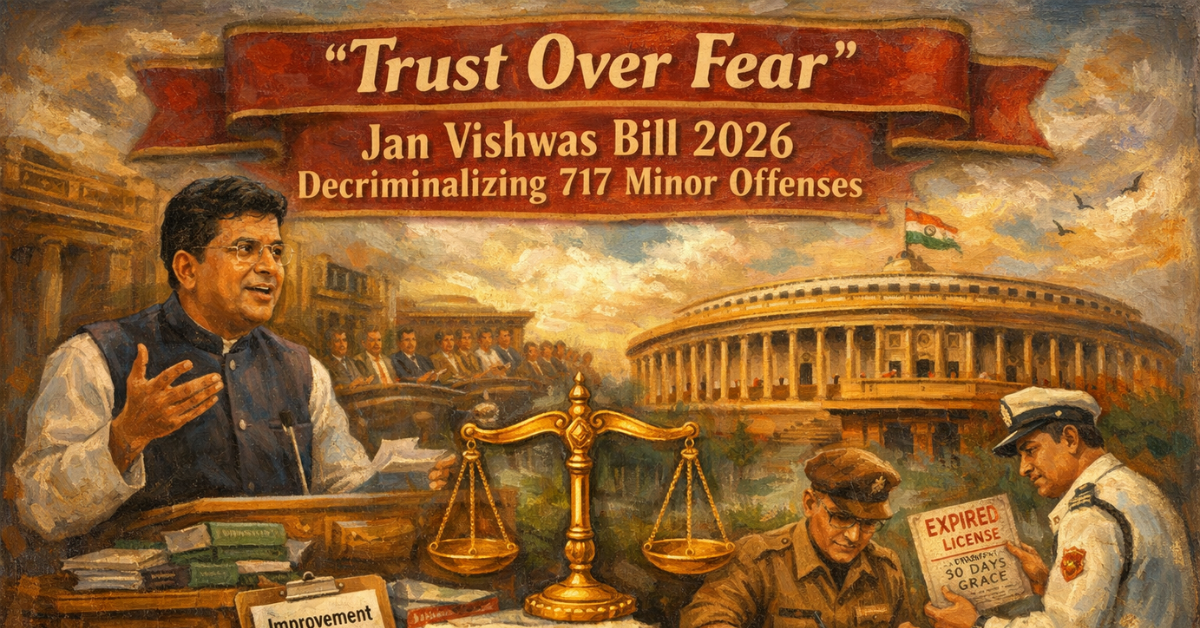
Parliament Clears Sweeping Decriminalization Reform
- Jan Vishwas (Amendment of Provisions) Bill, 2026 passed by both Houses of Parliament.
- 717 minor offenses decriminalized across 79 Central Acts.
- Introduces “correction-first” compliance and inflation-indexed penalties.
- Shifts minor cases from courts to administrative adjudicating officers.
- Opposition raises concerns over public safety and administrative discretion.
The passage of the Jan Vishwas (Amendment of Provisions) Bill, 2026 marks a structural shift in India’s regulatory approach, moving away from criminal enforcement toward civil compliance. Cleared by both Houses of Parliament, including the Rajya Sabha on April 2, 2026, the legislation is being positioned by the government as the most extensive decriminalization effort since Independence.
The bill builds on earlier reform efforts but expands them in both scale and scope. It amends 784 provisions across 79 Central Acts administered by 23 ministries, including sectors such as finance, commerce, health, and agriculture. According to Union Commerce Minister Piyush Goyal, the objective is to replace fear-driven compliance with a “trust-based governance” model that reduces friction for businesses and individuals.
Structural Scope and Legislative Design
The central premise of the bill is administrative simplification. A total of 717 provisions have been decriminalized, primarily those involving procedural lapses that do not indicate fraud or malicious intent. This includes failures in filing, minor reporting discrepancies, and technical non-compliance under regulatory statutes.
The reform spans a wide legislative base. These include Acts governing environmental regulation, food safety, trade practices, and corporate compliance. The intention is to remove the risk of imprisonment in cases where the violation is considered non-substantive in nature.
This approach reflects a broader policy alignment with the government’s long-standing administrative philosophy of reducing regulatory burden while maintaining enforcement through monetary penalties.
Key Provisions and Mechanisms
A defining feature of the law is the introduction of a “correction-first” framework. For 76 identified offenses, enforcement agencies must issue an Improvement Notice before initiating penalties. This provides a defined window for compliance, effectively shifting the system from punitive to corrective.
The bill also introduces inflation-linked penalties. Fines will automatically increase by 10 percent every three years. This mechanism is designed to prevent the erosion of deterrence due to inflation, reducing the need for repeated legislative amendments.
Another critical change is the shift toward administrative adjudication. Instead of routing minor offenses through courts, designated adjudicating officers will handle these cases. The government argues that this will ease judicial burden, particularly in lower courts where regulatory cases often contribute to case backlogs.
Changes Affecting Citizens and Daily Compliance
Beyond corporate and regulatory frameworks, the bill also modifies provisions that affect individuals directly. Under the Motor Vehicles Act, a 30-day grace period has been introduced for expired driving licenses. This replaces the earlier system where immediate penalties could apply upon expiration.
The bill also revisits several colonial-era provisions. Minor offenses under legacy laws, such as false alarms under regional police acts or cattle trespass provisions, have been either rationalized or removed. These changes reflect an attempt to modernize legal frameworks that have remained largely unchanged for decades.
Political Debate and Parliamentary Response
The legislation was not without opposition. Members from parties including the Indian National Congress and the Trinamool Congress raised concerns over potential dilution of accountability. A key point of contention was the removal of criminal liability in areas such as the manufacture of substandard medicines or misleading cosmetic products.
Critics argued that in sectors directly affecting public health, the absence of criminal penalties could weaken deterrence. There were also concerns about the expanded role of administrative officers in adjudication. Some opposition members suggested that this shift could increase discretion at the bureaucratic level, potentially raising risks related to transparency and corruption.
Despite these objections, the bill was passed through a voice vote, indicating a clear majority in favor.
Administrative Philosophy and Economic Context
The Jan Vishwas Bill aligns with a broader policy trajectory aimed at improving India’s ease of doing business environment. Over the past decade, multiple committees and expert panels have recommended decriminalization of business laws to reduce compliance anxiety and encourage formalization.
By removing imprisonment clauses for minor offenses, the government is attempting to reduce the perceived risk associated with regulatory engagement. This is particularly relevant for small and medium enterprises, which often lack the legal resources to navigate complex compliance frameworks.
Implications for Governance and Legal Systems
The long-term impact of the bill will depend on its implementation. While the reduction in criminal liability is expected to ease pressure on courts, the effectiveness of administrative adjudication will rely heavily on institutional capacity and oversight mechanisms.
There is also a broader philosophical shift embedded in the legislation. It redefines the relationship between the state and the citizen, placing greater emphasis on compliance through guidance rather than coercion.
Whether this transition leads to more efficient governance or introduces new administrative challenges will become clearer as enforcement begins across ministries and sectors.