


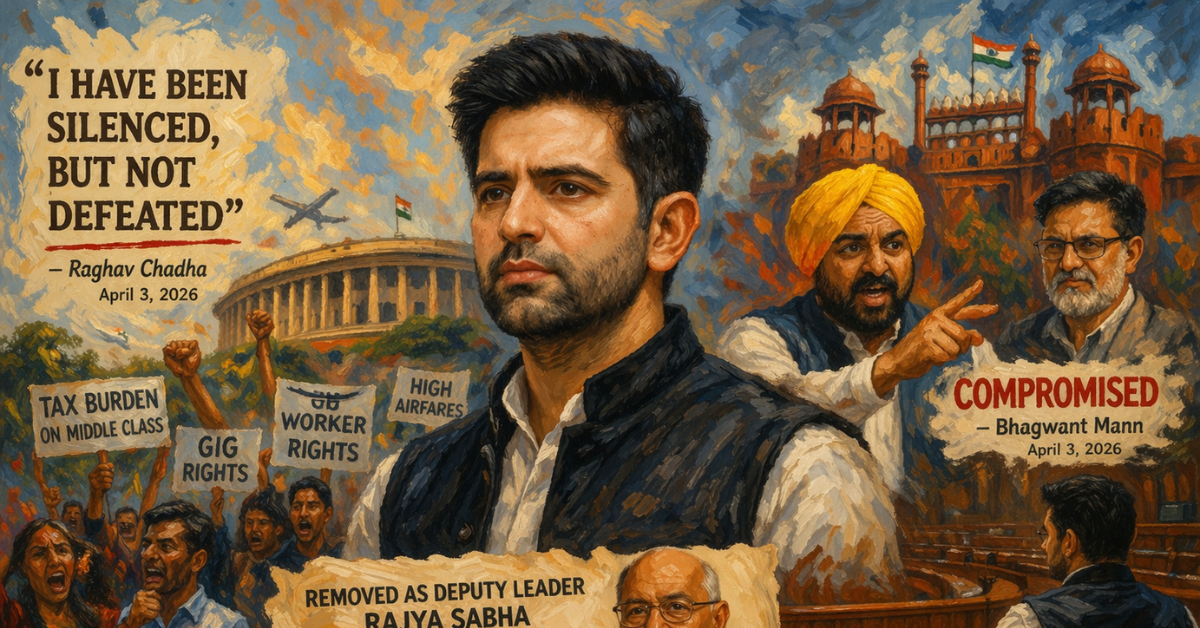
AAP Rift Deepens After Raghav Chadha’s Removal
- Raghav Chadha removed as Deputy Leader in Rajya Sabha on April 2, 2026
- Ashok Mittal appointed as replacement, signaling leadership shift
- Chadha alleges he was denied speaking opportunities by party leadership
- Bhagwant Mann calls Chadha “compromised,” raising serious internal concerns
- Underlying tensions linked to past absences, dissent, and political positioning
A visible internal conflict has emerged within the Aam Aadmi Party (AAP) following the removal of Raghav Chadha from his position as Deputy Leader in the Rajya Sabha. The decision, taken on April 2, 2026, marks a turning point in what appears to be a long-standing but largely contained disagreement within the party’s leadership structure.
Who is Raghav Chadha
Raghav Chadha is an Indian politician, Chartered Accountant, and a prominent figure within the Aam Aadmi Party (AAP). He is widely regarded as one of the younger leaders who rose quickly within the party’s structure, combining a professional background in finance with a visible public role in politics.
He was born on November 11, 1988, in New Delhi. He completed his schooling at Modern School, Delhi, and later graduated from the University of Delhi. He qualified as a Chartered Accountant and pursued further academic exposure in economics and public policy abroad. Before entering politics, he worked with consulting firms where his focus remained on taxation, financial advisory, and corporate governance.
Entry into Politics and Rise in AAP
Chadha joined the Aam Aadmi Party during its early years and became part of its policy and communications team. He gained recognition as a spokesperson, representing the party across television debates and public discussions.
His first major electoral success came in the 2020 Delhi Assembly elections, where he won from the Rajinder Nagar constituency. During his tenure, he also served as the Vice Chairman of the Delhi Jal Board, where he was associated with water management and infrastructure-related initiatives in the capital.
In 2022, he entered national politics after being elected to the Rajya Sabha from Punjab. This marked a transition from state-level leadership to a broader national role within the party. He became part of key internal bodies, including the Political Affairs Committee, which is responsible for major strategic decisions.
Political Identity and Role
Chadha has often been seen as a policy-focused leader within the party, with an emphasis on governance, fiscal matters, and regulatory issues. He has spoken on subjects such as taxation, public accountability, and urban governance, and has also handled legal and strategic responsibilities within the party’s framework.
His communication style, particularly in structured debates and policy discussions, contributed to his emergence as one of the recognisable national voices of the party during its expansion phase.
Personal Life
Raghav Chadha married actor Parineeti Chopra in September 2023. The marriage drew public attention, though he has largely maintained a measured approach in separating personal life from political responsibilities.
Leadership Change Signals Strategic Realignment
Chadha has been replaced by Ashok Mittal, a Rajya Sabha MP from Punjab and founder of Lovely Professional University. The appointment is not merely administrative. It reflects a broader recalibration of influence within AAP’s parliamentary wing, particularly at a time when Punjab remains central to the party’s governance and political identity.
Mittal’s elevation suggests a preference for leaders perceived to be aligned closely with current organisational priorities. It also indicates a shift toward tighter control over parliamentary messaging and representation.
Chadha’s Response and Allegations
On April 3, Chadha issued a public statement through a video message, stating, “I have been silenced, but not defeated.” The remark, delivered without overt confrontation, nevertheless pointed to internal restrictions placed on his role.
He alleged that the party leadership had requested the Rajya Sabha Secretariat to limit his speaking opportunities. While this claim remains unverified in official records, it highlights a breakdown of trust between Chadha and the party leadership.
Chadha framed his position around his focus on public-facing issues, including the tax burden on the middle class, rights of gig workers, and rising airfares. His argument suggests that the disagreement may not be ideological in a traditional sense, but rooted in differences over priorities and messaging.
Strong Pushback from Within the Party
Punjab Chief Minister Bhagwant Mann responded sharply, describing Chadha as “compromised.” The choice of language carries significant weight in political discourse, implying concerns about loyalty and alignment rather than routine disagreement.
Mann also pointed to Chadha’s absence during key political moments, including the arrest of Arvind Kejriwal in 2024 and subsequent developments involving party workers. These instances have been cited by party insiders as evidence of disengagement during critical periods.
Origins of the Internal Conflict
The current situation appears to be the culmination of tensions that have been building over more than a year. Several factors have contributed to the strain:
- Chadha’s absence during major political crises, including Kejriwal’s arrest
- Limited public engagement during sensitive party developments
- Reported refusal to sign a joint opposition notice targeting the Chief Election Commissioner in March 2026
Such actions, while individually explainable, collectively created a perception of divergence from the party’s coordinated strategy.
Speculation and Political Undercurrents
Adding another layer to the situation is speculation within sections of the party regarding Chadha’s alleged contact with the Bharatiya Janata Party (BJP). No formal evidence has been presented, and Chadha has not publicly addressed these claims. However, in a politically sensitive environment, such perceptions tend to carry considerable influence.
The emergence of these narratives suggests that the conflict is not limited to performance or communication, but extends into questions of political alignment and trust.
Position Within the Party Remains Intact, For Now
Despite his removal from the Rajya Sabha leadership role, Chadha continues to be a member of the Political Affairs Committee, the highest decision-making body within AAP. This indicates that the party has not fully sidelined him, but has instead reduced his operational role.
This dual approach reflects an attempt to manage internal dissent without escalating it into a complete rupture. It allows space for recalibration while maintaining institutional continuity.
What This Means for AAP’s Internal Stability
The episode highlights the challenges faced by political parties transitioning from activist-driven movements to structured governance systems. As organisational discipline strengthens, space for independent positioning often narrows.
For Chadha, the developments represent a moment of uncertainty that could reshape his political trajectory. For the Aam Aadmi Party, the situation tests its ability to handle internal disagreements without allowing them to evolve into deeper fractures that may affect its broader political standing.