


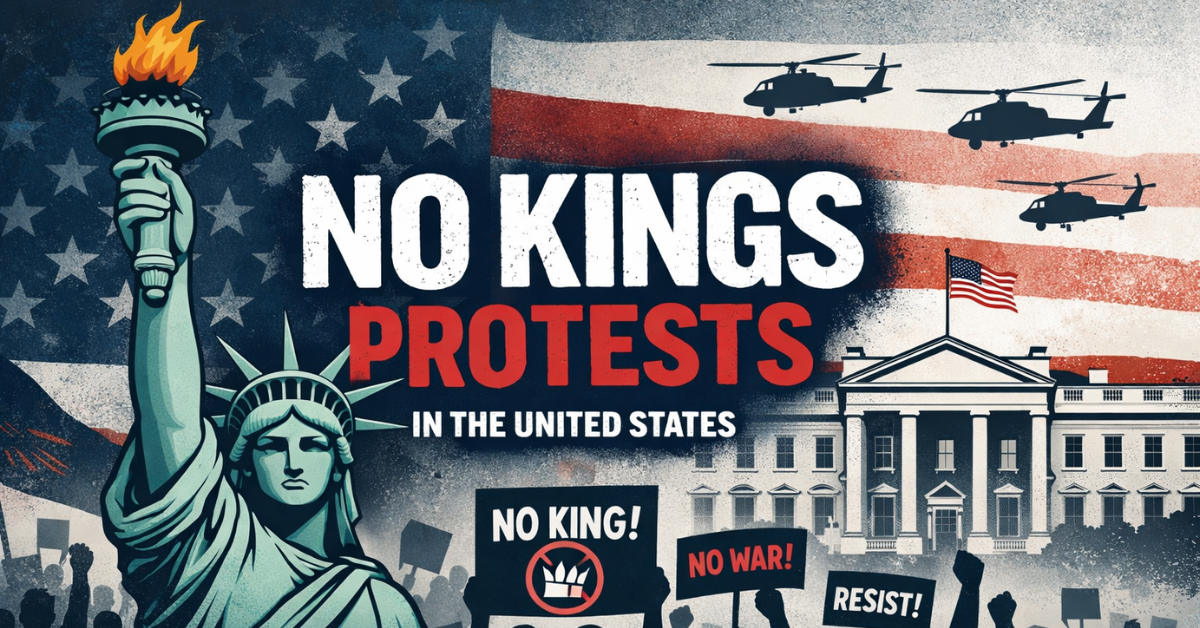
Scale, Meaning, and Political Impact of “No Kings” Protests
- 8–9 million people participated across 3,300+ protests nationwide.
- Major rallies held in New York City, Washington D.C., and St. Paul.
- Movement centers on opposition to executive overreach and Iran war.
- Trump approval rating stands near 36% with rising disapproval.
- Counter-protests and isolated clashes reported in multiple cities.
Overview
On Saturday, March 28, 2026, a coordinated wave of demonstrations swept across the United States under the banner of the “No Kings” movement. Organizers and several observers have described it as one of the largest single-day protest mobilizations in the country’s history. The protests were not confined to one city or issue. They represented a convergence of grievances, political messaging, and public dissent directed at the administration of Donald Trump during his second term.
This article examines participation levels, the meaning behind the slogan, the issues driving the protests, current approval ratings, and the response from supporters of the president.
Scale of the Protests
Nationwide Participation
Organizers of the “No Kings” movement estimate that between 8 and 9 million people took part in protests across more than 3,300 events nationwide. Demonstrations were reported in all 50 U.S. states, spanning major metropolitan areas, university towns, and smaller state capitals.
While independent verification of exact numbers remains ongoing, even conservative estimates suggest a turnout in the millions. This places the protests among the largest coordinated civic mobilizations in modern U.S. history, comparable in scale to events such as the Women’s March.
Major City Turnouts
Several cities recorded especially large gatherings:
- New York City: Estimated 350,000 or more participants
- Washington, D.C.: Over 200,000 demonstrators
- St. Paul, Minnesota: Around 200,000 at the flagship rally
These locations became focal points not only for turnout but also for speeches, media coverage, and organizational coordination.
Continued Activity (March 30, 2026)
Although peak mobilization occurred on Saturday, smaller demonstrations have continued into Monday, March 30. These include:
- Student walkouts at universities
- Candlelight vigils in state capitals
- Localized marches tied to specific grievances
This suggests the movement is not a one-day event but part of a sustained protest cycle.
International Dimension
Parallel rallies were held in cities such as London, Paris, Berlin, and Rome. While smaller in scale, these events indicate that the movement’s messaging has resonated beyond U.S. borders, particularly among groups critical of American foreign policy.
What Does “No Kings” Mean?
The phrase “No Kings” is rooted in a long-standing principle of American political identity: the rejection of monarchy. The slogan draws symbolic continuity from the American Revolution, where opposition to centralized, unaccountable authority became foundational.
In the current context, protesters use “No Kings” to express concerns about:
- Concentration of executive power
- Governance perceived as bypassing institutional checks
- The use of federal authority in ways critics describe as personalized or unilateral
The slogan does not refer to literal monarchy. Rather, it is a political metaphor suggesting that elected leaders must remain accountable to constitutional limits and democratic institutions.
What the Protests Are About
The demonstrations are not driven by a single issue. Instead, they represent a convergence of multiple political and social concerns.
1. The Iran Conflict
A central catalyst has been the ongoing military campaign known as “Operation Epic Fury,” a joint U.S.-Israeli effort targeting Iran. Critics argue that the escalation risks a prolonged regional conflict and question both its justification and execution.
Public opposition has focused on:
- Civilian risk and regional instability
- Lack of congressional authorization, as claimed by critics
- Concerns over long-term military entanglement
2. Immigration Enforcement and Civilian Deaths
Domestic outrage intensified following incidents tied to immigration enforcement operations, particularly “Operation Metro Surge.” Protesters cite the deaths of civilians during federal raids as evidence of excessive force.
These incidents have become symbolic within the movement, representing broader concerns about:
- Militarization of domestic law enforcement
- Accountability of federal agencies
- Treatment of immigrant communities
3. Claims of Authoritarian Governance
Another major theme is the allegation of “authoritarian overreach.” Protesters point to:
- Frequent use of executive orders
- Deployment of masked federal agents in U.S. cities
- Actions perceived as bypassing Congress
Critics argue that such measures erode institutional checks and balances. Supporters of the administration, however, frame them as necessary for national security and law enforcement.
4. Economic Pressures
Economic conditions have also contributed to public dissatisfaction. Protest messaging frequently references:
- Rising cost of living
- Wage stagnation in certain sectors
- Federal government shutdowns affecting public services
While these issues are not unique to the current administration, they have become intertwined with broader political frustrations.
Trump’s Approval Ratings
Recent polling indicates a decline in approval ratings for President Donald Trump during this period.
- Approval rating: Approximately 36 percent (based on Reuters/Ipsos and Benchmark polling)
- Disapproval range: Between 47 percent and 59 percent
- Strong disapproval: Around 51 percent in some surveys, including YouGov
The crossing of the 50 percent threshold in “strong disapproval” is notable. It suggests not only disagreement but intensified opposition among a significant portion of respondents.
It is important to note that polling methodologies vary, and approval ratings can fluctuate rapidly during periods of political and military tension.
Response from Pro-Trump Supporters
Official Response
The White House has dismissed the protests in strong terms. Press officials have characterized the demonstrations as politically motivated and unrepresentative of the broader electorate.
Common themes in official responses include:
- Framing protests as partisan opposition
- Emphasizing the legitimacy of electoral victory
- Positioning dissent as harmful during wartime
Counter-Protests
Several pro-Trump groups organized counter-rallies in cities such as Dallas and West Palm Beach. These events were smaller in scale but significant as indicators of political polarization.
Groups reported to be involved include:
- Proud Boys
- Oath Keepers
Their messaging generally focused on support for law enforcement, national sovereignty, and the administration’s foreign policy stance.
Clashes and Law Enforcement Response
While the majority of “No Kings” protests were peaceful, isolated clashes occurred in cities such as Portland and San Diego. These incidents involved:
- Verbal confrontations escalating into physical altercations
- Police intervention and arrests
- Separation of opposing groups to prevent further escalation
Authorities have emphasized that overall protest activity remained largely non-violent despite the scale.
Key International Hubs
While the largest crowds were in the U.S., major European and global cities held significant solidarity events, often coordinated by groups like Democrats Abroad and Indivisible Abroad:
- London, UK: Protesters gathered in Parliament Square, carrying banners that read “Stop the Far Right” and “Stand up to Racism.” The messaging here often linked the American “No King” sentiment to local UK concerns about civil liberties and right-wing populism.
- Rome, Italy: Thousands marched through the streets, where the protest took on a dual purpose. Demonstrators chanted against Premier Giorgia Meloni’s judicial reforms (which critics call a threat to judicial independence) while also waving banners against U.S. and Israeli military actions in Iran.
- Berlin, Germany: Labeled as “No Kings III,” the Berlin protest drew several hundred to the Brandenburg Gate. Speakers focused on the “global rollback of democracy,” specifically highlighting issues like abortion access, gun control, and the U.S. administration’s immigration policies.
- Paris, France: A crowd of several hundred, largely comprised of Americans living in France and members of French labor unions, gathered at the Place de la Bastille. The primary focus was a rejection of “endless wars,” specifically citing the conflict in Iran.
- Brussels & Amsterdam: Protests were held outside the U.S. Embassy in Brussels and the U.S. Consulate in Amsterdam. In these cities, the branding was strictly “No Tyrants Day,” framing the movement as a defense of the rule of law against executive overreach.
The “No Tyrants” Rebranding
In countries with constitutional monarchies (like the UK, the Netherlands, and Belgium), organizers often use the name “No Tyrants” instead of “No King.”
Reasoning: This is partly to avoid confusion with local royal families and partly to broaden the message to include any form of authoritarianism or “tyranny” by a head of state, regardless of their title.
Global Solidarity: The core message remains the same: that no leader—President or otherwise—is above the law or has the right to rule without accountability.
Common Global Themes
- Opposition to the Iran War: Many international participants viewed the U.S. military campaign as a destabilizing force for global security.
- Solidarity with Immigration Victims: Rallies often featured tributes to Renée Good and Alex Pretti, the two individuals killed during ICE raids in Minnesota, which served as a catalyst for the 2026 wave of protests.
- Human Rights: A shared emphasis on protecting voting rights and civil liberties that protesters feel are under threat globally.
Pro-Trump Response to International Rallies
Supporters of the administration have generally dismissed the international protests as “foreign interference” or “expat theater.” Pro-Trump media outlets have frequently argued that these rallies are populated by “liberal elites” living abroad who are out of touch with the “real America” and the security needs that the administration claims to be addressing through its current policies.
Political and Social Significance
The “No Kings” protests highlight a period of intensified political polarization in the United States. Several features stand out:
- Scale: Multi-million participation indicates widespread mobilization capacity
- Breadth: Issues span foreign policy, domestic enforcement, governance, and economics
- Symbolism: The framing of executive power as “monarchical” reflects deeper institutional concerns
- Continuity: Ongoing protests suggest sustained engagement rather than a single event
At the same time, the strong counter-response from pro-Trump groups underscores a deeply divided political landscape, where large segments of the population interpret the same events in fundamentally different ways.
Current Situation and What Comes Next
As of March 30, 2026, the movement remains active, though at reduced intensity compared to the peak on March 28. Organizers have indicated plans for:
- Continued demonstrations
- Legal advocacy and petitions
- Coordination with student and labor groups
The trajectory of the protests will likely depend on several factors:
- Developments in the Iran conflict
- Federal policy decisions
- Economic conditions
- Public opinion trends
Whether the “No Kings” movement becomes a sustained political force or fades after initial mobilization remains uncertain. What is clear is that it has already marked a significant moment in contemporary U.S. civic activity, reflecting both large-scale dissent and equally strong political opposition.