


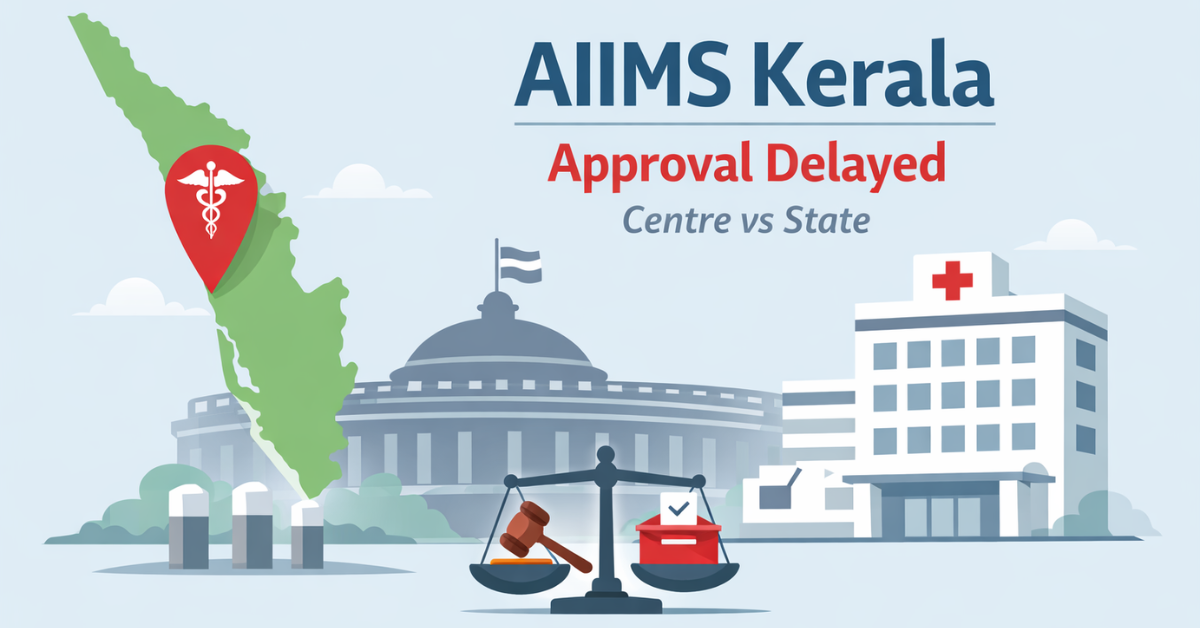
AIIMS Kerala: Status and Key Developments
- The Central Government has confirmed that AIIMS Kerala has not yet received formal approval as of March 2026.
- The project is currently stalled due to the absence of a new policy decision under the PMSSY scheme.
- Kinalur in Kozhikode has been identified by the Kerala government as the preferred site with required land ready.
- The Kerala High Court has sought a detailed explanation from the Centre regarding the delay.
- The issue has gained political significance ahead of the April 2026 Kerala Assembly elections.
The proposal to establish an All India Institute of Medical Sciences in Kerala has entered a prolonged phase of uncertainty. What was once seen as a routine expansion of India’s premier healthcare network has gradually turned into a complex administrative and political issue. As of late March 2026, the Central Government has made it clear that the project has not yet received formal approval, placing Kerala outside the current list of sanctioned AIIMS institutions.
Current Approval Status and Policy Position
The Union Ministry of Health and Family Welfare has stated in Parliament that the proposal for AIIMS Kerala remains pending. The primary reason cited is procedural. According to the Centre, a feasibility study for any new AIIMS can only begin after a formal policy decision is taken at the Union level to expand the scheme further.
At present, no such decision has been taken for the next phase of the Pradhan Mantri Swasthya Suraksha Yojana. The existing phase of the scheme has effectively concluded in March 2026, and discussions regarding the next phase are still underway within the government. This has created a pause in approvals across the board, including Kerala’s case.
The Union Budget for 2026–27 has allocated funds under a general category for new AIIMS institutions but has not specified any new state or project. This reinforces the view that expansion decisions are yet to be finalized.
Kerala’s Preparedness and Site Selection
The Kerala government has consistently maintained that it has fulfilled all requirements expected at its level. The state has identified Kinalur in Kozhikode district as the preferred location for the AIIMS campus. Approximately 250 acres of land have been earmarked, exceeding the minimum requirement set by the Centre.
Officials have also indicated that the land has been demarcated and initial steps toward acquisition and preparation have been completed. From the state’s perspective, the proposal is ready for technical evaluation and should move into the feasibility stage without further delay.
Earlier, multiple locations including Thiruvananthapuram, Kottayam, and Ernakulam were considered. However, Kinalur emerged as the most viable option based on internal assessments conducted by the state government.
Points of Disagreement Between Centre and State
Despite the state’s readiness, certain differences remain unresolved. The Centre has indicated that it prefers multiple site options for comparative evaluation, whereas Kerala has largely focused on a single location. This difference in approach has contributed to the delay.
There are also concerns from the central side regarding infrastructure parameters such as connectivity, water availability, and long-term expansion capacity. While these concerns have not been formally detailed in public documents, they are part of ongoing discussions between the two sides.
The Centre’s position emphasizes strict adherence to technical and procedural norms. In contrast, the state views its preparations as sufficient to initiate the next stage of the process.
Judicial Intervention by Kerala High Court
The Kerala High Court has stepped in to examine the delay in approving the project. In recent hearings, the court has directed the Central Government to submit a detailed affidavit explaining the criteria used to prioritize other states for AIIMS institutions.
The court has also questioned whether there is a broader policy objective of ensuring that each state eventually receives an AIIMS. If such a principle exists, the continued exclusion of Kerala has been asked to be justified.
The Centre has been given a deadline of April 10, 2026, to present its position clearly. This intervention is expected to bring greater transparency to the decision-making process, though it may not immediately resolve the issue.
Political Context and Electoral Timing
The delay in approving AIIMS Kerala has gained significant political attention, particularly with the Kerala Assembly elections scheduled for April 2026. The issue has been raised by multiple political parties within the state, cutting across ideological lines.
The Kerala Assembly has passed a unanimous resolution urging the Centre to approve the project. The matter has been framed as one of equitable treatment within the federal system, with leaders arguing that several other states have received AIIMS institutions over the years.
On the other hand, voices aligned with the Centre have emphasized procedural compliance and suggested that earlier delays in land identification and documentation may have contributed to the current situation.
Broader Policy Considerations
Kerala’s healthcare system is often regarded as one of the most advanced in India. This has led to some debate over whether the state is a priority for new AIIMS institutions, which are often established in regions with weaker healthcare infrastructure.
However, the role of AIIMS extends beyond addressing basic healthcare gaps. These institutions serve as centers for advanced treatment, medical research, and education. From this perspective, the absence of an AIIMS in Kerala represents a gap in tertiary healthcare capacity rather than primary care.
The decision to include Kerala in future phases of expansion may therefore depend on how policy frameworks balance these different dimensions of need.
What Lies Ahead
The future of AIIMS Kerala is closely tied to the next phase of the Pradhan Mantri Swasthya Suraksha Yojana, expected to cover the period from 2026 to 2031. If a new phase is approved, Kerala’s proposal is likely to be reconsidered along with other potential projects.
This would involve fresh feasibility studies, site evaluations, and budgetary approvals. The timeline for these steps remains uncertain, as discussions at the central level are still ongoing.
The High Court’s directive may accelerate clarity, but the final outcome will depend on alignment between policy decisions, administrative requirements, and political priorities.
A Project Waiting for Alignment
The AIIMS Kerala proposal reflects a broader pattern in large public infrastructure projects, where multiple layers of decision-making intersect. Administrative procedures, technical standards, and political considerations all play a role in shaping outcomes.
In this case, the absence of a clear policy decision has created a pause that affects not just Kerala but the overall expansion of AIIMS institutions in the country. Until that decision is made, the project remains in a holding phase.
For now, AIIMS Kerala stands as a proposal that is neither rejected nor approved, but awaiting alignment between process and priority at the national level.