


Commercial Relief Begins as Household Restrictions Continue
- Commercial LPG allocation raised to 50% of pre-crisis levels starting March 23
- Domestic users remain under strict refill limits and compliance rules
- Prices stabilize after early March hikes across major cities
- Supply chain steadies with increased production and secured shipping routes
- Over 3,500 anti-hoarding raids conducted nationwide in a single day
LPG Crisis Snapshot (March 21, 2026)
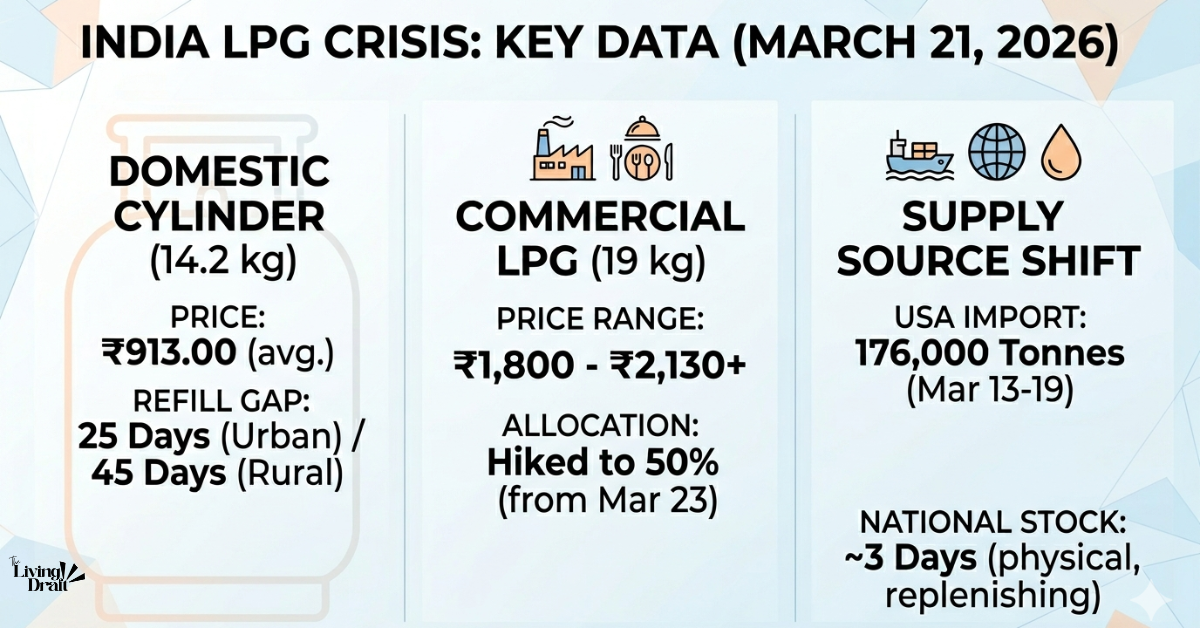
| Category | Key Metric | Current Status |
|---|---|---|
| Domestic LPG | 14.2 kg Price | ~₹913 (Delhi/Mumbai), ₹1,002.50 (Patna), ₹910.50 (Noida) |
| Commercial LPG | 19 kg Price | ₹1,836 (Mumbai) to ₹2,133 (Patna) |
| Commercial Supply | Allocation Level | Raised to 50% of pre-crisis levels (effective March 23) |
| Domestic Rules | Refill Gap | 25 days (Urban), 45 days (Rural) |
| Supply Chain | Stock Position | 2 to 4 days local stock with continuous replenishment |
| Enforcement | Anti-hoarding Action | 3,500+ raids, ~1,400 cylinders seized |
| Policy Shift | PNG Requirement | Mandatory application for businesses seeking higher allocation |
India’s ongoing LPG supply crisis showed its first measurable sign of relief on Saturday evening, with the government announcing a significant increase in commercial gas allocation. The move is expected to ease pressure on restaurants and hospitality services, even as restrictions on household consumption remain firmly in place.
Policy Shift Targets Hospitality Sector
In a late evening announcement, the Ministry of Petroleum and Natural Gas confirmed that commercial LPG allocation will be raised to 50 percent of pre-crisis levels, up from the earlier cap of 20 to 30 percent. The revised supply will take effect from March 23.
Hotels, restaurants, roadside eateries, and industrial kitchens are expected to benefit immediately. However, the additional allocation comes with a condition. Businesses must register with Oil Marketing Companies and apply for a Piped Natural Gas connection. The requirement signals a longer-term policy direction that encourages a shift away from LPG cylinders toward pipeline-based supply.
Prices Hold at Elevated Levels
Market prices remained steady following the sharp increases earlier this month. Domestic LPG cylinders of 14.2 kg are currently priced around ₹913 in major metros such as Delhi and Mumbai. Regional variation persists, with Patna recording the highest rate at ₹1,002.50, while Noida remains among the lowest at ₹910.50.
Commercial cylinders of 19 kg continue to reflect a uniform increase of ₹144. Current prices range from ₹1,836 in Mumbai to ₹2,133 in Patna, maintaining pressure on small businesses despite the supply increase.
Supply Chain Shows Signs of Stability
Government officials reported a 25 to 30 percent increase in domestic LPG production, achieved by redirecting propane and butane supplies from industrial use into the cooking gas pool.
Concerns around international supply routes also showed some easing. A total of 22 Indian-flagged vessels remain active in the Persian Gulf, with no reported incidents in the last 24 hours. Two tankers have successfully crossed the Strait of Hormuz under naval supervision, indicating continued movement of critical imports.
At the local level, stock levels remain tight but manageable. Reports from cities such as Nagpur indicate that Oil Marketing Companies hold only two to four days of physical stock at any given time. However, consistent in-transit replenishment has reduced the risk of a complete supply breakdown.
Strict Rules Continue for Domestic Consumers
Despite easing pressure on the commercial side, household consumers remain subject to strict controls. The mandatory gap between LPG refills continues at 25 days in urban areas and has been extended to 45 days in rural regions. The measure is aimed at preventing panic buying and stockpiling.
Enforcement efforts have intensified. Authorities conducted over 3,500 raids across the country in a single day, seizing approximately 1,400 illegally diverted cylinders.
A new compliance rule has also come into effect. Households with an active Piped Natural Gas connection are now required to surrender their LPG cylinders. The policy is intended to reallocate limited resources toward households without alternative fuel access.
Outlook: Stabilization Without Full Normalcy
The latest developments suggest that while the immediate risk of supply disruption is receding, the system remains under careful control. Authorities have advised the public to avoid panic behavior such as long queues or bulk booking.
With commercial demand partly addressed and supply chains stabilizing, attention is likely to remain on enforcement and gradual normalization. For now, the LPG ecosystem continues to operate under a managed balance rather than a full return to pre-crisis conditions.