


How the Indian Ocean Dipole Influences India’s Monsoon
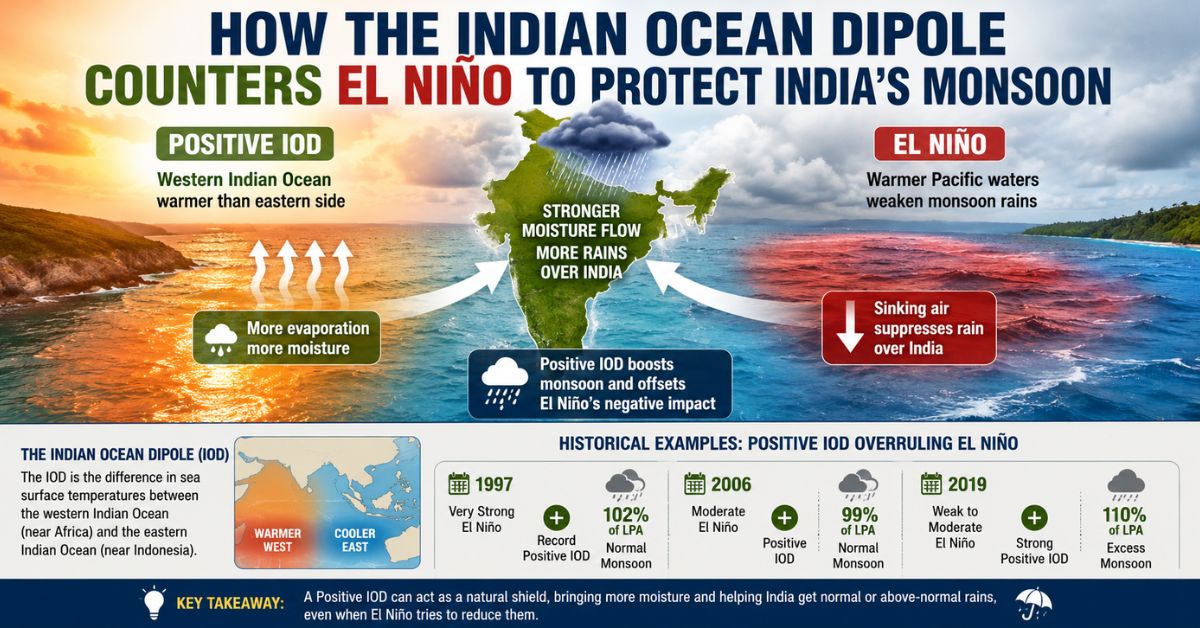
- The Indian Ocean Dipole (IOD) is a climate pattern driven by temperature differences between the western and eastern Indian Ocean, and it can significantly influence India’s monsoon rainfall.
- A Positive IOD develops when the western Indian Ocean becomes warmer than the eastern side, increasing moisture availability and supporting rainfall over the Indian subcontinent.
- Positive IOD events can partly offset the rainfall-suppressing effects of El Niño by strengthening moisture transport and atmospheric convection near India.
- Historical examples such as 1997, 2006, and 2019 show that strong Positive IOD conditions helped India achieve normal or above-normal monsoon rainfall despite unfavorable Pacific Ocean conditions.
- Meteorologists monitor both El Niño and the IOD because the interaction between the Pacific and Indian Oceans often determines the final outcome of India’s monsoon season.
For decades, El Niño has been one of the most closely watched climate patterns during India’s monsoon season. When ocean waters in the central and eastern Pacific Ocean become unusually warm, rainfall over India often weakens, raising concerns about drought, agriculture, water supplies, and economic growth.
Yet meteorologists have long known that El Niño does not always tell the full story. In some years, India has managed to escape severe monsoon damage despite the presence of a strong El Niño. The reason often lies much closer to home, in the Indian Ocean.
A climate pattern known as the Indian Ocean Dipole (IOD) can sometimes act as a powerful counterbalance to El Niño. When conditions align, a Positive IOD can strengthen moisture flow toward India and help maintain monsoon rainfall even when Pacific Ocean conditions are working against it.
Historical examples such as 1997, 2006, and 2019 continue to provide important lessons for forecasters trying to understand how different climate systems interact and influence India’s rainfall.
What Is the Indian Ocean Dipole?
The Indian Ocean Dipole is a climate pattern that measures differences in sea surface temperatures between the western and eastern parts of the Indian Ocean.
Scientists monitor two key regions:
- The western Indian Ocean, located near the eastern coast of Africa.
- The eastern Indian Ocean, located near Indonesia and northwestern Australia.
When temperatures differ significantly between these regions, an IOD event develops.
The phenomenon is often compared to El Niño because both involve changes in ocean temperatures that influence rainfall and atmospheric circulation. However, while El Niño occurs in the Pacific Ocean, the IOD operates entirely within the Indian Ocean basin.
The IOD can exist in three phases.
The Three Phases of the IOD
Positive IOD: A Positive IOD occurs when the western Indian Ocean becomes warmer than average while the eastern Indian Ocean becomes cooler than average. This phase generally supports stronger rainfall over parts of India and East Africa.
Negative IOD: A Negative IOD occurs when waters near Indonesia become warmer than average and the western Indian Ocean becomes relatively cooler. This phase can weaken monsoon conditions and may worsen drought risks if it occurs alongside El Niño.
Neutral IOD: A Neutral IOD means temperature differences across the Indian Ocean remain close to average. In this state, the IOD provides little influence on the monsoon, allowing other climate drivers to play a larger role.
Why El Niño Usually Reduces Monsoon Rainfall
To understand how the IOD can help India, it is important to understand how El Niño affects rainfall.
During an El Niño event, sea surface temperatures in the Pacific Ocean rise above normal levels. These warmer waters change global atmospheric circulation patterns.
One of the main consequences is a shift in regions where air rises and where it sinks.
Rising air promotes cloud formation and rainfall. Sinking air suppresses cloud development and reduces precipitation.
During many El Niño years, atmospheric conditions encourage sinking air over South Asia, making it harder for rain-bearing clouds to develop across India.
This often leads to:
- Reduced monsoon rainfall
- Longer dry spells
- Lower reservoir levels
- Agricultural stress
- Increased heat conditions
Although the relationship is not perfect, many of India’s drought years have coincided with El Niño events.
How a Positive IOD Helps the Monsoon
A Positive IOD can partly or sometimes significantly offset El Niño’s influence through changes in moisture supply and atmospheric circulation.
Increased Moisture Near India
When the western Indian Ocean becomes warmer than normal, evaporation increases.
Warmer ocean waters release more moisture into the atmosphere. This creates conditions that encourage stronger moisture transport toward the Indian subcontinent.
As a result, rain-bearing winds arriving from the Arabian Sea can carry additional moisture, helping sustain monsoon rainfall.
Even if El Niño is weakening atmospheric support for rainfall, the warmer western Indian Ocean can continue feeding moisture into the monsoon system.
Stronger Convection Over the Western Indian Ocean
Meteorologists use the term “convection” to describe the upward movement of warm, moist air.
A Positive IOD promotes stronger convection over the western Indian Ocean because warmer waters encourage air to rise.
As moist air rises, clouds develop and rainfall processes become more active.
This can strengthen weather systems that contribute to India’s monsoon circulation.
Partial Correction of Atmospheric Imbalances
El Niño often disrupts a large-scale atmospheric circulation pattern known as the Walker Circulation.
The disruption can reduce rainfall over India by favoring sinking air over the region.
A Positive IOD helps counter some of these effects by creating a separate zone of rising air over the western Indian Ocean.
While it does not completely eliminate El Niño’s influence in every case, it can reduce the negative impact and improve rainfall outcomes.
The Famous Example of 1997
The year 1997 remains one of the most important case studies in monsoon science.
Meteorologists worldwide were concerned because a very strong El Niño was developing across the Pacific Ocean.
Sea surface temperatures in parts of the Pacific rose dramatically above average, making it one of the strongest El Niño events ever recorded.
Under normal circumstances, such conditions would have raised serious concerns about a weak Indian monsoon.
However, another extraordinary event was taking place in the Indian Ocean.
A record-strength Positive IOD developed during the same period.
The western Indian Ocean became unusually warm while waters near Indonesia cooled significantly.
This temperature contrast created powerful atmospheric responses that increased moisture transport toward India.
Instead of experiencing a severe rainfall deficit, India received near-normal monsoon rainfall. Seasonal rainfall reached roughly 102 percent of the long-period average.
The outcome surprised many observers and demonstrated that the Indian Ocean could sometimes outweigh the influence of the Pacific Ocean.
Because of this, 1997 is often cited as the clearest example of a Positive IOD protecting India’s monsoon from a powerful El Niño.
The 2006 Example
Another important case occurred in 2006.
That year featured El Niño conditions that raised concerns about monsoon performance.
However, a Positive IOD emerged during the latter part of the season.
The strengthening IOD helped improve rainfall conditions, particularly during the second half of the monsoon.
Although rainfall distribution varied across regions, India ultimately recorded near-normal seasonal rainfall at approximately 99 percent of the long-period average.
The 2006 event showed that even when a Positive IOD develops later in the season, it can still provide meaningful support to monsoon rainfall.
This is particularly important for agriculture because September rainfall often plays a key role in crop development and reservoir replenishment.
The 2019 Example
The year 2019 provided another reminder of the IOD’s importance.
A strong Positive IOD developed in the Indian Ocean and became one of the strongest such events in recent decades.
The monsoon season eventually delivered rainfall well above normal levels.
India recorded around 110 percent of its long-period average rainfall, making it one of the wettest monsoon seasons in many years.
Although climate conditions were not identical to 1997, the event reinforced the idea that a strong Positive IOD can significantly boost rainfall over India.
The 2019 season also highlighted how forecasts based only on Pacific Ocean conditions can sometimes miss important signals coming from the Indian Ocean.
Historical Examples of Positive IOD Offsetting El Niño
| Year | El Niño Strength | IOD Status | Monsoon Outcome |
|---|---|---|---|
| 1997 | Very Strong | Record Positive | Around 102% of Long Period Average |
| 2006 | Moderate | Positive | Around 99% of Long Period Average |
| 2019 | Weak to Moderate Earlier in Season | Strong Positive | Around 110% of Long Period Average |
Why Meteorologists Monitor Both Oceans
Modern monsoon forecasting has become increasingly sophisticated because scientists recognize that no single climate factor determines rainfall outcomes.
El Niño remains extremely important, but it is only one part of a larger climate system.
Forecasters now routinely monitor:
- El Niño and La Niña conditions in the Pacific Ocean
- Indian Ocean Dipole developments
- Arabian Sea temperatures
- Bay of Bengal conditions
- Snow cover across Eurasia
- Atmospheric circulation patterns
The interaction between these factors often determines whether a monsoon season performs better or worse than expected.
In some years, El Niño dominates.
In other years, the Indian Ocean provides enough support to offset part of the Pacific’s influence.
What These Historical Examples Teach Us
The experiences of 1997, 2006, and 2019 demonstrate an important lesson about India’s monsoon.
A strong El Niño does not automatically guarantee drought.
Likewise, a Positive IOD does not guarantee excellent rainfall everywhere.
Instead, the final monsoon outcome depends on how multiple climate systems interact over several months.
The strongest examples show that a Positive IOD can act as a powerful source of moisture and atmospheric support for the Indian monsoon. By increasing evaporation, enhancing convection, and strengthening moisture transport toward the subcontinent, it can reduce some of the negative effects associated with El Niño.
For meteorologists, these historical events remain valuable reminders that India’s monsoon is shaped not only by the Pacific Ocean but also by conditions much closer to home. As climate forecasting continues to improve, understanding the relationship between El Niño and the Indian Ocean Dipole will remain essential for predicting rainfall, preparing farmers, and managing water resources across the country.