

Key Highlights
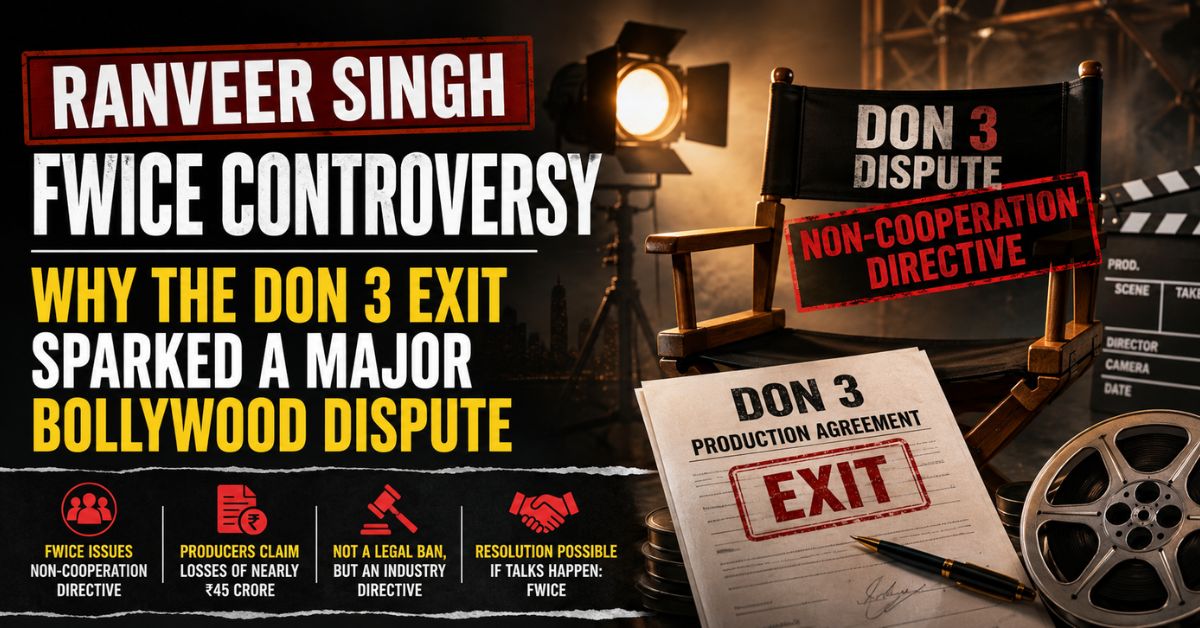
- FWICE issued a non-cooperation directive against Ranveer Singh over the Don 3 dispute.
- Producers Farhan Akhtar and Ritesh Sidhwani reportedly claimed losses of nearly ₹45 crore.
- The federation clarified that the move is not a legal ban but an industry directive.
- Ranveer Singh’s team stated that professional matters should be handled with dignity and maturity.
- The controversy has sparked debate about trade union authority in Bollywood.
Ranveer Singh is currently facing one of the biggest professional controversies of his career after the Federation of Western India Cine Employees (FWICE) issued a “Non-Cooperation Directive” against the actor on May 25, 2026. The dispute is connected to his reported exit from Farhan Akhtar’s highly awaited film Don 3, a project that had already created strong excitement among Bollywood fans and the trade industry.
Over the last few days, the controversy has moved beyond a normal casting disagreement and turned into a larger debate about the authority of trade unions in Bollywood, the responsibilities of actors toward producers, and whether industry bodies should interfere in private contractual matters.
Although many headlines described the move as a “ban” on Ranveer Singh, FWICE officials later clarified that the action is technically a non-cooperation directive. This means workers connected to the federation have been asked not to participate in projects involving the actor until the issue is resolved.
The development has shocked many in the Hindi film industry because FWICE represents a massive workforce across Bollywood and television production. From spot boys and lighting technicians to makeup artists and cameramen, thousands of workers fall under its network.
How The Don 3 Dispute Started
The controversy reportedly began after Ranveer Singh exited Don 3 in December 2025. According to reports, filming for the movie was expected to begin within a few weeks when the actor stepped away from the project.
The film, directed by Farhan Akhtar and backed by Excel Entertainment, was one of the most talked-about Bollywood productions in development. Ranveer Singh had been announced as the new lead of the iconic Don franchise after Shah Rukh Khan’s exit from the series.
Because of the franchise’s popularity, the announcement itself had generated major reactions online. Some fans welcomed the fresh casting choice while others remained emotionally attached to Shah Rukh Khan’s version of the character.
Despite the mixed reactions, industry insiders believed Don 3 had the potential to become one of the biggest action films of the next few years.
However, things reportedly changed when Ranveer Singh decided to walk out of the project.
According to complaints later submitted to film bodies, producers Farhan Akhtar and Ritesh Sidhwani claimed that nearly ₹45 crore had already been spent on pre-production work before the actor’s exit. These expenses reportedly included set planning, scheduling, location work, staff hiring, technical preparation, and promotional activities connected to the film.
The producers allegedly viewed the sudden departure as financially damaging because major production arrangements had already been finalized.
Why FWICE Entered The Matter
After the dispute escalated, the matter was reportedly brought before FWICE and other film industry associations.
FWICE later stated that it had sent three separate notices to Ranveer Singh asking him to appear before the federation and discuss the issue. According to reports, reminders were sent in April and May 2026.
The federation claimed that Ranveer Singh’s team eventually responded by arguing that FWICE did not have authority over private contractual disputes between actors and producers.
This response reportedly upset the federation leadership, which believed the actor should have cooperated with the mediation process.
Soon after, FWICE announced its non-cooperation directive.
Several federation representatives publicly stated that industry discipline must apply equally to everyone, including major stars. According to officials, the move was not intended as a legal punishment but as an industry-level response to what they described as “non-professional conduct.”
What The “Non-Cooperation Directive” Actually Means
One of the biggest misunderstandings surrounding the controversy is the word “ban.”
FWICE leaders themselves admitted that the federation is not a court and cannot legally stop a citizen from working. However, because the organization controls a large workforce connected to film production, its directives can still create serious practical problems.
The order asks workers and unions affiliated with FWICE not to participate in shoots or projects involving Ranveer Singh until the issue is resolved.
| Area Affected | Impact Of Directive |
|---|---|
| Camera Crews | Asked not to work on Ranveer Singh projects |
| Light Technicians | May avoid participation in shoots |
| Spot Boys | Production support may be affected |
| Makeup Artists | Union members instructed to cooperate with directive |
| Vanity Van Suppliers | Logistics support may face disruption |
| Production Teams | Shoot schedules could become difficult to manage |
Since Bollywood productions depend heavily on coordinated labor support, even a non-legal boycott can affect shooting schedules and project planning.
If workers refuse to participate, producers may struggle to organize large-scale shoots smoothly.
Industry experts say this is why such directives carry weight despite lacking direct legal authority.
Ranveer Singh’s Official Response
Ranveer Singh’s spokesperson later issued a carefully worded statement after the controversy became public.
The statement said that the actor respects the film fraternity and everyone associated with the Don franchise. It also mentioned that professional discussions should be handled with “maturity, dignity and mutual respect.”
Importantly, Ranveer Singh’s team avoided directly attacking FWICE or the producers publicly.
The actor’s side appeared to take a restrained approach, likely to prevent the situation from becoming even more aggressive in the media.
So far, Ranveer Singh himself has not given a detailed public interview explaining his version of events.
This silence has only increased public curiosity around what truly happened behind the scenes during the Don 3 negotiations.
The Bigger Debate Inside Bollywood
The controversy has now opened a much larger conversation inside the Hindi film industry.
Many producers and trade experts believe actors should be held accountable if they leave projects at advanced production stages. According to this view, sudden exits can create huge financial losses not only for producers but also for hundreds of workers whose schedules depend on those productions.
Supporters of FWICE argue that the federation is protecting the larger workforce connected to the industry.
They believe stars cannot ignore industry processes while thousands of technicians and daily wage workers face uncertainty when productions collapse or get delayed.
At the same time, critics of the directive believe the situation is more complicated.
Several legal experts have questioned whether trade unions should intervene in disputes that are mainly contractual matters between private parties.
Some observers also argue that public pressure campaigns against actors could create an unhealthy working environment in the industry.
Another major concern involves the right to livelihood. Critics say that if industry groups collectively prevent someone from working, the issue could eventually raise constitutional and legal questions.
Because of this, the Ranveer Singh controversy is no longer being viewed only as a film dispute. It has become part of a wider discussion about power structures inside Bollywood.
Why Don 3 Was So Important
The situation has gained even more attention because Don 3 was considered one of the most important upcoming Hindi films.
The Don franchise carries a strong legacy in Indian cinema. Amitabh Bachchan originally played the iconic character in the 1978 film, which later became a cult classic.
Years later, Shah Rukh Khan revived the franchise successfully through Farhan Akhtar’s modern action adaptations.
When Ranveer Singh was announced as the new face of Don, the decision became one of the most debated casting choices in Bollywood.
For Ranveer Singh, the film represented an opportunity to lead a major action franchise at a time when the Hindi film industry is increasingly focused on large-scale theatrical spectacles.
For Excel Entertainment, the movie was expected to become a flagship project capable of competing with other pan-India action franchises.
This is one reason the dispute has attracted such heavy media attention.
What Happens Next
As of now, the non-cooperation directive remains active.
FWICE officials have stated that the matter can still be resolved if Ranveer Singh personally meets the federation and discussions take place with the producers.
No official update has been shared regarding whether negotiations are currently happening behind closed doors.
Meanwhile, uncertainty also remains around the future of Don 3 itself.
The producers have not announced a revised shooting schedule or confirmed whether the project will continue with the same casting plans.
The controversy comes at a sensitive time for Bollywood, where large-budget films already face pressure from rising production costs, changing audience habits, and intense competition from South Indian cinema and streaming platforms.
Because of this, many industry observers are watching closely to see whether the dispute ends through negotiation, legal action, or a private settlement.
For now, the Ranveer Singh and FWICE controversy stands as one of the most significant Bollywood industry disputes of 2026, combining celebrity power, financial stakes, labor politics, and questions about how India’s film industry should handle professional disagreements in the future.