


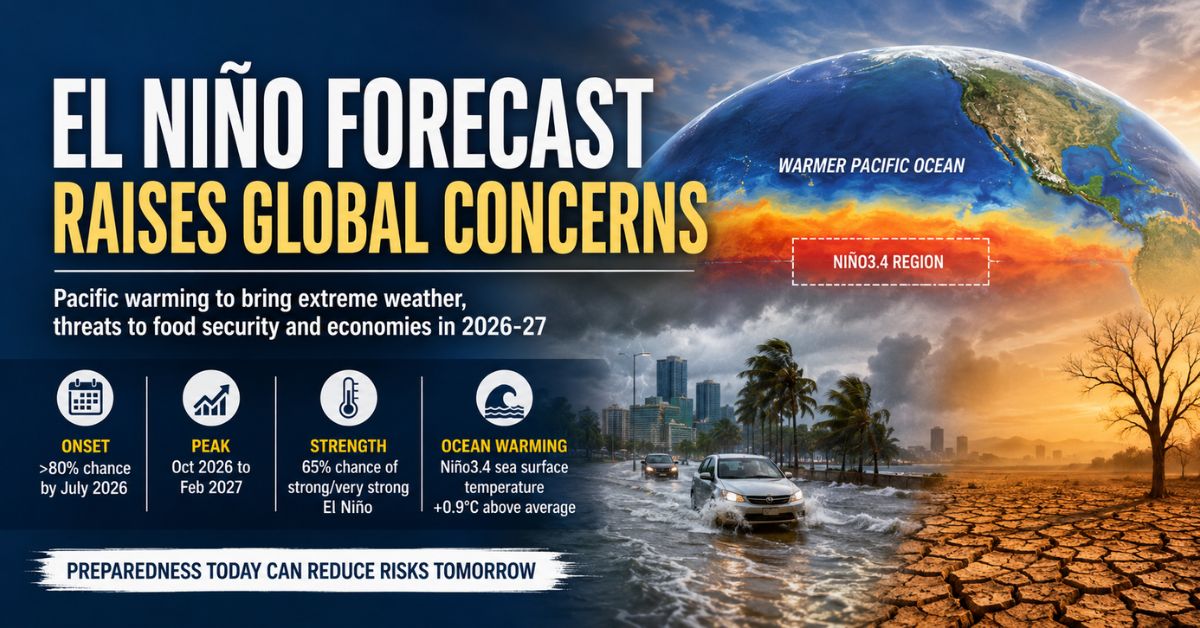
El Niño Forecast 2026
- Climate agencies expect El Niño conditions to develop by July 2026 with high confidence.
- Several forecast models indicate a possible strong or very strong event by late 2026.
- Pacific Ocean temperatures in the Niño3.4 region have already risen sharply.
- Scientists warn of possible impacts on monsoon rainfall, food prices, floods, and droughts.
- India may witness below-normal monsoon rainfall during the 2026 season.
The Pacific Ocean is showing strong signs of a rapidly developing El Niño event, raising concerns among climate scientists that the world could face another period of extreme weather, heat, and agricultural disruption during the second half of 2026 and early 2027.
New forecasts released by the U.S. National Oceanic and Atmospheric Administration (NOAA) and the World Meteorological Organization (WMO) indicate that neutral climate conditions seen earlier this year are fading quickly as sea surface temperatures in the central Pacific continue to rise. Meteorologists now estimate there is more than an 80 percent chance that El Niño conditions will fully develop by July 2026.
Several leading climate models are also warning that the event could become unusually strong by the end of the year. Some experts are even discussing the possibility of a “Super El Niño,” an informal term used when Pacific Ocean temperatures rise more than 2 degrees Celsius above the long-term average.
| Forecast Metric | Current Status |
|---|---|
| Onset Timing | More than 80% chance of development by July 2026 |
| Expected Peak | October 2026 to February 2027 |
| Predicted Strength | 65% probability of strong or very strong event |
| Niño3.4 Ocean Temperature | Around +0.9°C above average |
The warming trend is already visible in the Niño3.4 region of the Pacific Ocean, a key area used to monitor El Niño conditions. Sea surface temperatures there have climbed to around 0.9 degrees Celsius above average, according to recent monitoring data. Scientists say the pace of warming has surprised many forecasters because the ocean heat build-up beneath the surface is significantly stronger than expected.
Climate researchers note that the sub-surface heat content in the Pacific is currently much higher than levels recorded during the early stages of the powerful 2023-24 El Niño event. This deeper heat is important because it can continue feeding warm water toward the surface over the coming months, helping the system strengthen further.
Another major signal has come from the Southern Oscillation Index, commonly known as SOI. The index recently turned sharply negative, showing that the atmosphere is beginning to respond to the warming ocean. Scientists describe this process as “ocean-atmosphere coupling,” which is considered one of the key ingredients for sustaining a major El Niño event.
El Niño is a natural climate pattern that occurs when surface waters in the central and eastern Pacific Ocean become warmer than normal. The warming changes wind patterns and disrupts weather systems across the globe. Depending on its strength, El Niño can influence rainfall, droughts, storms, temperatures, and agricultural production in many countries.
The current forecast suggests the event may peak between October 2026 and February 2027. Climate models currently indicate about a 65 percent chance that the event could become “strong” or “very strong.”
If that happens, global temperatures may climb to record levels once again. Scientists say El Niño years often push average global temperatures higher because heat stored in the Pacific Ocean is released into the atmosphere. The previous major El Niño contributed to some of the warmest months ever recorded worldwide.
Several regions are already preparing for possible climate disruptions linked to the forecast.
In the United States, forecasters expect a higher risk of heavy rainfall and flooding across parts of the southern states later this year. Countries along the western coast of South America, including Peru and Ecuador, may also face increased flooding threats because El Niño often brings unusually warm coastal waters and stronger rainfall to the region.
Meanwhile, northern parts of the United States and Canada could experience a warmer-than-normal winter season. Past El Niño events have often reduced snowfall and increased winter temperatures across these regions.
In Asia and Oceania, the concerns are different. Climate experts warn that countries such as Australia and Indonesia could face higher risks of drought and wildfires as rainfall patterns weaken. Dry conditions during major El Niño periods have historically increased bushfire activity in Australia and lowered water availability across Southeast Asia.
India is also closely monitoring the developing conditions because El Niño has historically been associated with weaker monsoon rainfall. Early projections suggest the 2026 monsoon could remain below normal at around 92 percent of the long-term average.
| Region | Possible Impact |
|---|---|
| India | Below-normal monsoon rainfall and pressure on agriculture |
| Australia | Higher wildfire and drought risk |
| Indonesia | Reduced rainfall and dry conditions |
| Southern United States | Heavy rainfall and flood risk |
| Peru and Ecuador | Flooding linked to warmer coastal waters |
Although a below-normal monsoon does not automatically mean drought, reduced rainfall can create pressure on farming, water storage, and electricity generation in several states. Agriculture remains highly dependent on monsoon rainfall, especially in rural regions where irrigation infrastructure is limited.
Experts say crops such as rice, sugarcane, pulses, and oilseeds could be affected if rainfall distribution becomes uneven during the monsoon season. Reservoir levels and groundwater recharge may also come under stress if rainfall deficits continue over several months.
The global agriculture market is already reacting cautiously to the forecasts. Commodity analysts warn that a strong El Niño could disrupt the production of major crops such as rice, cocoa, sugar, wheat, and palm oil. Countries dependent on stable rainfall patterns may face lower output, while transport and supply chains could also experience disruptions from floods or droughts.
Food prices are another major concern. Previous strong El Niño events have contributed to spikes in global food inflation because lower crop production often reduces supplies while demand remains high. Economists say developing countries may face greater pressure because food costs directly affect household budgets and inflation rates.
Energy markets may also see indirect effects. Hydropower production in some countries could decline if drought conditions reduce water availability, while hotter temperatures may increase electricity demand for cooling.
Scientists, however, continue to caution that long-range forecasting still carries uncertainty.
Meteorologists often face what is known as the “spring predictability barrier,” a period during which climate models become less reliable in predicting the future intensity of El Niño or La Niña events. Forecast accuracy usually improves later in the year as ocean and atmospheric signals become clearer.
Despite that uncertainty, experts say this year’s warning signals appear stronger and more consistent than usual. Many international climate models are showing similar warming trends across the Pacific, increasing confidence that El Niño conditions will emerge in the near term.
Climate agencies are expected to release updated forecasts over the coming weeks as additional ocean temperature data becomes available. Governments and disaster management authorities in several countries are also expected to review preparedness plans for possible floods, droughts, heatwaves, and wildfire risks.
Environmental researchers say the growing influence of climate change may also intensify the impact of natural climate cycles such as El Niño. Rising global temperatures can amplify heat extremes and worsen weather-related disasters when strong El Niño conditions develop.
The combination of long-term climate warming and a powerful El Niño could create challenging conditions for agriculture, water management, public health, and disaster response systems in many parts of the world.
For now, scientists are continuing to closely monitor Pacific Ocean temperatures and atmospheric changes. While the exact strength of the developing event remains uncertain, the current forecasts suggest that the world may soon enter another period of heightened climate instability driven by one of the planet’s most influential weather patterns.