


Key Highlights
- India and the UAE expanded cooperation on strategic petroleum reserves during PM Modi’s Abu Dhabi visit.
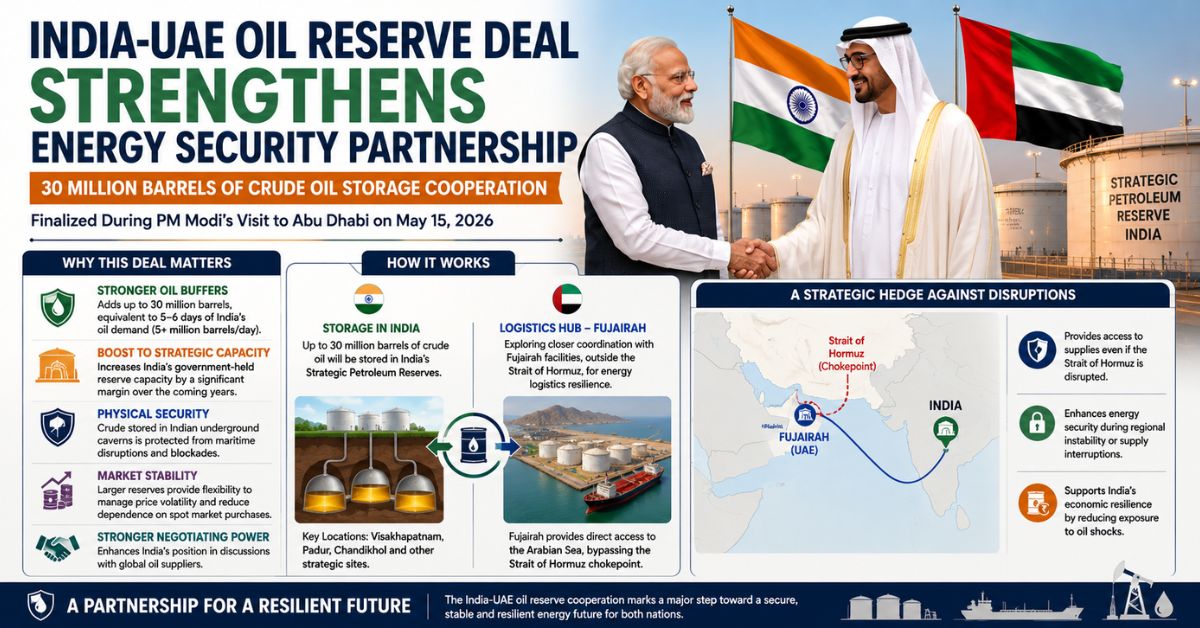
- The agreement could add up to 30 million barrels of crude oil storage capacity linked to India’s SPR system.
- Energy experts say the move may improve India’s protection against future supply disruptions and oil price shocks.
- India’s underground reserve facilities in Visakhapatnam and Padur are expected to play a major role in the expanded partnership.
- The agreement is also being viewed as part of the wider India-Middle East-Europe Economic Corridor (IMEC) strategy.
India and the United Arab Emirates have expanded their energy partnership through a major agreement linked to India’s Strategic Petroleum Reserve system, a move officials and analysts say could strengthen India’s protection against future oil supply disruptions in West Asia.
The agreement, discussed and finalized during Prime Minister Narendra Modi’s visit to Abu Dhabi on May 15, involves the expansion of crude oil storage cooperation between India and the Abu Dhabi National Oil Company, commonly known as ADNOC.
Under the arrangement, the UAE is expected to increase its participation in India’s strategic reserve infrastructure by up to 30 million barrels of crude oil storage capacity. The move represents one of the largest recent developments in India’s long-term energy security planning.
India currently consumes more than 5 million barrels of crude oil per day and remains heavily dependent on imports to meet domestic energy demand. Because of this dependence, disruptions in global shipping routes or sudden geopolitical conflicts in West Asia can directly affect fuel prices, inflation, and industrial activity in India.
India Expands Its Strategic Oil Buffer
Energy experts say expanding strategic petroleum reserves gives governments additional time to respond during emergencies such as supply interruptions, military conflicts, or major price shocks in international oil markets.
India already operates underground strategic storage facilities in locations such as Visakhapatnam and Padur, while additional infrastructure projects are being developed in other regions including Odisha.
These reserves are designed to hold emergency crude oil supplies that can be used during periods of severe market disruption. Analysts say the expanded UAE partnership could significantly strengthen India’s existing reserve capacity over the coming years.
One of the most important aspects of the agreement is that the crude oil would be physically stored within Indian territory rather than remaining on commercial shipping routes. Energy specialists say this reduces vulnerability during maritime disruptions because oil stored in underground caverns is less exposed to shipping delays or regional blockades.
The Strategic Importance of Fujairah
The agreement also highlights the growing strategic role of the UAE in India’s broader energy security planning. Over the past decade, the relationship between the two countries has gradually shifted beyond a traditional buyer-seller arrangement toward deeper cooperation involving infrastructure, logistics, investment, and technology.
Officials and industry observers have also pointed to the importance of the Port of Fujairah in the UAE, which is located outside the Strait of Hormuz.
The Strait of Hormuz remains one of the world’s most important energy chokepoints, with a large share of global oil exports passing through the narrow maritime route each day. Periodic tensions and security concerns in the region have repeatedly raised fears about potential disruptions to energy supplies.
Because Fujairah provides direct access to the Arabian Sea without requiring passage through Hormuz, analysts say the port has become increasingly important for regional energy logistics and supply chain resilience.
While officials have not publicly disclosed the full operational details of future reserve-sharing arrangements, experts believe closer India-UAE coordination on storage and logistics could improve energy security for both countries during periods of instability.
Economic and Market Implications
The reserve agreement also carries broader economic implications. By increasing strategic storage capacity, India may gain greater flexibility in managing short-term price volatility in global crude markets. Governments with larger reserve systems can sometimes delay emergency spot-market purchases during sudden price spikes, helping reduce economic pressure during crises.
Analysts also say stronger reserves improve India’s negotiating position with global oil suppliers because the country becomes less vulnerable to immediate supply disruptions.
The agreement comes at a time when India is expanding efforts to strengthen energy infrastructure as part of its wider economic and industrial growth strategy. Demand for oil and natural gas is expected to rise steadily over the next decade as manufacturing, transportation, aviation, and urban development continue to expand.
Part of the Wider IMEC Vision
The UAE, meanwhile, has increasingly positioned itself as a long-term strategic partner for India not only in energy trade but also in infrastructure investment, logistics, banking, and advanced technology cooperation.
The reserve partnership is also being viewed within the larger framework of the proposed India-Middle East-Europe Economic Corridor, or IMEC, which aims to connect India, the Gulf region, and Europe through integrated transport, logistics, and energy networks.
Policy experts say stable energy flows will remain essential for the success of any large-scale economic corridor linking Asia and Europe. In that context, the India-UAE reserve cooperation is increasingly being seen as part of a broader effort to create more resilient regional supply chains amid continuing geopolitical uncertainty in West Asia.
For India, the agreement strengthens an important layer of national energy preparedness. For the UAE, the partnership deepens its role in one of the world’s fastest-growing major energy markets while expanding long-term strategic ties with New Delhi.