


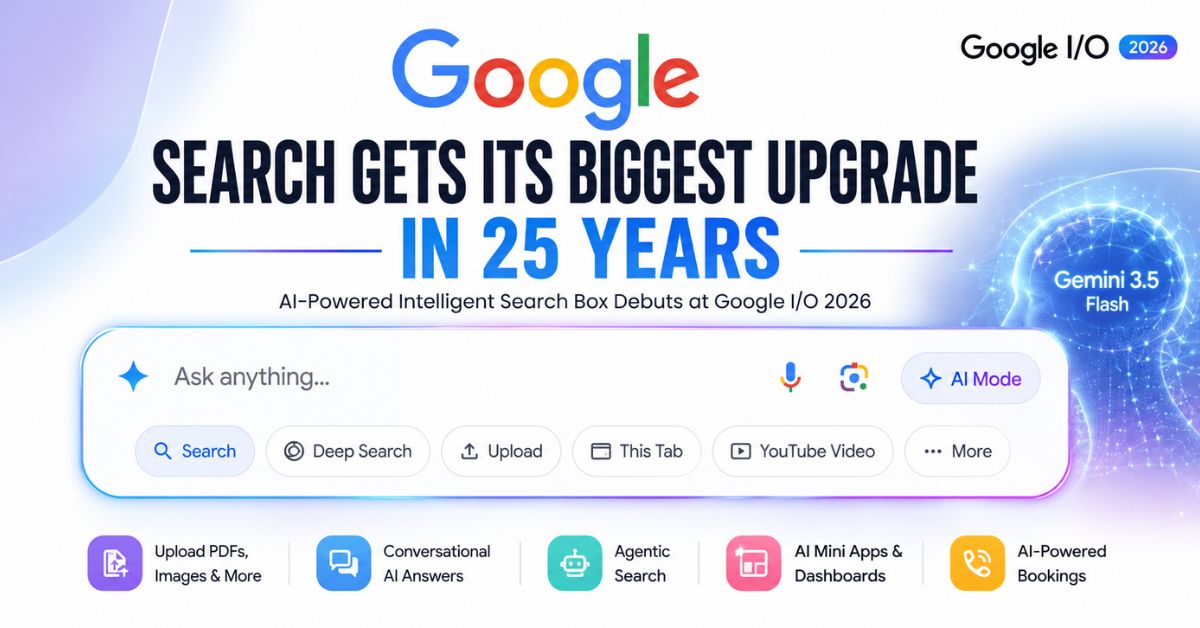
Google Search’s Biggest Shift in 25 Years
- Google unveiled the new “Intelligent Search Box” during Google I/O 2026.
- The redesigned search experience is powered by the Gemini 3.5 Flash AI model.
- Users can now upload PDFs, videos, images, and browser tabs directly into Search.
- Google is introducing agentic AI tools, mini apps, and AI-generated dashboards.
- Several advanced AI features will initially remain exclusive to AI Pro and Ultra subscribers.
For more than two decades, the Google Search box stayed almost untouched. A plain white field with a blinking cursor became one of the most recognizable interfaces on the internet. That changed at Google I/O 2026, where Google officially introduced what it calls the “Intelligent Search Box,” a major redesign powered by the new Gemini 3.5 Flash AI model.
The announcement marks a significant shift in how Google wants people to search online. Instead of typing short keywords and scrolling through blue links, users are now being encouraged to ask detailed questions, upload files, interact with AI-generated dashboards, and continue conversations directly inside Search.
Google described the change as the biggest upgrade to Search in more than 25 years.
What Is the New Google Intelligent Search Box?
The new Intelligent Search Box replaces the older static keyword-based search experience with a conversational AI interface built directly into Google Search.
Unlike the classic search field, the new version expands dynamically as users type longer questions. Google says this is designed to encourage natural language searching instead of short keyword phrases.
For example, instead of searching:
“best waterproof speaker”
users can now type detailed prompts like:
“I need a waterproof Bluetooth speaker for my pool area that supports Alexa and has long battery life.”
The search box now responds more like an AI assistant than a traditional search engine.
This redesign also removes the barrier between standard Search and AI Mode. Users can move from normal search results into AI conversations without opening separate tabs or interfaces.
Gemini 3.5 Flash Powers the Entire Upgrade
At the center of the new experience is Gemini 3.5 Flash, Google’s latest AI model announced during I/O 2026. Google says the model is designed specifically for fast reasoning, long conversations, and agentic workflows.
According to Google, Gemini 3.5 Flash is four times faster than earlier frontier models while also improving coding, reasoning, and real-time responsiveness.
The model now powers AI Mode inside Search globally.
One of the biggest technical changes is something Google calls “query fan-out.” Instead of processing one search request at a time, the AI breaks a complicated query into multiple smaller searches simultaneously. This allows the system to compare information from several sources before generating an answer.
Google says this approach improves depth and context for complex searches.
The AI can also maintain long conversational sessions. Users no longer need to repeat context every time they ask a follow-up question.
Multimodal Search Is Now Built Into Google Search
Perhaps the most dramatic change is that the Google Search box is no longer limited to text.
The new interface supports multimodal input, allowing users to drag and drop images, PDFs, spreadsheets, videos, and even active Chrome tabs directly into Search.
Google demonstrated several use cases during the keynote:
- Uploading a lease agreement PDF and asking the AI to summarize late fee policies
- Recording a short video clip of a broken appliance and asking Search to diagnose the issue
- Comparing information across multiple browser tabs
- Asking Search to analyze spreadsheets or documents
This effectively turns Search into a research assistant instead of only a discovery tool.
The system also introduces “AI Suggestions,” which go beyond normal autocomplete. Rather than simply predicting the next word, Search now helps users structure better and more detailed questions.
Google Is Turning Search Into an Agentic Platform
The bigger story from Google I/O 2026 may not be the search box itself, but the broader transition toward what Google repeatedly called “agentic AI.”
Google announced that Search will soon include background AI agents capable of continuously monitoring the web on behalf of users.
These “Information Agents” are expected to launch in Summer 2026 for Google AI Pro and Ultra subscribers.
Users will be able to provide detailed instructions once, after which the agent keeps scanning the internet automatically.
Google used apartment hunting as one example. A user could specify:
- Budget
- Neighborhood preferences
- Floor requirements
- Pet policies
- Transit access
The AI agent would then continuously monitor listings, blogs, and websites before notifying the user when matching properties appear.
This represents a major change in how search works. Instead of users repeatedly searching every day, Google wants AI agents to perform ongoing tasks automatically.
Generative UI and Mini Apps Are Coming to Search
Another major announcement from Google I/O 2026 was the introduction of Generative UI, sometimes shortened to GenUI.
Instead of returning static pages filled with text links, Search can now dynamically generate interactive interfaces tailored to the query.
Google says these AI-generated interfaces can include:
- Interactive dashboards
- Simulations
- Charts
- Tables
- Progress trackers
- Visual explainers
For example, if someone searches for financial trends or astrophysics concepts, Search may generate interactive visualizations instead of plain text summaries.
Google also introduced the idea of “Mini Apps.”
These are persistent AI-powered workspaces created automatically inside Search for long-term projects such as:
- Wedding planning
- Moving homes
- Fitness tracking
- Shopping research
- Study preparation
Rather than opening multiple apps and bookmarks, Google wants users to manage projects directly inside Search results.
Reports from the event suggest this system is powered partly by Google’s internal “Antigravity” framework for dynamic interface generation.
Shopping and Booking Features Expand Beyond Search Results
Google also announced several commerce-focused AI tools connected to the new Search experience.
The new Universal Cart allows users to combine products from multiple retailers into a single AI-assisted shopping flow.
Search can now also integrate product reviews from YouTube and compare recommendations automatically.
In another notable update, Google confirmed that upgraded Duplex technology will allow Search to place calls to local businesses on behalf of users for tasks like:
- Booking appointments
- Scheduling repairs
- Checking availability
- Arranging pet care
This pushes Google Search closer to becoming a task-execution platform rather than just an information tool.
Personal Intelligence and Privacy Features
Google is also expanding what it calls “Personal Intelligence.”
Users can optionally allow Search to access personal Google services such as Gmail, Calendar, and Photos for more personalized responses.
Examples shown by Google include:
- Finding recipes from old emails
- Creating shopping lists automatically
- Building travel itineraries from calendar events
- Surfacing information from photos and documents
Google says these systems operate with privacy protections and opt-in controls.
The company also confirmed wider use of SynthID watermarking technology for AI-generated content.
SynthID embeds invisible identifiers into AI-generated images and media to help users identify synthetic content online.
Which Features Are Free and Which Require Subscription?
Google confirmed that the core Intelligent Search Box and Gemini 3.5 Flash AI Mode are rolling out globally to all users.
However, several advanced agentic features will remain tied to premium AI subscriptions.
| Feature | Availability |
|---|---|
| Intelligent Search Box | Global rollout for all users |
| Gemini 3.5 Flash AI Mode | Available globally |
| Generative UI | Expected Summer 2026 |
| Information Agents | Google AI Pro and Ultra only |
| Mini App Builder | Initially US-only for premium users |
Google has not yet confirmed full international availability timelines for every feature.
Why This Upgrade Matters for the Future of Search
The Intelligent Search Box is more than a visual redesign. It signals Google’s transition away from traditional keyword search toward AI-assisted task completion.
For years, Google Search worked mainly as a discovery engine. Users entered keywords, visited websites, and gathered information manually.
The new system attempts to collapse those steps into one conversational interface powered by AI.
This shift also raises broader questions for publishers, SEO professionals, and websites that rely heavily on Google traffic.
Recent academic research has already shown that AI-generated search summaries can significantly change how users interact with websites and search results.
As AI answers become more detailed and persistent, publishers may see changes in click-through rates, traffic patterns, and visibility.
At the same time, Google appears determined to position Search as the central interface for AI-powered productivity, shopping, research, and personal organization.
The search box that once handled simple keywords is now evolving into a multimodal AI operating layer connected to documents, videos, browser tabs, apps, and personal data.
That transformation may ultimately become one of the most important shifts in Google Search history.