


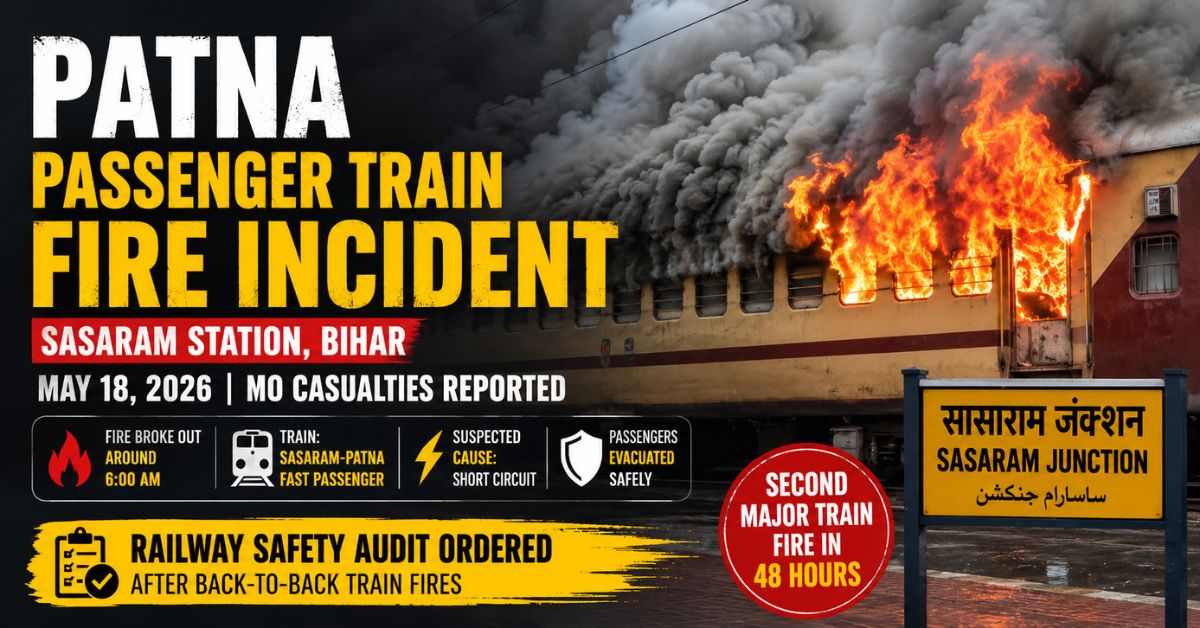
Patna Passenger Train Fire Incident Highlights
- A major fire broke out on the Sasaram-Patna Fast Passenger train at Sasaram Junction on May 18, 2026.
- No casualties or injuries were reported after passengers were evacuated safely.
- Railway officials suspect a short circuit as the preliminary cause of the blaze.
- The incident happened one day after another serious fire on the Rajdhani Express near Ratlam.
- Railway authorities are now facing renewed questions over passenger train fire safety systems.
A major fire broke out on the Sasaram-Patna Fast Passenger train at Bihar’s Sasaram Junction on Monday morning, May 18, 2026, creating panic among passengers and raising fresh concerns over railway fire safety across India. The incident happened at around 6:00 AM while the train was standing at platform number 6 before its scheduled departure for Patna.
Railway officials confirmed that no casualties or injuries were reported. Affected passengers were evacuated safely after thick smoke and flames engulfed one of the coaches. The fire was later brought under control by railway staff, the Railway Protection Force (RPF), and local fire brigade teams.
The incident has quickly become one of the most discussed railway emergencies in Bihar because it came just one day after another serious train fire involving the Thiruvananthapuram-Hazrat Nizamuddin Rajdhani Express near Ratlam in Madhya Pradesh. Railway authorities are now facing pressure to explain whether deeper technical or maintenance failures are developing across the network.
How the Sasaram-Patna Train Fire Started
According to preliminary information shared by railway officials and local reports, the fire began inside one of the coaches of the Sasaram-Patna Fast Passenger train while it was stationary at Sasaram railway station in Rohtas district.
Initial investigations suggest that a short circuit may have caused the blaze. Railway Protection Force Inspector Sanjeev Kumar stated that officials are investigating the exact source of the fire and assessing the damage caused to the coach.
Several eyewitnesses reported seeing smoke first emerging from the coach before flames spread rapidly. Videos from the station showed thick black smoke rising above the platform area while railway personnel tried to isolate the affected compartment. Some reports also stated that nearby trees close to the railway tracks briefly caught fire due to the heat and sparks coming from the burning coach.
The affected coach was eventually detached from the rest of the train to stop the fire from spreading further.
Panic at Sasaram Junction
Although no lives were lost, the incident caused major panic at Sasaram Junction during the early morning hours. Witnesses described scenes of confusion as passengers rushed out of nearby coaches and moved away from the platform after seeing flames rising from the train.
Local Hindi media reports said many passengers left behind bags and belongings while escaping from the train area. Some passengers reportedly refused to continue their journey even after the fire was controlled.
The timing of the incident may have prevented a much larger tragedy. The train was scheduled to depart around 6:45 AM, and officials indicated that the affected coach was relatively empty when the fire started. Railway sources believe the situation could have become far more dangerous if the blaze had erupted during peak boarding time, especially in a crowded general compartment.
This detail has become an important part of the ongoing discussion around the Patna passenger train fire incident because Bihar’s passenger trains are frequently overcrowded during morning travel hours.
Questions Over Railway Emergency Preparedness
While railway officials have focused on the suspected short circuit angle, local allegations about emergency preparedness have started attracting attention.
Some eyewitnesses and residents claimed that fire safety systems at the station were either delayed or ineffective during the initial phase of the blaze. According to local accounts circulating after the incident, there were allegations that some platform fire extinguishers were not functioning properly and water pressure from emergency hydrants was inadequate.
These claims have not yet been officially confirmed by Indian Railways or the Bihar administration. However, they are likely to become part of the broader investigation into the incident.
Railway authorities have not publicly acknowledged reports regarding empty hydrants or non-functional extinguishers as of Monday afternoon. Current official statements remain focused on the short circuit theory and the successful evacuation effort.
The absence of confirmed injuries has prevented the situation from turning into a national disaster, but the allegations are already fueling debate on social media over railway maintenance standards and station-level safety readiness.
Second Major Train Fire in Two Days
One of the biggest reasons the Sasaram fire has gained national attention is its timing.
Just a day earlier, on May 17, a fire broke out on the Thiruvananthapuram-Hazrat Nizamuddin Rajdhani Express near Ratlam in Madhya Pradesh. According to railway officials, two coaches were damaged in that incident, though passengers were evacuated safely.
The back-to-back train fire incidents have triggered concern inside the railway system. Reports indicate that railway authorities have now ordered high-level safety reviews and technical investigations involving senior railway departments.
According to reports linked to the Rajdhani fire investigation, officials from the Integral Coach Factory (ICF) and the Research Designs and Standards Organisation (RDSO) are involved in examining possible technical failures.
While there is no official confirmation yet that the Sasaram incident is directly connected to the Rajdhani Express fire, railway experts are expected to study whether wiring systems, electrical maintenance standards, or coach materials could be contributing factors.
Impact on Rail Operations in Bihar
The incident briefly disrupted operations on the Sasaram-Ara-Patna rail section. Railway officials temporarily shut down overhead electrical supply in the affected area to allow firefighters to work safely.
Some train services experienced delays after the incident, though major route cancellations were not immediately announced. The damaged coach was separated from the train before the remaining rake was eventually cleared for onward movement.
The Sasaram-Patna route is important for daily commuters, students, and office workers traveling toward Patna from Rohtas district and nearby regions. Any disruption on this route tends to affect a large number of passengers across central Bihar.
The fire has also renewed focus on the condition of passenger trains operating in eastern India, where overcrowding and aging railway infrastructure remain major concerns.
Historical Railway Fire Incidents Near Patna
The latest Sasaram fire is not the first railway fire linked to Bihar or Patna-bound trains in recent years.
In May 2025, smoke and panic were reported after a fire broke out in the battery panel area of the Patna Azimabad Express near Phulwari station. No casualties occurred in that case.
In June 2024, multiple coaches of a Patna-Jharkhand passenger train caught fire in Bihar’s Lakhisarai district.
One of the deadliest railway fire tragedies in Bihar’s history occurred in April 1990 near Patna, when the Mokama-Danapur Passenger train caught fire after a gas cylinder leak. Dozens of passengers lost their lives in that disaster.
These incidents continue to shape public concern around fire safety standards on Indian passenger trains.
Investigation Continues After Sasaram Train Fire
Railway officials are expected to conduct a detailed technical investigation into the Sasaram-Patna passenger train fire over the coming days. Authorities will likely examine electrical wiring, coach maintenance records, and emergency response systems at Sasaram Junction.
For now, officials maintain that the quick evacuation and the relatively empty condition of the coach helped prevent a catastrophic loss of life.
The Patna passenger train fire incident has once again highlighted the fragile balance between India’s massive rail operations and passenger safety. With two major train fires occurring within 48 hours, pressure is now mounting on Indian Railways to demonstrate whether existing safety systems are sufficient for one of the world’s busiest rail networks.