


Key Highlights
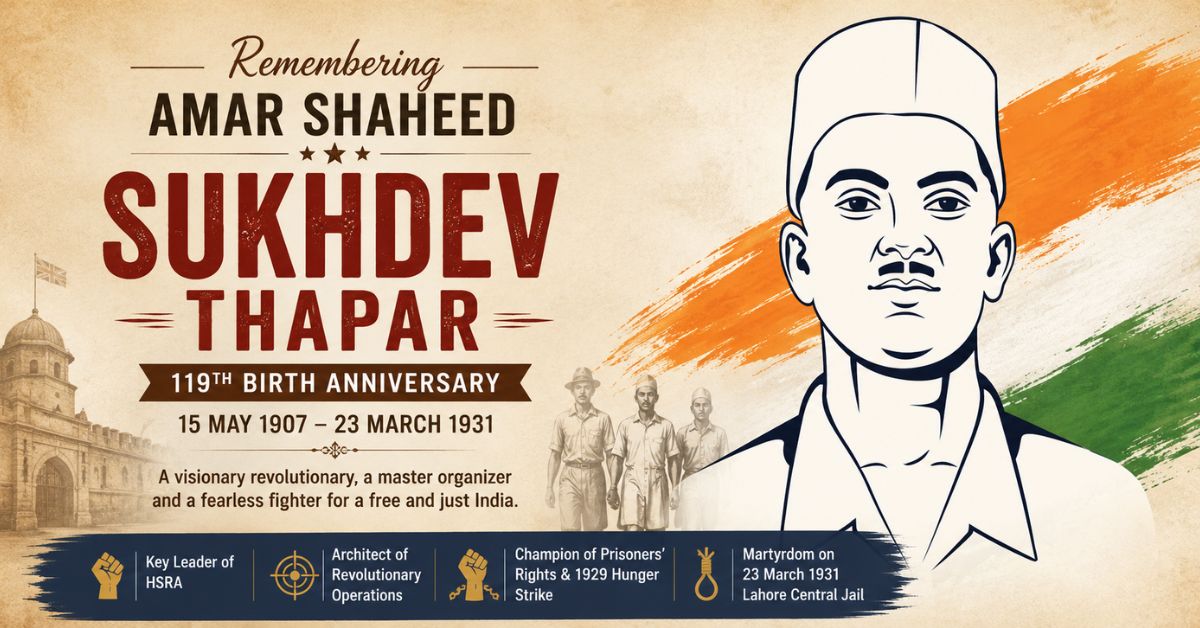
- Sukhdev Thapar’s 119th birth anniversary is being observed on May 15, 2026, across India.
- He was a senior member and chief organizer of the Hindustan Socialist Republican Association (HSRA).
- Sukhdev played a major role in the Lahore Conspiracy Case linked to the assassination of British officer John Saunders.
- He participated in the historic 1929 prison hunger strike demanding political rights for Indian prisoners.
- He was executed alongside Bhagat Singh and Rajguru on March 23, 1931, becoming one of India’s most remembered revolutionary martyrs.
India is observing the 119th birth anniversary of Sukhdev Thapar on May 15, 2026, remembering one of the most influential yet often understated revolutionaries of the Indian independence movement. While the names of Bhagat Singh and Rajguru became symbols of armed resistance against British colonial rule, historians and official records show that Sukhdev was one of the chief organizers and ideological forces behind the revolutionary network operating in northern India.
Born in Ludhiana in 1907, Sukhdev Thapar became a leading member of the Hindustan Socialist Republican Association, commonly known as HSRA. He played a major role in recruiting young revolutionaries, establishing underground networks, organizing political study circles, and shaping the ideological direction of the movement during a crucial phase of India’s struggle against British rule.
More than nine decades after his execution in Lahore Central Jail, Sukhdev continues to be remembered as “Amar Shaheed Sukhdev Thapar,” a title that reflects his enduring place in India’s national memory.
Who Was Sukhdev Thapar?
Sukhdev Thapar was born on May 15, 1907, in the Naughara locality of Ludhiana in Punjab, then part of British India. His father, Ramlal Thapar, died when Sukhdev was very young, after which he was raised by his uncle Lala Achintram. Multiple historical accounts confirm that Achintram’s nationalist influence deeply shaped Sukhdev’s political thinking during his formative years.
He later studied at National College in Lahore, an institution established by Lala Lajpat Rai as an alternative to British-controlled educational institutions. It was here that Sukhdev came into close contact with revolutionary ideas and future comrades such as Bhagat Singh.
Unlike many freedom fighters who worked within constitutional politics, Sukhdev believed British colonialism could not be removed without direct revolutionary action. Historical references indicate he was deeply influenced by the Russian Revolution and socialist literature, particularly Marxist and Leninist political thought.
The Organizational Brain of the HSRA
Although Bhagat Singh became the most publicly recognized face of the revolutionary movement, researchers and British police records from the Lahore Conspiracy Case consistently described Sukhdev as one of the principal organizers of the HSRA in Punjab.
He reportedly created secret study circles where young recruits discussed revolution, socialism, anti-imperialism, and global political movements. His role extended beyond ideology. He was involved in recruitment, communication systems, operational planning, and coordination among underground revolutionary cells across northern India.
British authorities viewed him as highly dangerous because of his ability to organize disciplined revolutionary networks. In official records related to the Lahore Conspiracy Case, Sukhdev was listed as “Accused Number 1,” indicating the seriousness with which colonial authorities viewed his role.
Historians also note that Sukhdev strongly believed in the idea of a “professional revolutionary,” a concept associated with Vladimir Lenin. According to this approach, revolutionaries needed complete dedication, intellectual preparation, secrecy, and lifelong commitment to political struggle.
The Saunders Assassination and Lahore Conspiracy Case
One of the defining events associated with Sukhdev Thapar was the killing of British police officer John Saunders in Lahore on December 17, 1928.
The action came after the death of Lala Lajpat Rai, who suffered fatal injuries during a police lathi charge while protesting against the Simon Commission. Revolutionaries within the HSRA had originally intended to target British police officer James A. Scott, whom they held responsible for the assault on Rai. However, Saunders was mistakenly identified and shot instead.
Sukhdev, Bhagat Singh, and Shivaram Rajguru were all linked to the operation. The British government later used the incident, along with the Central Legislative Assembly bombing case, to build what became known as the Lahore Conspiracy Case.
The trial became one of the most politically charged legal proceedings in colonial India. British authorities used special tribunals, strict prison controls, and emergency legal powers to prosecute the revolutionaries.
Historical records also show that Hans Raj Vohra, a former associate of the revolutionaries, became an approver for the British prosecution. His testimony significantly damaged the defense case against Bhagat Singh, Rajguru, and Sukhdev.
Prison Hunger Strike and Political Resistance
After his arrest, Sukhdev participated in the famous 1929 hunger strike carried out by revolutionary prisoners.
The prisoners protested discriminatory treatment inside British jails, where Indian political prisoners were reportedly denied the same facilities given to European inmates. Their demands included access to books, newspapers, better food, clean clothing, and recognition as political prisoners rather than ordinary criminals.
The hunger strike gained widespread public attention across India and transformed the imprisoned revolutionaries into national symbols of resistance. It also increased public sympathy for Bhagat Singh, Sukhdev, and their associates.
Sukhdev’s Letter to Mahatma Gandhi
One of the lesser-discussed but historically important aspects of Sukhdev Thapar’s life was his letter to Mahatma Gandhi shortly before his execution.
In the letter, Sukhdev questioned Gandhi’s political approach toward revolutionaries and criticized attempts to portray armed resistance as irrational violence. He argued that the revolutionaries were fighting for a socialist and exploitation-free India, not merely political independence from British rule.
The letter reflected the ideological divide that existed within India’s freedom movement during the late 1920s and early 1930s. While Gandhi advocated non-violence and civil disobedience, revolutionaries such as Sukhdev believed colonial violence required a more militant response.
Modern historians increasingly view these debates as central to understanding the complexity of India’s independence struggle.
The Execution on March 23, 1931
Sukhdev Thapar, Bhagat Singh, and Rajguru were sentenced to death in the Lahore Conspiracy Case.
Although the execution was officially scheduled for March 24, 1931, records indicate the British administration advanced the hanging and carried it out on the evening of March 23 inside Lahore Central Jail.
The executions triggered anger and mourning across India. Demonstrations, protests, and public gatherings were held in several cities. Their deaths transformed the three young revolutionaries into enduring national icons.
To avoid public unrest, British authorities secretly removed their bodies from the jail and reportedly cremated them near the Sutlej River at Hussainiwala under heavy security during the night.
Today, the Hussainiwala National Martyrs Memorial in Punjab stands at the site associated with their cremation and remains one of the most significant memorials connected to India’s revolutionary freedom fighters.
Why March 23 Is Observed as Shaheed Diwas
Every year, India observes Shaheed Diwas on March 23 to honor the martyrdom of Bhagat Singh, Rajguru, and Sukhdev. Government institutions, schools, universities, and political leaders pay tribute to the revolutionaries on the day.
The observance is particularly significant because it recognizes a stream of the freedom movement that emphasized revolutionary sacrifice and anti-colonial militancy.
Recent scholarly discussions have also highlighted that these revolutionaries envisioned not only freedom from British rule but also a more equal and socially just society.
Legacy of Amar Shaheed Sukhdev Thapar
The legacy of Sukhdev Thapar continues across India through memorials, institutions, and public commemorations.
Shaheed Sukhdev College of Business Studies, one of Delhi University’s prominent institutions, is named after him. In Ludhiana, the main interstate bus terminal also carries his name as the Amar Shaheed Sukhdev Thapar Inter-State Bus Terminal.
His birthplace in Ludhiana has been preserved as a memorial site, and his story continues to be taught in Indian history and political studies.
More importantly, historians increasingly describe Sukhdev not simply as a companion of Bhagat Singh, but as a disciplined organizer, ideological thinker, and strategist who played a major role in shaping revolutionary politics in colonial India.
On his 119th birth anniversary, tributes across India are once again bringing attention to a revolutionary whose contribution extended far beyond slogans and symbolism. His life represented a combination of intellectual conviction, political discipline, and personal sacrifice that left a permanent mark on India’s freedom struggle.