


Key Highlights
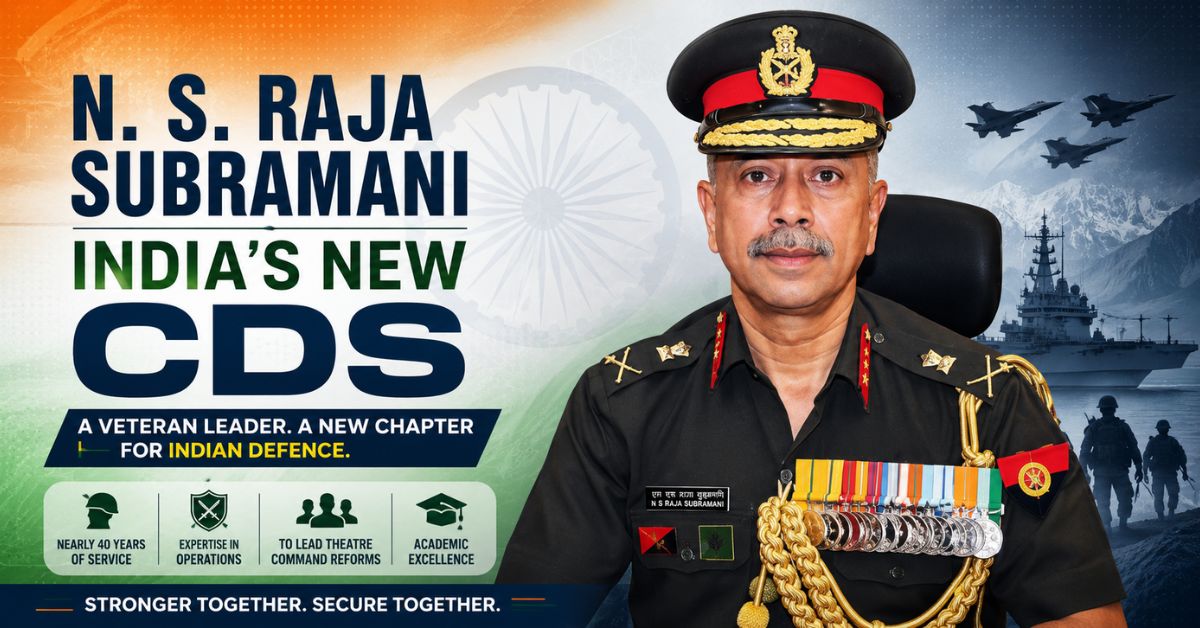
- Lieutenant General N. S. Raja Subramani (Retd.) has been appointed as India’s next Chief of Defence Staff and will take charge on May 31, 2026.
- He previously served as the 47th Vice Chief of the Army Staff and later as Military Adviser in the National Security Council Secretariat.
- Lt Gen Subramani has nearly four decades of military experience, including leadership roles in Central Command, Kharga Corps, and counter-insurgency operations.
- As CDS, he is expected to lead India’s military theatre command reforms and strengthen coordination between the Army, Navy, and Air Force.
- He is also known for his academic background, with degrees from King’s College London, Madras University, and military institutions in India and the UK.
Lieutenant General N. S. Raja Subramani (Retd.) has been appointed as India’s next Chief of Defence Staff (CDS), becoming the third officer to hold the country’s highest military post since the position was created in 2019. He will officially take charge on May 31, 2026, succeeding General Anil Chauhan after the completion of his tenure.
The appointment places Lt Gen Subramani at the center of one of the Indian military’s biggest structural reforms in decades. As CDS, he will oversee joint planning between the Army, Navy, and Air Force, while also serving as Secretary of the Department of Military Affairs under the Ministry of Defence. His selection is being viewed as a continuation of India’s long-term push toward integrated theatre commands, defence modernization, and greater operational coordination among the armed forces.
The government’s decision has drawn attention not only because of the strategic importance of the post, but also because of Lt Gen Subramani’s reputation inside the Army as a field commander with deep operational experience and strong academic credentials.
N. S. Raja Subramani’s Military Career Spans Nearly Four Decades
Lt Gen N. S. Raja Subramani was commissioned into the 8th Battalion of the Garhwal Rifles in December 1985. Over nearly forty years in uniform, he served in some of the Indian Army’s most sensitive operational environments, including border deployments, mountain formations, and counter-insurgency operations in the Northeast and Jammu and Kashmir.
Throughout his career, he held several key command and staff appointments that shaped his rise through the military hierarchy. Among his most notable assignments was command of the Kharga Corps, also known as II Corps, one of the Indian Army’s major strike formations. He later became the General Officer Commanding-in-Chief of the Central Command, which oversees strategic military areas across northern and central India.
Before retiring from active service in July 2025, he served as the 47th Vice Chief of the Army Staff. That role made him one of the senior-most officers in the Indian Army and involved responsibility for force planning, operational preparedness, procurement coordination, and administrative reforms.
After retirement, he was appointed Military Adviser at the National Security Council Secretariat in September 2025, where he worked on strategic and security matters linked to India’s national defence planning.
His return to active military leadership as CDS marks an unusual but important transition, reflecting the government’s confidence in his strategic experience and institutional knowledge.
Why the CDS Position Matters in India
The role of Chief of Defence Staff was created after years of debate on military reforms following the Kargil conflict and recommendations made by national security review committees. The office was designed to improve coordination between the three armed services and reduce duplication in planning and procurement.
The CDS serves as the principal military adviser to the Defence Minister on tri-service matters. Unlike the individual chiefs of the Army, Navy, and Air Force, the CDS is expected to focus on jointness and long-term strategic integration across all branches of the military.
The first CDS of India was General Bipin Rawat, who died in a helicopter crash in 2021 while still in office. General Anil Chauhan later became the second CDS in 2022. Lt Gen Raja Subramani will now become the third officer to occupy the position.
One of the most important tasks before the new CDS will be the implementation of integrated theatre commands. The reform aims to reorganize the Army, Navy, and Air Force into unified operational commands that can respond faster during conflict situations. Military planners believe the system will improve coordination, reduce overlapping structures, and strengthen India’s preparedness along both western and northern borders.
Focus on China and Pakistan Expected Under His Leadership
Several reports following his appointment described Lt Gen Subramani as an officer with extensive expertise on both China and Pakistan. His operational experience includes postings connected to northern border management and strategic military planning.
India’s defence establishment currently faces simultaneous security challenges across multiple fronts. Tensions along the Line of Actual Control with China continue to shape military deployment priorities, while cross-border security concerns with Pakistan remain central to India’s defence posture.
Military analysts believe that the new CDS will play a major role in balancing force modernization with immediate operational readiness. Issues such as indigenous defence production, joint logistics, cyber capability, drone warfare, and rapid mobilization are expected to remain high on the agenda under his tenure.
His earlier work connected to defence procurement and “Make in India” initiatives has also been noted in reports covering his appointment.
Educational Background Sets Him Apart
Within military circles, Lt Gen Raja Subramani is often regarded as one of the more academically accomplished senior officers of his generation.
He is an alumnus of the National Defence Academy and the Indian Military Academy, the two premier training institutions for Indian military officers. He later attended the Joint Services Command and Staff College in the United Kingdom and the National Defence College in New Delhi.
His academic qualifications include a Master of Arts degree from King’s College London and an M.Phil in Defence Studies from University of Madras.
This combination of operational experience and academic training is considered important for the CDS role, which increasingly requires long-term strategic planning, diplomatic coordination, and understanding of modern military technology alongside conventional command experience.
Decorations and Service Honors
Lt Gen Raja Subramani has received several of India’s highest military service awards over the course of his career.
His decorations include the Param Vishisht Seva Medal (PVSM), Ati Vishisht Seva Medal (AVSM), Sena Medal (SM), and Vishisht Seva Medal (VSM). These awards are given for distinguished service, exceptional leadership, and operational contributions in the armed forces.
The recognition reflects both his field command experience and his contributions at senior leadership levels within the Army.
What His Appointment Means for India’s Defence Structure
The appointment of Lt Gen Raja Subramani comes at a time when India is attempting to accelerate defence reforms while dealing with a rapidly changing regional security environment.
The government has been pushing for deeper military integration, greater use of indigenous defence equipment, and faster decision-making during joint operations. The CDS office sits at the center of all these efforts.
His experience in operational commands, national security structures, and military administration gives him a broad profile that fits the current direction of India’s defence planning. Officials and defence observers expect continuity in ongoing reforms rather than major policy disruptions.
At the same time, the success of theatre command restructuring will depend heavily on coordination between the services, political backing, and institutional consensus. That process has moved gradually over the last few years, and the new CDS will likely face the difficult task of balancing reform speed with military practicality.
For many people searching online about “NS Raja Subramani CDS,” the main question is why his appointment matters beyond a routine military transition. The answer lies in the expanding role of the CDS itself. The office is no longer seen only as a senior advisory post. It has become central to how India plans future wars, coordinates military resources, and responds to emerging security challenges.
Lt Gen N. S. Raja Subramani now steps into that responsibility at a critical moment for India’s armed forces.