


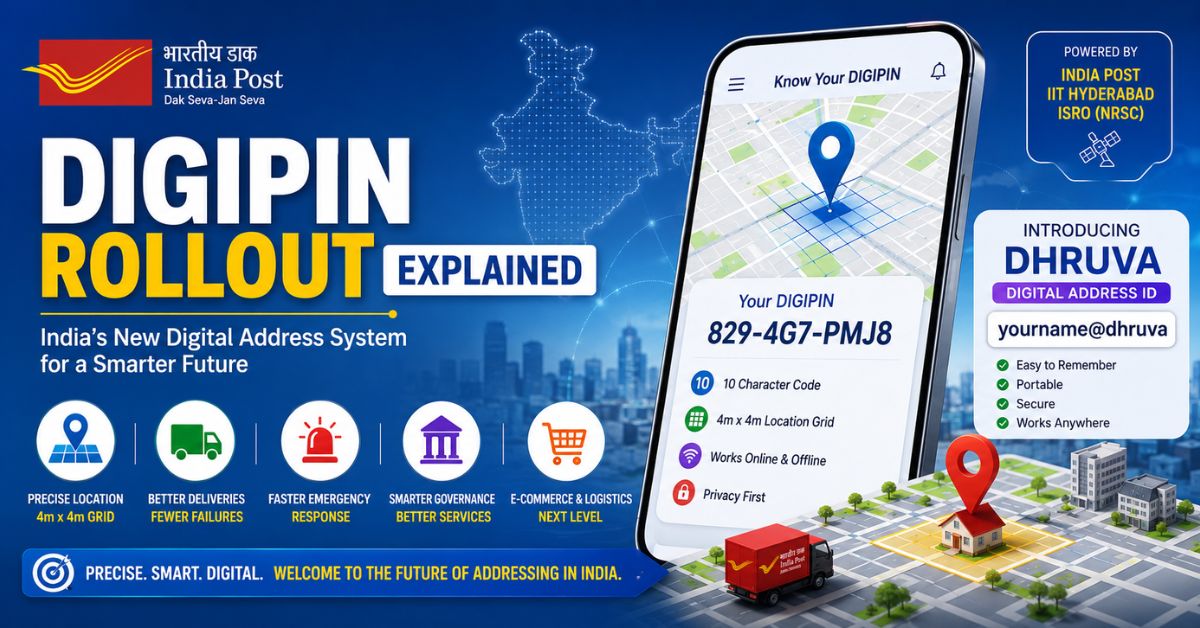
DIGIPIN Rollout Highlights
- India Post’s DIGIPIN system assigns a unique 10-character code to every 4m x 4m location grid across India.
- The digital addressing system is being integrated into e-commerce, emergency services, urban planning, and government operations.
- DHRUVA digital IDs now allow users to receive parcels using virtual address handles instead of full written addresses.
- Major logistics and e-commerce companies are testing DIGIPIN to reduce failed deliveries and improve last-mile navigation.
- India Post aims to make digital location identifiers a nationwide standard alongside traditional PIN codes by 2027.
India is slowly moving toward a future where finding an exact address may no longer depend on landmarks, handwritten directions, or confusing street names. The rollout of DIGIPIN by India Post is now becoming one of the country’s most important digital infrastructure projects, especially for logistics, emergency response, e-commerce, and government services.
The system, officially called Digital Postal Index Number or DIGIPIN, is designed to work alongside the traditional six-digit PIN code system. But unlike regular PIN codes that identify a broad geographic area, DIGIPIN can pinpoint an exact location within a tiny 4-meter by 4-meter grid anywhere in India.
The project was initially introduced in 2025 through pilot programs. By May 2026, the rollout has entered a wider implementation phase, with government agencies, logistics companies, and technology platforms beginning to integrate the system into real-world operations.
What Is DIGIPIN and Why India Post Created It
For decades, India’s postal system has relied on PIN codes introduced in 1972. While the system remains effective for mail sorting, it often struggles in modern use cases where exact coordinates matter.
A single PIN code can cover a large region that may stretch across villages, apartment blocks, industrial areas, or multiple neighborhoods. Delivery agents frequently depend on landmarks or phone calls to locate homes and offices.
DIGIPIN attempts to solve this problem by assigning a unique alphanumeric code to every small grid across the country.
Instead of representing administrative zones, the code is generated using geospatial coordinates based on latitude and longitude. The technology was developed through collaboration between India Post, IIT Hyderabad, and ISRO’s National Remote Sensing Centre.
Under the system, the entire country is divided into micro-grids measuring 4 meters by 4 meters. Every grid receives a unique 10-character code.
That means even two adjacent buildings can have separate DIGIPIN identifiers.
How DIGIPIN Works in Real Life
The process is designed to remain simple for users despite the technical system running behind it.
People can generate their DIGIPIN through the official India Post portal using GPS access on their smartphones. Once location access is granted, the portal identifies the exact grid position and displays the corresponding code.
The code can then be shared for deliveries, navigation, or service requests.
Unlike standard addresses, the code remains highly precise. A traditional address may require multiple directions such as “near temple,” “behind market,” or “third lane after signal.” DIGIPIN removes much of that confusion.
This precision is particularly important in areas where streets are unnamed, buildings are unnumbered, or local landmarks change frequently.
DIGIPIN vs Traditional PIN Code
| Feature | Traditional PIN Code | DIGIPIN |
|---|---|---|
| Format | 6-digit numeric code | 10-character alphanumeric code |
| Coverage Area | Large regional zones | 4m x 4m grid |
| Main Purpose | Mail sorting | Precise location identification |
| System Type | Administrative mapping | Geospatial coordinates |
| Accuracy | Broad area | Exact location |
Traditional PIN codes will continue to operate normally for postal sorting and administrative use. DIGIPIN is being introduced as an additional digital layer rather than a replacement.
India Post officials have repeatedly indicated that both systems will coexist for the foreseeable future.
DHRUVA Digital IDs Add Another Layer to the System
One of the most important developments in the DIGIPIN rollout is the introduction of DHRUVA, short for Digital Hub for Reference and Unique Virtual Address.
While DIGIPIN identifies a physical location, DHRUVA acts more like a personal digital identity linked to that location.
The concept is similar to how UPI simplified banking transactions. Instead of sharing long account numbers, users share simple handles like name@bank.
Under DHRUVA, people can create digital address handles such as yourname@dhruva.
This allows parcels and communications to reach users without needing long written addresses.
A recent pilot completed across five states demonstrated the system’s potential. During the trial, a Speed Post shipment was reportedly delivered from Delhi to Puducherry using only the recipient’s name and DHRUVA digital ID, without a conventional address written on the package.
Another important feature is portability. If a person changes residence, the DHRUVA ID remains the same. Only the linked DIGIPIN location needs to be updated.
This could eventually create a persistent national digital address system that moves with the user.
E-commerce Companies Begin DIGIPIN Integration
India’s e-commerce industry is one of the biggest reasons DIGIPIN is receiving attention beyond postal services.
Online retailers and logistics firms lose substantial money each year due to failed deliveries and Return-to-Origin shipments caused by incomplete or inaccurate addresses.
In crowded urban regions, delivery workers often spend extra time calling customers for directions. In rural regions, vague addresses can delay shipments by days.
Major logistics and e-commerce companies are now testing or integrating DIGIPIN fields into their checkout systems.
Companies including Amazon, Flipkart, and Delhivery are exploring how the technology can reduce failed deliveries and improve last-mile efficiency.
For businesses, even a small reduction in delivery failures can save massive operational costs.
For customers, the system may reduce delays, missed deliveries, and address verification calls.
The impact may be especially important in rapidly growing towns where infrastructure develops faster than official addressing systems.
Emergency Services Could Benefit From Exact Location Mapping
One of the strongest arguments in favor of DIGIPIN is its use in emergency response.
Ambulances, police teams, and fire services often face delays because addresses are difficult to locate during emergencies.
Several cities, including Pune and Indore, have started experimenting with DIGIPIN integration for emergency dispatch systems.
Officials believe exact digital coordinates can significantly reduce confusion in dense neighborhoods or informal settlements where street layouts are difficult to interpret.
Instead of relying on spoken directions, responders can navigate directly to a precise grid location.
Experts believe this could become especially valuable during floods, earthquakes, industrial accidents, and large-scale rescue operations.
Government Services and Urban Planning
Beyond deliveries and navigation, DIGIPIN is gradually becoming part of India’s broader digital governance strategy.
State governments and ministries are studying how precise geospatial addressing can improve public service delivery.
Urban planning agencies may use DIGIPIN mapping to manage utilities, road projects, drainage systems, and land records more accurately.
Rural development programs could also benefit because many villages still lack standardized addressing systems.
Another major advantage is inclusion.
Many people living in informal settlements or remote areas do not possess conventional address documentation. Financial institutions are now exploring whether DIGIPIN can eventually help strengthen KYC verification processes.
Banks and fintech companies see potential in using verified geospatial addresses for identity and service access.
DIGIPIN’s Privacy Model Explained
As the rollout expands, questions around privacy and surveillance have also increased.
India Post has described the framework as an “Address-as-a-Service” model.
Officials say the code itself does not contain personal information. The DIGIPIN only represents a physical coordinate on the map.
Ownership or identity data would remain separate and accessible only through authorized or consent-based systems.
This distinction is important because the grid location itself is public infrastructure, similar to latitude and longitude coordinates.
Supporters of the project argue that the system improves location precision without automatically exposing personal details.
At the legal level, amendments linked to the Post Office Act are being discussed to provide digital addresses with formal recognition for government and official use.
Offshore and Maritime Expansion
One lesser-known feature of DIGIPIN is its maritime coverage.
The grid system extends into India’s Exclusive Economic Zone, allowing offshore structures to receive precise digital identifiers.
This includes oil rigs, marine assets, research stations, and shipping-related infrastructure.
Such capabilities may later support coastal security operations, maritime logistics, and offshore emergency response systems.
How to Find Your DIGIPIN
India Post has already made the system publicly accessible through its “Know Your DIGIPIN” portal.
Users can visit the official website, enable GPS permissions, and instantly generate their code.
A dedicated mobile app is also available, allowing users to generate QR codes linked to their DIGIPIN location.
These QR codes can be shared with delivery workers, visitors, or service providers.
The process currently works best on modern smartphones with accurate GPS support.
India’s Digital Address Future
India’s digital public infrastructure has already transformed payments through UPI, identity verification through Aadhaar, and document access through DigiLocker.
DIGIPIN may become the next major layer in that ecosystem.
The long-term vision is clear. Instead of writing lengthy addresses filled with landmarks and directions, users may eventually rely on short digital location identifiers.
By 2027, India Post aims to normalize the use of digital address systems across government services, e-commerce, emergency response, and navigation.
The transition will likely take years because traditional addresses remain deeply embedded in daily life. But the early rollout signals a larger shift in how India may handle location data in the future.
For a country with dense cities, rapidly expanding towns, and millions of addresses that remain difficult to locate, DIGIPIN could become one of the most important infrastructure upgrades in modern India.