


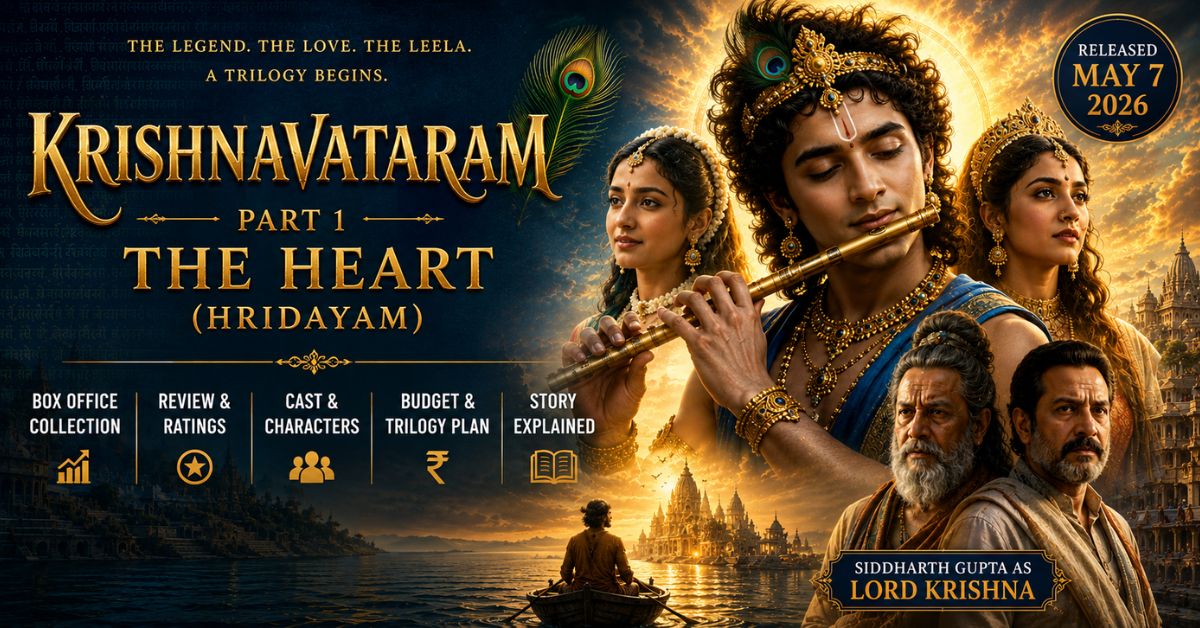
Krishnavataram Part 1: The Heart Highlights
- Krishnavataram Part 1: The Heart released on May 7, 2026, as the first chapter in a planned devotional trilogy based on the life of Lord Krishna.
- The film is directed by Hardik Gajjar and focuses on Krishna’s emotional and human side instead of a traditional battle-heavy mythological approach.
- The movie reportedly carries a budget of around ₹150 crore and has earned an estimated ₹9.80 crore worldwide gross by May 10, 2026.
- Critics praised the film’s painterly visuals, soulful music, and emotional storytelling, while some viewers found the first half slow and mythology-heavy.
- The cast includes Siddharth Gupta as Krishna, Sushmitha Bhat as Radha, Sanskruti Jayana as Satyabhama, and special appearances by Jackie Shroff and Pankaj Tripathi.
Indian mythological cinema returned to the big screen in a major way with Krishnavataram Part 1: The Heart, a large-scale devotional epic directed by Hardik Gajjar. Released on May 7, 2026, the film has quickly become one of the most discussed spiritual dramas of the year because of its emotional storytelling, grand visuals, and unusual approach to the story of Lord Krishna.
Unlike traditional mythological films that focus mainly on miracles and battles, Krishnavataram Part 1: The Heart tries to present Krishna as both divine and deeply human. The movie combines devotion, romance, philosophy, and political undertones while also attempting to connect ancient mythology with the concerns of modern audiences.
The film opened modestly at the box office, but positive audience reactions and strong word-of-mouth support helped it grow rapidly over its first weekend. Discussions around the movie have also increased online because of its visual style, spiritual marketing campaign, and the debut performances of several actors.
Krishnavataram Part 1 Box Office Collection and Budget
One of the biggest talking points around Krishnavataram Part 1: Hridayam has been its unusual box office trajectory. The film reportedly carries an estimated production budget of around ₹150 crore, making it one of the most ambitious devotional and mythological dramas produced in recent years.
Released on May 7, 2026, the film opened with modest numbers but later witnessed strong growth through positive audience word-of-mouth. The makers initially released the film with only around 510 shows nationwide, but the show count increased rapidly over the weekend due to rising demand.
| Day | India Nett Collection (Approx.) | Notes |
|---|---|---|
| Paid Previews | ₹40 Lakh | Early screenings before official release. |
| Day 1 (Thursday) | ₹42 Lakh | Modest opening with around 510 shows nationwide. |
| Day 2 (Friday) | ₹1.15 Crore | Strong growth as show count expanded. |
| Day 3 (Saturday) | ₹2.10 – ₹2.25 Crore | Sharp jump with improved occupancy in metros and family circuits. |
| Day 4 (Sunday) | ₹3.25 – ₹3.50 Crore | Highest single-day total during opening weekend as show count neared 2,000. |
| Day 5 (Monday) | ₹1.00 – ₹1.10 Crore | Steady hold despite expected weekday drop. |
| Day 6 (Tuesday) | ₹0.82 Crore | Collections remained stable in key urban centers. |
| Day 7 (Wednesday) | ₹0.75 Crore | Weekday trend remained steady through the first week. |
| Day 8 (Thursday) | ₹0.70 Crore | Second week opened on a controlled but stable note. |
| Day 9 (Friday) | ₹1.10 Crore | Second weekend started with visible growth. |
| Day 10 (Saturday) | ₹2.40 Crore | Major jump driven by family audiences and positive word-of-mouth. |
| Day 11 (Sunday) | ₹3.20 Crore | Current highest single-day collection of the theatrical run. |
| Day 12 (Monday) | ₹0.85 Crore | Strong second Monday hold compared to opening week. |
| Day 13 (Tuesday) | ₹0.75 Crore (Est.) | Film continued to sustain occupancy in selected circuits. |
| Current Total | ₹18.12 Crore | Strong second-week growth driven mainly by Hindi markets. |
The film’s rapid expansion has become one of the major stories surrounding its theatrical run. Due to increasing audience demand, exhibitors reportedly increased screenings from around 510 shows on opening day to nearly 2,000 by the first Sunday.
Trade circles have particularly highlighted the film’s second weekend surge, which is being seen as a positive sign for a mythology-based drama in the current theatrical market. The Day 11 collection of ₹3.20 crore currently stands as the film’s highest single-day figure.
While the Hindi version remains the primary revenue driver, the Tamil and Telugu dubbed releases have also contributed to the overall performance. Reports suggest the southern versions have added nearly ₹65 lakh to the total cume so far.
Regional performance has reportedly been especially strong in Gujarat and Maharashtra, where family audiences and devotional viewers have supported the film consistently during weekends.
The movie has also received positive audience feedback for its cinematography, devotional themes, emotional storytelling, musical score, and portrayal of Lord Krishna’s departure from Vrindavan. The film currently holds a 6.9/10 rating on IMDb.
Trade analysts are now comparing its trend to sleeper devotional successes seen in recent years. Although the film still faces a long road toward recovering its reported ₹150 crore budget through theatrical business alone, its improving momentum and growing audience acceptance have made it one of the more closely watched mythological releases of 2026.
What Krishnavataram Part 1 Is About
The film begins with one of the most emotional moments in Krishna mythology, the death of Lord Krishna at Bhalka Tirth. Instead of following a straight chronological structure, the story shifts between timelines and eventually moves into a modern setting in Jagannath Puri in 2026.
This modern framing device is one of the film’s biggest creative risks. A young man searching for meaning in contemporary life slowly discovers Krishna’s teachings and emotional philosophy. Through this journey, the narrative travels back into Krishna’s past, exploring his relationships, responsibilities, and inner conflicts.
The subtitle The Heart or Hridayam reflects the film’s primary focus. Rather than centering on warfare or politics, this chapter concentrates on Krishna’s emotional connections with Radha, Rukmini, and Satyabhama.
The film particularly emphasizes the perspective of Satyabhama, which is uncommon in mainstream adaptations of Krishna mythology. This creative decision gives the story a more personal and emotional tone. Themes of love, jealousy, devotion, sacrifice, and spiritual longing remain central throughout the narrative.
The screenplay reportedly draws inspiration from the Brahma Vaivarta Purana, an important Sanskrit text known for its detailed exploration of Krishna’s personal relationships and divine love.
Cast of Krishnavataram Part 1: The Heart
The film features a mix of newcomers and experienced performers.
Siddharth Gupta plays Lord Krishna and carries much of the film’s emotional weight. His portrayal focuses more on calmness, empathy, and internal conflict instead of exaggerated divinity.
Sushmitha Bhat appears as Radha and represents the spiritual and emotional side of Krishna’s life.
Sanskruti Jayana plays Satyabhama in what has become one of the film’s most talked-about performances. She is also the granddaughter of former Gujarat Chief Minister Anandiben Patel, and this film marks her acting debut.
Nivaashiyni Krishnan portrays Rukmini and brings a quieter emotional layer to the story.
The film also includes special appearances by Jackie Shroff as a priest or spiritual figure and Pankaj Tripathi as Vyasa.
Critics have particularly appreciated the chemistry between the central cast members and the restrained performances, which avoid the loud theatrical style often associated with mythological cinema.
Reviews and Audience Reactions
Critical reception for the film has generally remained positive, although reviewers have pointed out certain pacing issues.
Several critics praised the film’s visual ambition and musical storytelling. The cinematography by Ayananka Bose has received strong appreciation for creating a painterly visual atmosphere inspired by Indian temple art and classical paintings.
The music composed by Prasad S. has also become an important strength of the movie. Songs such as Prem Ki Leela and Krishna Govinda have connected well with audiences and are being praised for fitting naturally into the story rather than appearing as interruptions.
Reviewers from major entertainment publications gave largely favorable ratings.
- Times of India: 3.5/5
- Mashable India: 4/5
- Bollywood Hungama: “A sincere and visually rich saga.”
However, many critics also noted that the first half feels slow in places. Some viewers felt the storytelling assumes prior knowledge of Krishna mythology, which may confuse audiences unfamiliar with the deeper lore.
Despite these criticisms, audience reactions online have been more emotional than analytical. Many viewers have described the film as spiritually immersive and visually calming rather than action-driven.
The Spiritual Marketing Strategy Behind the Film
One reason the film generated attention before release was its unusual promotional campaign.
Instead of relying only on conventional entertainment marketing, the team adopted a devotional and spiritual outreach strategy. The trailer launch took place at the Krishna Janmabhoomi temple complex in Mathura rather than at a traditional media event.
Promotional events were also organized at Prem Mandir and ISKCON Vrindavan, strengthening the film’s connection with spiritual communities.
The cast and filmmakers reportedly met with UP Chief Minister Yogi Adityanath before release to seek blessings for the project. Spiritual leader Sri Sri Ravi Shankar and singer Anup Jalota publicly appreciated the film for promoting Sanatan values and devotional storytelling.
This marketing strategy helped the movie stand apart from mainstream Bollywood promotions and created a stronger connection with religious audiences.
Visual Effects and Production Design
One of the most ambitious parts of the project is its visual design.
Instead of shooting mainly inside standard studio environments in Mumbai or Hyderabad, the filmmakers reportedly constructed large sets near Visnagar in Gujarat for the Dwarka sequences. This decision helped create architecture inspired by ancient temple aesthetics rather than generic fantasy designs.
The production team spent a long time developing the visual style of the film. Principal photography reportedly started in August 2024 and continued until late 2025 because of extensive VFX work and post-production.
The movie uses a hybrid visual technique combining 2D painterly textures with modern 3D computer graphics. Rather than pursuing hyper-realistic visuals, the creators aimed for a dream-like spiritual atmosphere that resembles classical Indian paintings.
Many viewers have especially praised the underwater and Dwarka scenes for their visual richness.
Connection With Rajadhiraaj Musical
Film enthusiasts have also noticed similarities between the movie and the 2024 stage production Rajadhiraaj: Love. Life. Leela, which became popular at the Nita Mukesh Ambani Cultural Centre.
Writers Raam Mori and Prakash Kapadia reportedly carried several musical and emotional storytelling elements from the stage production into the film adaptation.
This influence explains why Krishnavataram Part 1 feels closer to a classical musical drama than a conventional mythological action film. Songs are used to move the narrative forward and explore emotional relationships instead of functioning merely as commercial additions.
How Krishnavataram Differs From Older Krishna Films
Indian cinema has produced many Krishna-based films over the decades, including the famous 1967 Telugu classic Sri Krishnavataram starring N. T. Rama Rao.
However, the 2026 version takes a very different approach.
Older mythological films usually presented Krishna as an untouchable divine figure with grand speeches and theatrical performances. Krishnavataram Part 1: The Heart instead focuses on Krishna’s emotional vulnerability and human relationships.
The film tries to explore what Krishna’s teachings mean in today’s world while also examining the emotional burdens carried by a divine figure.
This more intimate storytelling style may not appeal to audiences expecting large battle sequences or fast-paced action, but it has helped the movie build a unique identity among younger viewers interested in spiritual storytelling.
Future of the Krishnavataram Trilogy
The filmmakers have already confirmed that this movie is only the first chapter in a planned trilogy.
The Heart focuses primarily on Krishna’s emotional life and philosophy of love. The future installments are expected to move toward his political intelligence, diplomatic role, and eventually the events leading to the Mahabharata war and the Bhagavad Gita.
If the franchise succeeds commercially, it could become one of the largest mythological film series attempted in modern Indian cinema.
For now, Krishnavataram Part 1: The Heart has managed to create strong curiosity among audiences looking for devotional cinema with modern visual storytelling. Its success may ultimately depend not only on box office numbers but also on whether it can sustain long-term cultural and spiritual interest among viewers searching for stories rooted in Indian mythology.