


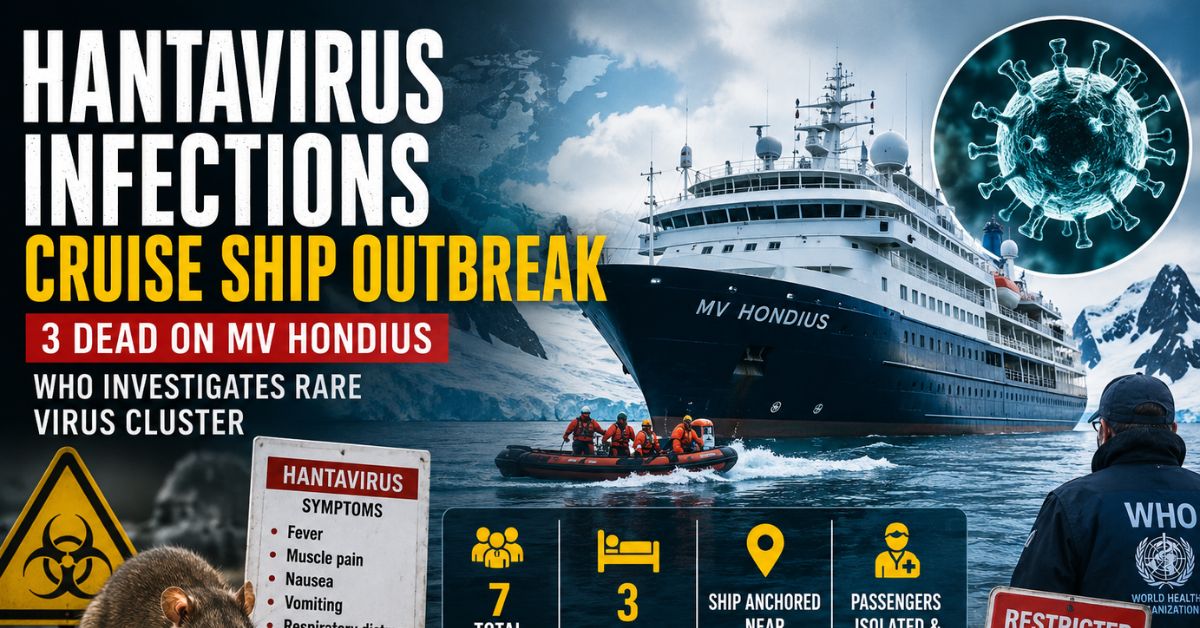
Hantavirus Cruise Ship Outbreak Leaves Three Dead as WHO Monitors MV Hondius
- Three passengers linked to the MV Hondius outbreak have died amid a rare hantavirus cluster
- WHO confirmed seven total cases, including two laboratory-confirmed infections
- The cruise ship remains anchored near Cabo Verde after several ports denied docking access
- Health officials suspect the Andes virus strain, which may spread through limited person-to-person transmission
- Passengers onboard are currently isolated in cabins while sanitization and medical inspections continue
A rare hantavirus outbreak aboard the expedition cruise ship MV Hondius has triggered international concern after three passengers died and several others fell seriously ill during a voyage across the Atlantic Ocean. Health authorities, including the World Health Organization (WHO), are now investigating whether the infections were caused by the Andes strain of hantavirus, one of the few forms of the virus known to occasionally spread between humans.
The incident has quickly become one of the most closely watched public health stories of May 2026 because hantavirus outbreaks on cruise ships are extremely unusual. The vessel, operated by Oceanwide Expeditions, departed from Ushuaia in Argentina in early April and traveled through Antarctica, South Georgia, Saint Helena, and Ascension Island before becoming stranded near Cabo Verde after multiple passengers developed severe respiratory symptoms.
As of May 4 and May 5, WHO confirmed that seven people connected to the cruise had either confirmed or suspected hantavirus infections. Three of those patients have died.
What Happened on the MV Hondius Cruise Ship
The outbreak reportedly began during the long expedition voyage known as the “Atlantic Odyssey,” a route popular among travelers interested in wildlife observation and polar tourism. The ship carried roughly 150 passengers and crew members from several countries, including the United Kingdom, the Netherlands, Germany, Spain, and the United States.
According to WHO and international media reports, the first known patient was a 70-year-old Dutch man who developed symptoms on April 6 while onboard the ship. His condition deteriorated rapidly, and he later died from respiratory complications. His wife, aged 69, also became ill and died after being transferred to a hospital in Johannesburg, South Africa. A third passenger, identified as a German national, died aboard the vessel on May 2.
Several other passengers and crew members later reported fever, breathing difficulty, vomiting, gastrointestinal illness, and severe respiratory distress. One British passenger remains in intensive care in Johannesburg after laboratory testing confirmed hantavirus infection.
Passengers aboard the ship have described confusion, fear, and uncertainty as authorities prevented the vessel from docking at several ports. Cape Verde denied permission for normal passenger disembarkation while medical teams boarded the ship for testing and sanitization procedures.
Why the Hantavirus Cruise Ship Outbreak Is So Unusual
Hantavirus infections are generally rare and are most commonly linked to contact with rodent urine, saliva, or droppings. Humans usually become infected after inhaling contaminated particles in enclosed or poorly ventilated spaces.
Cruise ships are not normally associated with hantavirus outbreaks. That is why the MV Hondius incident has drawn global attention from epidemiologists and infectious disease specialists.
Health officials suspect the Andes virus strain may be involved in this outbreak. This strain is native to parts of South America and is considered different from many other hantaviruses because limited person-to-person transmission has previously been documented.
WHO has stated that investigations are still ongoing and the exact transmission pathway has not yet been fully confirmed. However, authorities noted that no rodents were found onboard the vessel during initial inspections, increasing questions about whether at least some infections may have spread between people in the confined cruise environment.
The possibility of human transmission aboard a ship carrying international passengers has raised concern because cruise vessels naturally involve close contact, shared air systems, communal dining, and limited medical isolation facilities.
Despite the seriousness of the outbreak, WHO currently assesses the wider global public health risk as low.
Symptoms Reported Among Infected Passengers
Medical officials say the symptoms observed onboard are consistent with Hantavirus Pulmonary Syndrome (HPS), a dangerous respiratory disease that can rapidly become life-threatening.
Common early symptoms include:
- Fever
- Fatigue
- Muscle pain
- Headaches
- Nausea
- Vomiting
- Abdominal discomfort
In severe cases, patients later develop pneumonia-like complications, fluid accumulation in the lungs, low blood pressure, respiratory failure, and shock.
Doctors monitoring the MV Hondius outbreak reported that some patients deteriorated very quickly after initially showing mild symptoms. This rapid progression is one reason hantavirus infections are considered medically dangerous despite being rare.
Health experts say mortality rates for Hantavirus Pulmonary Syndrome can range between 30% and 40% depending on the virus strain and how quickly treatment begins.
Cruise Ship Passengers Kept in Isolation
Passengers remaining aboard the MV Hondius are reportedly being isolated inside their cabins while medical inspections and sanitation operations continue. The ship has remained near Cabo Verde as authorities coordinate next steps with WHO and national governments.
Oceanwide Expeditions confirmed that emergency protocols were activated after multiple passengers became ill. The company has reportedly implemented deep cleaning procedures, medical monitoring, and restricted passenger movement inside the ship.
Medical evacuation flights have already transferred critically ill passengers to South Africa for treatment. There are also discussions about allowing the vessel to dock in the Canary Islands for humanitarian reasons and further investigation.
The outbreak has reminded many observers of the early COVID-19 cruise ship quarantines seen during 2020, when isolated maritime environments became hotspots for disease transmission. Experts say cruise ships remain uniquely vulnerable during infectious disease events because medical facilities onboard are limited compared to large hospitals on land.
WHO Response and International Monitoring
The World Health Organization formally acknowledged the outbreak after receiving notification through international health regulation systems on May 2, 2026. WHO later published a disease outbreak notice confirming two laboratory-confirmed cases and five suspected infections linked to the ship.
WHO officials have emphasized several important points:
- The outbreak currently appears contained to the ship and close contacts
- Wider public transmission risk remains low
- Contact tracing and laboratory testing are ongoing
- Further genetic testing is needed to identify the exact virus strain
The agency is working with authorities in South Africa, Cape Verde, the Netherlands, and the United Kingdom as the investigation continues.
South African laboratories confirmed at least one hantavirus infection in a critically ill patient transferred from the cruise ship. Health teams are now studying whether infections began before embarkation in Argentina or spread later during the voyage itself.
What Is Hantavirus and How Dangerous Is It?
Hantavirus refers to a family of viruses usually carried by rodents. Different strains exist in different regions of the world.
In the Americas, hantavirus infections are mainly associated with severe lung disease called Hantavirus Pulmonary Syndrome. In parts of Europe and Asia, some hantavirus strains cause kidney-related illness known as Hemorrhagic Fever with Renal Syndrome.
The virus is considered rare, but outbreaks can become deadly because symptoms often resemble ordinary flu infections during the early stages. Many patients do not realize the severity of the illness until breathing complications begin.
There is currently no specific antiviral cure for hantavirus infection. Treatment usually focuses on supportive hospital care, oxygen therapy, and intensive respiratory support for severe patients.
Health experts advise travelers to avoid contact with rodents and contaminated environments, especially in remote wilderness areas where hantavirus is naturally present.
Growing Questions Around Expedition Tourism
The MV Hondius outbreak has also renewed discussion about medical preparedness on remote expedition cruises. Adventure tourism to Antarctica and isolated Atlantic islands has grown significantly in recent years, with more travelers choosing long voyages into remote regions where emergency medical access is limited.
Some infectious disease experts believe these types of cruises may face additional risks because passengers often visit wildlife-heavy environments and isolated ecological zones where rodent exposure may occur more easily.
The WHO investigation into the hantavirus infections cruise ship outbreak remains active, and health authorities are expected to release more information after laboratory sequencing and epidemiological analysis are completed.
For now, the MV Hondius remains under close monitoring as passengers wait for permission to safely disembark and return home.