


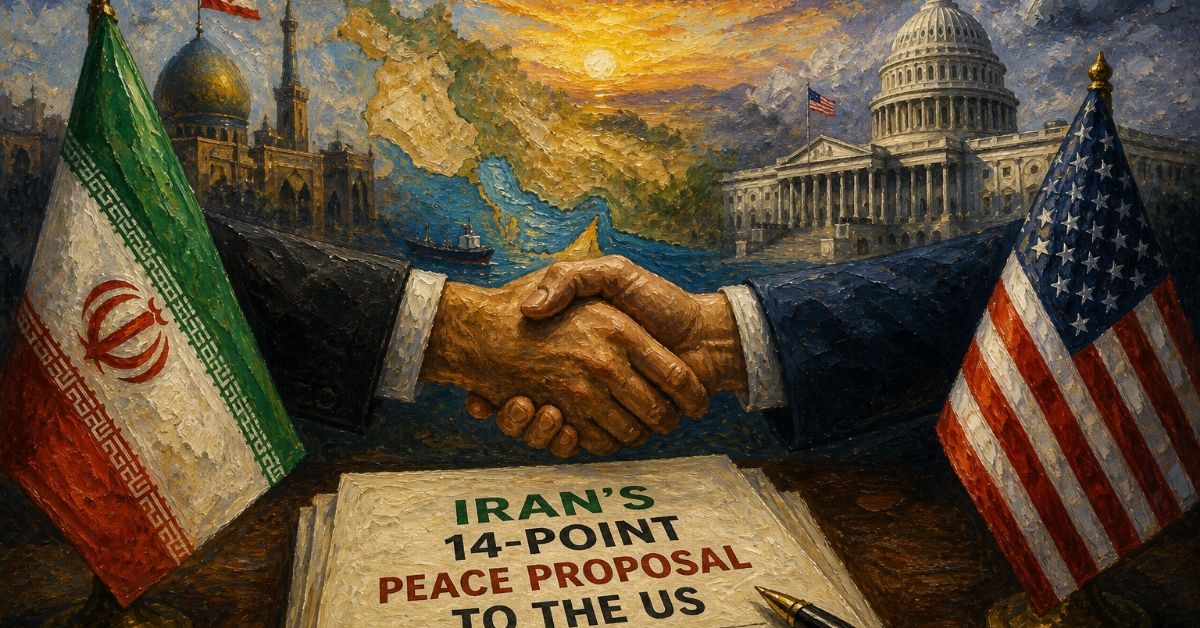
Iran’s 14-point proposal sets stage for high-stakes US negotiations
- Iran has submitted a 14-point peace proposal to the United States via Pakistan
- The plan follows a February escalation and an April ceasefire now under strain
- Tehran seeks sanctions relief, military withdrawal, and security guarantees
- Washington has expressed skepticism and continues to demand nuclear concessions
- Key details of the proposal remain unverified or undisclosed publicly
In early May 2026, Iran submitted a 14-point peace proposal to the United States through diplomatic channels involving Pakistan, marking a new phase in efforts to stabilize a conflict that escalated sharply at the end of February. The proposal, described by officials and regional media as a counter to an earlier US framework, comes amid a fragile ceasefire that has held since early April but remains vulnerable to collapse.
While both sides have acknowledged ongoing backchannel communication, much of the substance of Iran’s proposal remains either partially disclosed or subject to competing interpretations. What has emerged so far suggests a wide gap between Tehran’s demands and Washington’s expectations, particularly on military withdrawal, sanctions, and nuclear commitments.
Conflict Background and Ceasefire Context
The current crisis traces back to late February, when military strikes triggered a rapid escalation between Iran and US-aligned forces. The confrontation expanded beyond direct exchanges, drawing in regional actors and affecting maritime routes, particularly around the Strait of Hormuz.
By early April, diplomatic pressure from multiple countries led to a ceasefire arrangement. Pakistan played a visible role in facilitating communication between the two sides, alongside other regional actors. Officials on both sides described the ceasefire as temporary, intended to create space for negotiations rather than a permanent settlement.
Since then, intermittent tensions have persisted, with both Iran and the United States maintaining military readiness while engaging in parallel diplomatic efforts.
What Iran Is Demanding
According to multiple reports and official briefings, Iran’s proposal centers on a set of broad political and economic conditions. These include an accelerated timeline for ending hostilities, with Tehran reportedly pushing for a complete resolution within 30 days rather than a prolonged ceasefire.
Iran is also seeking the withdrawal of US military forces from areas it considers directly linked to the conflict. This includes maritime deployments and regional positions that have been part of the recent escalation. Alongside this, Tehran has called for a comprehensive end to hostilities across related theaters, including areas where allied groups are active.
Economic relief forms a central pillar of the proposal. Iranian officials have called for the lifting of sanctions, the release of frozen financial assets, and compensation for damage incurred during recent military operations. These demands reflect long-standing grievances but have taken on renewed urgency in the context of the current conflict.
Security guarantees are another key component. Iran is seeking formal assurances that future military strikes or coercive actions will not be undertaken, a condition that has historically been difficult to formalize in US-Iran agreements.
In the maritime domain, Iran has proposed changes to how security and navigation are managed in the Strait of Hormuz. While details remain limited, the proposal appears to envision a revised framework that would reduce the risk of confrontation in one of the world’s most critical energy corridors.
What Remains Unclear
Despite the broad outlines, significant elements of the proposal have not been independently verified. There is no publicly available official document detailing all 14 points, and much of the reported content comes from secondary accounts or state-affiliated media.
In particular, specific provisions related to Iran’s nuclear program remain unclear. While some reports suggest that nuclear restrictions may form part of the negotiation, no confirmed details have been released regarding enrichment limits, timelines, or monitoring mechanisms.
Similarly, claims about operational measures, such as detailed military commitments or structured phases of implementation, have not been corroborated by independent sources. Analysts caution that these elements may reflect interpretation rather than confirmed terms.
The scope of regional provisions, including references to Lebanon or broader Middle East security arrangements, also varies across reports. It remains uncertain whether these are formal components of the proposal or part of broader political messaging.
The United States Response
Washington has responded cautiously to the proposal, with officials indicating that it is under review while signaling clear reservations. President Donald Trump has publicly expressed skepticism, suggesting that the terms as described would not be acceptable in their current form.
US officials have emphasized that any agreement must include firm commitments from Iran on its nuclear program. This has been a consistent position in previous negotiations and remains a central point of contention.
There is also resistance within US policy circles to the sequencing implied in Iran’s proposal. Tehran appears to be seeking upfront concessions, particularly on sanctions and military posture, while Washington has traditionally pushed for reciprocal or conditional steps tied to verification.
Despite these differences, diplomatic engagement has not been suspended. Iranian media reports indicate that a formal response has been conveyed back through Pakistan, though the content of that response has not been publicly disclosed.
Strategic Deadlock and Risks
The current situation reflects a broader strategic deadlock. Iran is attempting to leverage its regional position and the risks to global energy routes to secure concessions, while the United States is seeking to maintain pressure without escalating into a wider conflict.
The 30-day timeline proposed by Iran adds urgency to the negotiations but also increases the risk of breakdown. If talks fail to produce a framework acceptable to both sides, the ceasefire could collapse, leading to renewed hostilities.
At the same time, both sides appear to be managing escalation carefully. Public statements have been calibrated, and there has been no immediate move to abandon diplomatic channels. This suggests that while positions remain far apart, there is still an interest in avoiding a full-scale conflict.
Regional and Global Implications
The outcome of these negotiations carries implications beyond the immediate conflict. The Strait of Hormuz remains a critical artery for global energy supply, and any instability in the region has direct effects on international markets.
Regional actors are also closely watching the developments. Countries across the Middle East have a stake in both the security environment and the diplomatic balance that emerges from these talks. The involvement of intermediaries reflects a broader effort to contain the crisis within a manageable framework.
For global powers, the situation represents a test of diplomatic coordination. While the current process is being mediated through specific channels, the broader international community is likely to play a role if negotiations move toward a more formal agreement.
A Negotiation with Uncertain Outcome
As of early May 2026, the trajectory of the Iran-US negotiations remains uncertain. The existence of a structured proposal indicates that both sides are engaged, but the gaps between their positions are substantial.
The coming weeks will determine whether the current ceasefire can transition into a more durable arrangement or whether it will give way to renewed confrontation. Until more details are confirmed and positions become clearer, the proposal remains both a sign of diplomatic movement and a reminder of how far apart the two sides remain.