


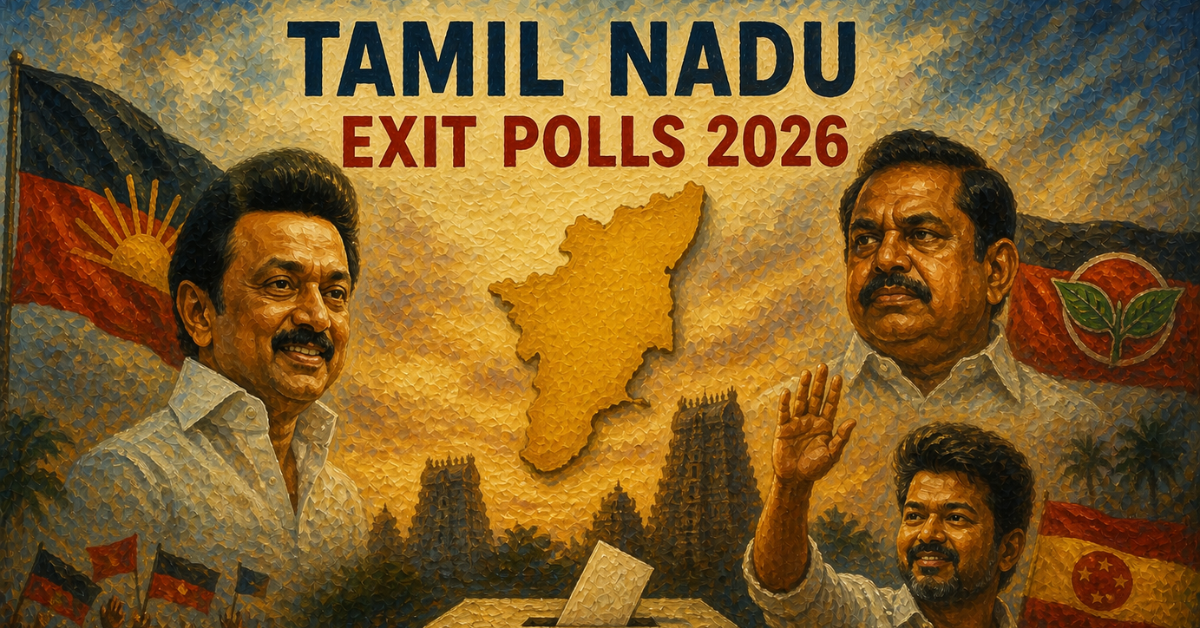
Exit polls point to tight race in Tamil Nadu with new entrant reshaping contest
- Most exit polls suggest DMK-led alliance may retain power in 234-seat assembly
- Actor Vijay’s TVK emerges as a major disruptive force across projections
- Some agencies predict a hung assembly due to multi-cornered contest
- AIADMK projected to remain competitive but trails in most surveys
- Official results to be declared on May 4
Exit polls for the 2026 Tamil Nadu Assembly elections indicate a closely contested race, with most projections suggesting that the Dravida Munnetra Kazhagam-led alliance could retain power, though with a reduced margin compared to the previous election. The results for all 234 constituencies will be declared on May 4.
Across multiple surveys, the DMK-led Secular Progressive Alliance is projected to approach or cross the majority mark of 118 seats. However, the range of estimates varies significantly, reflecting uncertainty in a contest that has expanded beyond the traditional two-party framework.
Today’s Chanakya projects the DMK alliance securing around 140 seats, with the AIADMK-led bloc at approximately 72. People’s Pulse and P-Marq also indicate a DMK advantage, though with narrower margins. These projections collectively point toward continuity in governance, albeit with a more competitive opposition presence.
In contrast, Axis MyIndia presents a sharply different scenario, projecting a major surge for Tamilaga Vettri Kazhagam, the party founded by actor Vijay. According to this estimate, TVK could secure a substantial number of seats, potentially emerging as the single largest party or playing a decisive role in government formation in the event of a hung assembly.
JVC is another outlier, projecting a strong performance by the All India Anna Dravida Munnetra Kazhagam, placing it ahead of the DMK in its estimates. This divergence highlights the lack of consensus among polling agencies.
| Agency | DMK+ | AIADMK+ | TVK | Others |
|---|---|---|---|---|
| Today’s Chanakya | 140 ± 11 | 72 ± 9 | 18 ± 5 | 4 ± 2 |
| Axis MyIndia | 92–110 | 22–32 | 98–120 | 5–10 |
| People’s Pulse | 125–145 | 65–80 | 18–24 | 2–5 |
| P-Marq | 122–132 | 87–100 | 10–12 | 0–6 |
| JVC | 75–95 | 128–147 | 8–15 | 2–5 |
The emergence of TVK has introduced a new dimension to Tamil Nadu’s political landscape. Analysts suggest that the party has drawn significant support from younger voters and first-time participants, potentially altering traditional voting patterns that have long been dominated by the DMK and AIADMK.
The election also recorded a high voter turnout, estimated at around 85 percent, which is among the highest in the state’s history. Historically, elevated turnout levels have been interpreted as a sign of voter mobilization and possible shifts in electoral preference, though their precise impact remains difficult to assess before counting.
The DMK has centered its campaign on governance continuity and welfare schemes, while opposition parties have focused on anti-incumbency and law-and-order concerns. The presence of multiple competitive parties has made seat projections particularly sensitive to small changes in vote share.
Polling experts caution that exit polls in Tamil Nadu are inherently challenging due to the multi-cornered nature of the contest. Even marginal shifts in voter preference can result in substantial differences in seat distribution. Recent elections at both state and national levels have also highlighted the limitations of predictive models.
With projections ranging from a comfortable DMK return to scenarios involving a hung assembly or an opposition surge, the outcome remains uncertain. The final results on May 4 will determine whether the state continues under the current leadership or moves toward a more fragmented political arrangement.