


India’s Linguistic Landscape in Numbers
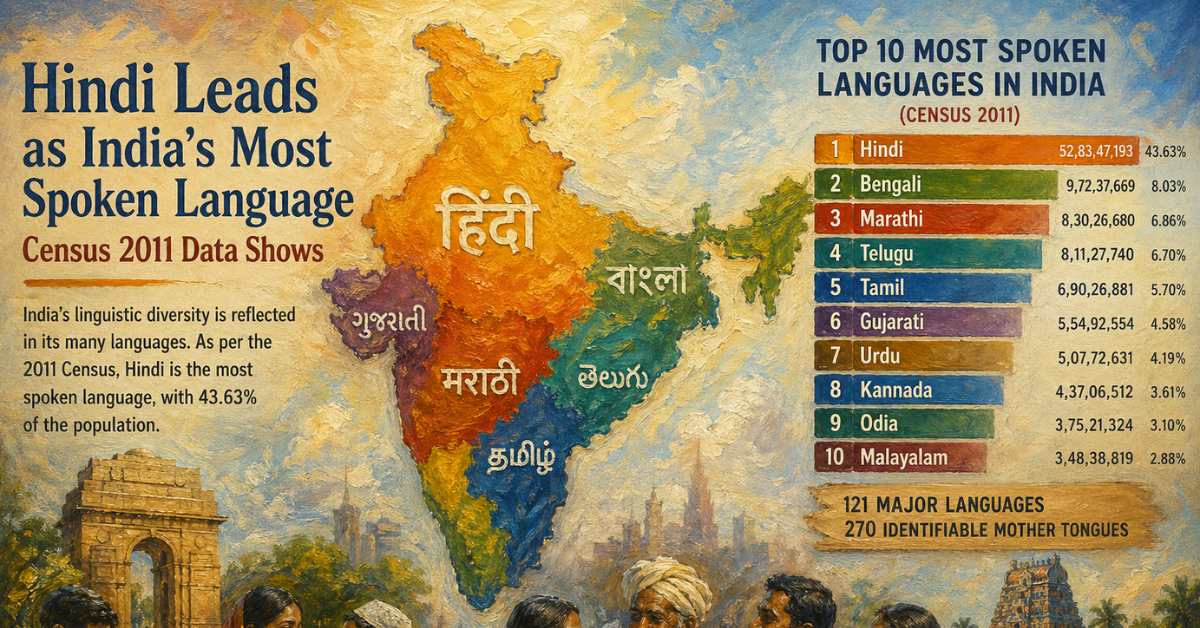
- Hindi remains the most spoken language with 43.63% share as per Census 2011.
- Bengali ranks second, followed by Marathi, Telugu, and Tamil.
- Top 10 languages together account for a majority of India’s population.
- Southern languages form a strong regional cluster with significant speaker base.
- Census recorded 121 major languages and 270 identifiable mother tongues.
India’s linguistic profile remains sharply defined by the dominance of Hindi, which continues to be the most widely spoken language in the country, according to Census 2011 data. The dataset remains the official benchmark used by government bodies and provides a detailed view of how language distribution shapes the country’s demographic and cultural structure.
Hindi accounts for 43.63 percent of the population, with over 52 crore speakers. The figure reflects not just standard Hindi but a broad grouping of related mother tongues classified under the Hindi category by census authorities. This method of aggregation has long influenced how linguistic dominance is interpreted at the national level.
Bengali holds the second position with just over 8 percent share, followed by Marathi and Telugu, each contributing close to 7 percent of the population. Tamil ranks fifth, while Gujarati, Urdu, Kannada, Odia, and Malayalam complete the top ten list. These languages, though smaller in share compared to Hindi, represent strong regional identities and well-defined linguistic zones across states.
Top 10 Most Spoken Languages in India (Census 2011)
| Rank | Language | Number of Speakers | Share of Population |
|---|---|---|---|
| 1 | Hindi | 52,83,47,193 | 43.63% |
| 2 | Bengali | 9,72,37,669 | 8.03% |
| 3 | Marathi | 8,30,26,680 | 6.86% |
| 4 | Telugu | 8,11,27,740 | 6.70% |
| 5 | Tamil | 6,90,26,881 | 5.70% |
| 6 | Gujarati | 5,54,92,554 | 4.58% |
| 7 | Urdu | 5,07,72,631 | 4.19% |
| 8 | Kannada | 4,37,06,512 | 3.61% |
| 9 | Odia | 3,75,21,324 | 3.10% |
| 10 | Malayalam | 3,48,38,819 | 2.88% |
Regional Balance and Linguistic Clusters
The distribution of these languages highlights a distinct regional pattern. Northern and central India are largely defined by Hindi and its variants, while eastern India shows strong Bengali representation. Western India is anchored by Marathi and Gujarati, whereas southern India presents a cluster of major Dravidian languages including Telugu, Tamil, Kannada, and Malayalam.
This regional concentration reinforces the federal nature of India’s linguistic identity, where language often aligns closely with state boundaries, governance, and cultural expression.
Beyond the Top Ten
While the top ten languages cover a significant portion of the population, the broader picture reveals far greater diversity. The census recorded 121 major languages and 270 identifiable mother tongues, underscoring the layered and complex nature of communication across the country.
A Continuing Reference Point
More than a decade later, the 2011 census remains the most comprehensive source on India’s linguistic composition. It continues to inform debates on education policy, administrative language use, and digital content distribution, even as demographic shifts and urban migration gradually reshape language usage across regions.