


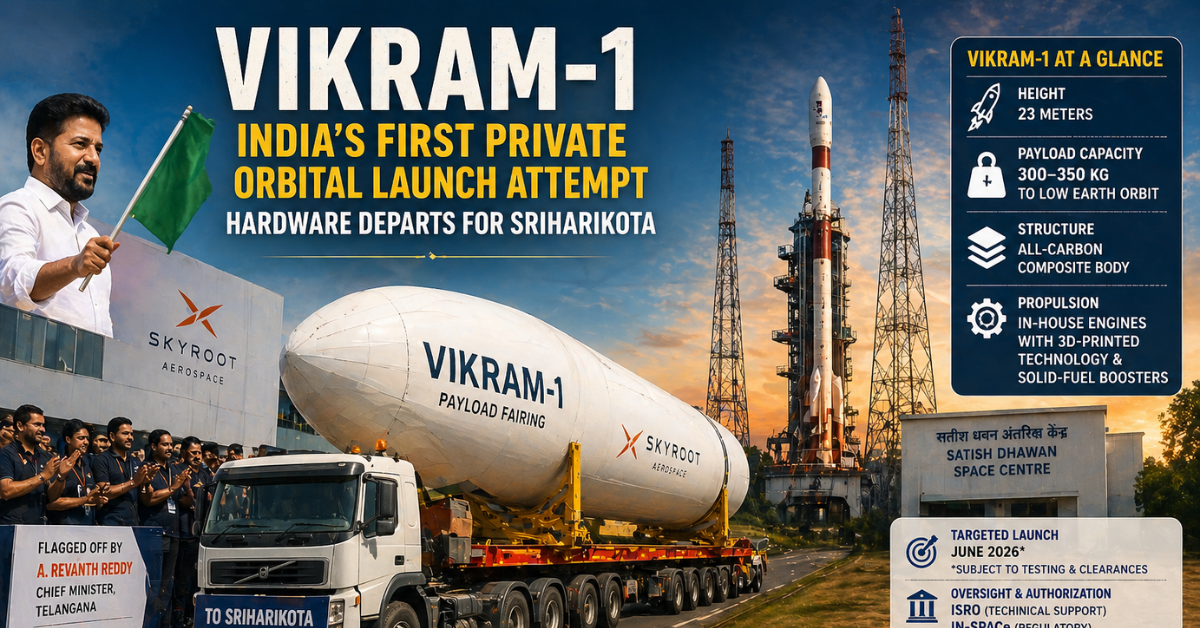
Vikram-1 Hardware Departs for Sriharikota Ahead of India’s First Private Orbital Launch Attempt
- Skyroot Aerospace flags off Vikram-1 rocket hardware from Hyderabad on April 25, 2026.
- Payload fairing transported to Satish Dhawan Space Centre for final integration.
- Maiden orbital launch targeted for June 2026, subject to testing and clearances.
- Rocket designed for small satellite launches with up to 350 kg LEO capacity.
- Marks a significant step in India’s transition toward private space participation.
The flight hardware for India’s first privately developed orbital launch vehicle has begun its journey to the launch site, marking a notable step in the country’s evolving space sector.
On April 25, 2026, the payload fairing of the Vikram-1 rocket, developed by Skyroot Aerospace, was formally flagged off from the company’s Max-Q campus in Hyderabad. The ceremony was led by Telangana Chief Minister A. Revanth Reddy, reflecting the state’s growing role in India’s expanding private aerospace ecosystem.
The hardware is being transported to the Satish Dhawan Space Centre in Sriharikota, where final integration and testing will be carried out ahead of the planned launch window. The maiden orbital mission is currently targeted for June 2026, although the timeline remains subject to technical validation and regulatory clearances.
Vikram-1 has been designed as a cost-efficient, multi-stage launch vehicle tailored for the small satellite market. The rocket stands about 23 meters tall and is capable of carrying up to 300 to 350 kilograms into Low Earth Orbit. For its first mission, the payload is expected to be limited, focusing on validating performance and collecting flight data rather than full-scale commercial deployment.
The vehicle uses an all-carbon composite structure to reduce weight and improve efficiency. Its propulsion systems have been developed in-house and include 3D-printed engines along with solid-fuel boosters designed to deliver high thrust during liftoff. These design choices align with broader trends in the global launch industry toward lightweight materials and scalable systems.
The upcoming mission is expected to mark the first attempt by an Indian private company to carry out a full orbital launch. Skyroot Aerospace had earlier demonstrated suborbital capability with the Vikram-S mission in 2022, but Vikram-1 represents a transition toward commercially viable orbital operations.
The launch is being conducted with technical support from the Indian Space Research Organisation and authorization from IN-SPACe, the national regulatory body overseeing private participation in the space sector. This framework reflects a collaborative model in which private firms operate alongside established government infrastructure.
The development also points to a broader shift in India’s aerospace landscape. Telangana has emerged as a growing hub for aerospace and defense manufacturing, supported by increased investment and rising engineering exports linked to high-precision industries.
For Skyroot Aerospace, the Vikram-1 mission forms part of a longer-term commercial strategy. The company is working toward a launch-as-a-service model aimed at providing flexible and relatively low-cost satellite deployment options. It has outlined plans to scale manufacturing capacity in the coming years to support more frequent launches, though these targets remain aspirational at this stage.
The company, currently valued at around $500 million, is also expected to explore further funding opportunities. A successful orbital mission could strengthen investor confidence and accelerate its position within India’s private space sector.
The departure of Vikram-1 hardware signals more than a routine logistical step. It reflects a gradual shift in India’s space program toward a mixed ecosystem, where private companies are taking on a more active role in launch capabilities and commercial space access.