


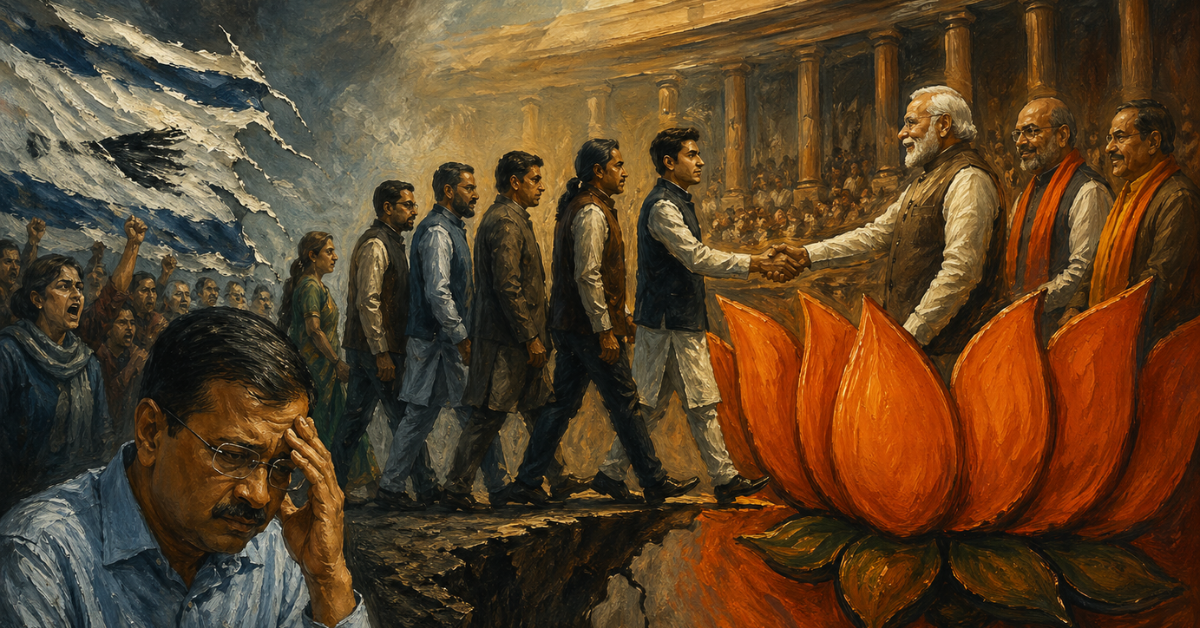
Crisis Narrative Around AAP’s Upper House Strength
- Reports claim multiple AAP Rajya Sabha MPs may have shifted allegiance
- AAP calls the move “Operation Lotus” and plans legal challenge
- Anti-Defection Law and two-thirds rule central to the dispute
- BJP could gain advantage in Rajya Sabha if shift is confirmed
- Punjab political stability now under close watch
The reported exit of several Aam Aadmi Party leaders from the Rajya Sabha, led by Raghav Chaddha, has triggered a sharp political confrontation, with the party alleging a coordinated attempt by the Bharatiya Janata Party to weaken its parliamentary presence. While these developments remain unconfirmed in official parliamentary records, statements attributed to party leaders and emerging political narratives have placed the issue at the center of national debate.
At the core of the controversy lies the claim that as many as seven AAP Rajya Sabha MPs have either resigned or are in the process of aligning with the BJP. If substantiated, such a shift would significantly alter the balance within the Upper House and raise serious questions about party discipline, internal cohesion, and the limits of India’s Anti-Defection Law.
AAP’s Response and “Operation Lotus” Charge
Senior AAP leaders, including Arvind Kejriwal and Sanjay Singh, have described the alleged developments as part of what they term “Operation Lotus.” This phrase has been used by opposition parties in recent years to describe efforts by the BJP to engineer defections and destabilize rival governments.
Sanjay Singh has publicly indicated that he intends to approach the Rajya Sabha Chairman seeking disqualification of the MPs involved, arguing that such a move constitutes a betrayal of the electoral mandate. The party’s position is that its Rajya Sabha members were elected on a specific ideological platform and cannot shift allegiance without violating constitutional norms.
From AAP’s standpoint, the issue is not merely about numbers but about the erosion of political ethics. The leadership has framed the alleged defection as an attempt to weaken opposition voices in Parliament, particularly at a time when legislative debates remain sharply contested.
The BJP’s Strategic Advantage
If the reported shift of AAP MPs materializes in formal terms, it would strengthen the BJP’s position in the Rajya Sabha, where the ruling party has historically faced constraints due to lack of a clear majority.
The Upper House has often acted as a check on the government’s legislative agenda, especially on contentious bills. Additional numbers, even from a small party like AAP, can improve the government’s ability to pass legislation without relying heavily on regional allies.
The BJP has not always directly confirmed such moves in similar past situations, often framing them as voluntary decisions by individual leaders. However, opposition parties have consistently argued that these shifts are politically engineered.
Internal Friction Within AAP: Reported Causes
One of the central explanations being offered for the alleged breakaway revolves around internal tensions within AAP, particularly involving Raghav Chaddha.
There have been reports suggesting that Chaddha’s relationship with the party leadership had become strained over recent months. His removal from the position of Deputy Leader in the Rajya Sabha was widely interpreted in political circles as a sign of diminishing influence within the party hierarchy.
Another point of contention reportedly relates to his extended stay abroad. During a period when senior AAP leaders were facing legal challenges in India, Chaddha’s absence in London for medical treatment and personal reasons was seen by some within the party as a lack of alignment with the leadership during a critical phase.
While none of these factors alone confirm a political rupture, taken together they form part of the narrative being used to explain the current situation.
Claims of Ideological Shift
In statements attributed to the defecting group, there is an emphasis on what they describe as a departure by AAP from its founding principles.
Chaddha is reported to have suggested that the party no longer reflects the ideals of transparency and clean governance on which it was built. The phrase “right man in the wrong party” has been linked to his remarks, indicating a deeper ideological disagreement rather than a purely strategic move.
Such claims, however, remain contested. AAP leaders maintain that the party continues to adhere to its core principles and have dismissed these allegations as post-facto justifications for political realignment.
The “Sinking Ship” Narrative
Another strand of the narrative comes from both defectors and BJP leaders, including Manoj Tiwari, who have described AAP as a declining political force.
This argument is based on several factors. Critics point to governance challenges in Delhi and Punjab, including allegations of corruption and administrative inefficiencies. There are also claims that internal decision-making within the party has become increasingly centralized, limiting the role of senior leaders.
AAP, on its part, rejects this characterization, arguing that it continues to expand its electoral footprint and remains a significant challenger in multiple states.
Legal Framework: Anti-Defection Law and the Two-Thirds Rule
The legal dimension of the reported development is critical. India’s Anti-Defection Law, under the Tenth Schedule of the Constitution, is designed to prevent elected representatives from switching parties.
However, the law includes a provision that allows a group of legislators to avoid disqualification if at least two-thirds of them agree to merge with another party.
In the context of AAP’s Rajya Sabha representation, the reported number of seven MPs out of ten crosses this threshold. If proven, this would allow them to claim a legal merger with the BJP, thereby retaining their seats.
This provision has been used in the past by multiple parties and remains one of the most debated aspects of India’s parliamentary system. Critics argue that it enables large-scale defections under the guise of legality, while supporters say it protects collective political decisions.
Profiles of Key Figures Involved
Apart from Raghav Chaddha, several other prominent names have been mentioned in the reported group.
Sandeep Pathak is known as a key organizational strategist within AAP and has played a central role in the party’s electoral campaigns.
Harbhajan Singh represents a non-traditional political entrant whose presence in Parliament has symbolic value.
Ashok Mittal and Rajinder Gupta bring business and institutional backgrounds into the political space.
Other reported names include Swati Maliwal and Vikram Sahney, each with distinct professional and public service profiles.
The diversity of this group reflects AAP’s broader strategy of incorporating individuals from varied fields into its parliamentary ranks.
Focus Shifts to Punjab
With a significant portion of AAP’s Rajya Sabha MPs elected from Punjab, attention is now turning to the state’s political landscape.
There is growing speculation about whether similar shifts could occur within the Punjab Legislative Assembly. Such a scenario, often described as a “domino effect,” would have far-reaching consequences for the stability of the state government.
At present, there is no confirmed evidence of such movement among AAP MLAs. However, the possibility remains a subject of intense political discussion.
Parliamentary Numbers and Broader Context
The question of how many AAP MPs are in the Rajya Sabha has gained renewed importance in light of these developments. While the party’s overall strength in Parliament remains limited compared to national parties, its MPs often play a role in shaping debates and influencing outcomes in closely contested votes.
AAP’s Lok Sabha presence is relatively small, which makes its Rajya Sabha representation more significant in legislative terms. Any change in this balance could affect the party’s ability to intervene effectively in national policy discussions.
Summary of Reported Defectors
| Name | Background |
|---|---|
| Raghav Chaddha | Former prominent AAP face in Delhi and Punjab |
| Sandeep Pathak | AAP’s chief election strategist |
| Swati Maliwal | Former Delhi Commission for Women Chief |
| Harbhajan Singh | Former Indian cricketer |
| Ashok Mittal | Founder, Lovely Professional University |
| Vikram Sahney | Entrepreneur and philanthropist |
| Rajinder Gupta | Industrialist, Trident Group |
What Lies Ahead in This Political Flashpoint
The coming days will be critical in determining the direction of this political episode. Formal confirmations, if any, will need to come through parliamentary records, official resignations, or rulings by the Rajya Sabha Chairman.
If the Anti-Defection Law is invoked, the matter could also take a legal route, potentially reaching the courts.
Beyond the immediate legal and political implications, the episode raises broader questions about party cohesion, ideological consistency, and the evolving nature of political alignments in India.
For AAP, the challenge will be to maintain its organizational stability while addressing the narratives emerging from this controversy. For the BJP, the situation presents a potential opportunity to consolidate its position in the Upper House.
The story remains fluid. Its final shape will depend not on claims or counterclaims, but on verifiable actions within the constitutional framework.