


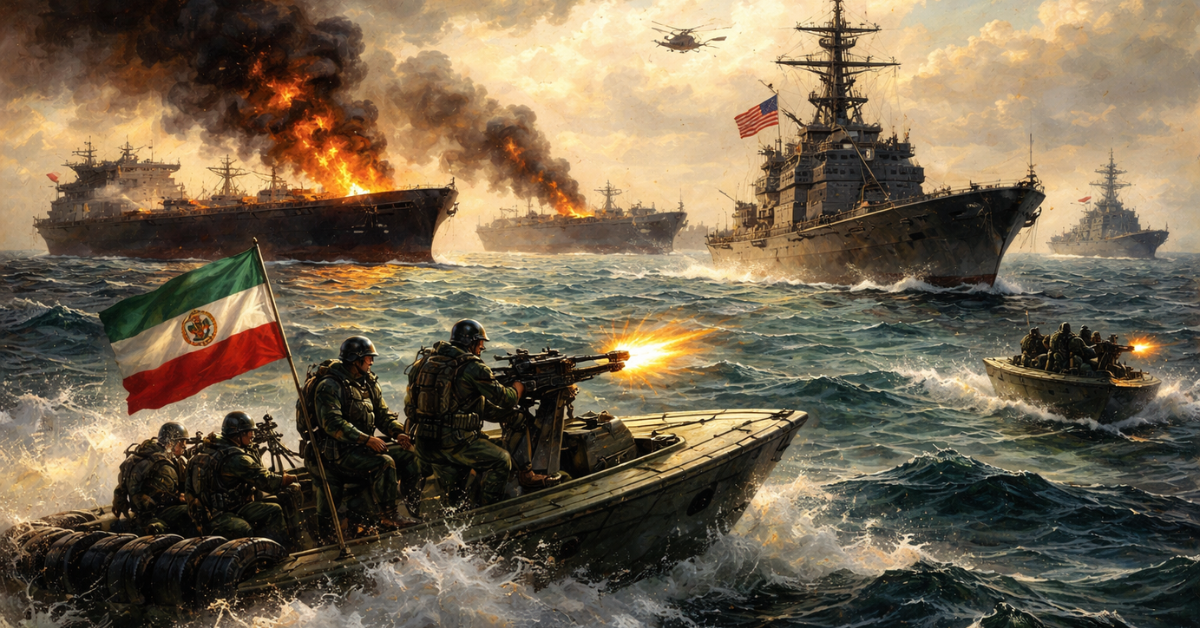
Strait Closure Sparks Global Energy Shock
- Iran has fully shut the Strait of Hormuz again after a brief reopening, halting global maritime movement.
- The IRGC has warned vessels against approaching the waterway, calling it cooperation with hostile forces.
- India-flagged tankers were targeted and forced to retreat, prompting diplomatic protest.
- Oil and LNG markets are under strain as nearly 20% of global supply faces disruption.
- A fragile ceasefire deadline looms on April 22 amid rising regional instability.
The closure of the Strait of Hormuz has returned as the central flashpoint in a widening geopolitical crisis, with Iran enforcing a complete shutdown of one of the world’s most critical maritime routes. What had appeared to be a short-lived reopening has now given way to renewed military confrontation, diplomatic strain, and economic uncertainty. As of April 19, 2026, the narrow corridor connecting the Persian Gulf to the Arabian Sea stands effectively sealed under Iranian control, with global consequences unfolding in real time.
Strategic Chokepoint Under Siege
The Strait of Hormuz is among the most sensitive passages in global trade infrastructure. At its narrowest, the channel spans roughly 21 miles, yet it carries close to one-fifth of the world’s oil and a significant share of liquefied natural gas exports. Any disruption here does not remain regional for long. It moves quickly into global markets, shipping schedules, and national energy policies.
Iran’s decision to reimpose a full closure marks a calculated escalation. Late on April 18, the Islamic Revolutionary Guard Corps (IRGC) reversed its earlier position that had allowed limited movement for a 24-hour period. The reversal was immediate and forceful. Naval units were instructed to prevent any vessel from leaving anchorage zones in both the Persian Gulf and the Sea of Oman.
Iranian authorities framed the closure as a defensive necessity tied to what they describe as an unlawful naval blockade imposed by the United States Navy. Their position is direct. If Iranian ports remain restricted, no other nation will be permitted to use the passage.
The Ultimatum and Enforcement
Iran’s message has been delivered with little ambiguity. Approaching the strait is now defined as collaboration with hostile forces. This classification has practical consequences. Ships that attempt transit face active engagement from Iranian patrol units.
Reports from April 18 indicate that IRGC gunboats opened fire on multiple commercial vessels attempting to navigate toward the strait. These incidents did not appear to be isolated warnings. They reflect a shift toward direct enforcement.
Among the vessels affected were India-flagged tankers. One of them, a large crude carrier transporting nearly two million barrels of Iraqi oil, was forced to reverse course after coming under threat. The Indian government responded by summoning Iran’s ambassador and issuing a formal expression of concern.
India’s position is shaped by both economic and strategic factors. A substantial portion of its crude imports passes through this corridor. Any prolonged closure complicates supply chains and increases procurement costs at a time when domestic demand remains steady.
Military Confrontation Expands
The maritime escalation cannot be separated from the broader conflict that has been unfolding since late February. The war, which began on February 28, has already resulted in significant casualties within Iran, with estimates exceeding 3,400 deaths.
A major turning point came with the assassination of former Supreme Leader Ali Khamenei, an event that triggered retaliatory operations across multiple fronts. These responses have extended beyond Iran’s borders, drawing in regional actors and increasing the risk of a wider confrontation.
On the opposing side, the administration of President Donald Trump has maintained what it describes as a maximalist strategy. The United States has continued its naval blockade of Iranian ports, arguing that sustained pressure is necessary to force a long-term settlement.
This policy has now collided directly with Iran’s decision to weaponize geography. The strait, long recognized as a potential pressure point, has effectively become the frontline.
Fragile Ceasefire Nearing Deadline
Parallel to the maritime crisis, diplomatic efforts have been underway to contain the broader conflict. A ceasefire arrangement brokered by Pakistan is scheduled to expire on April 22.
The agreement has always been limited in scope. It sought to pause hostilities across several fronts but did not fully address maritime tensions. The events of April 18 suggest that the ceasefire framework is already under strain, if not partially collapsed.
In Lebanon, a separate ten-day truce between Israel and Hezbollah remains technically active. However, its relevance is increasingly uncertain as the focus shifts to naval confrontation and energy security.
The approaching deadline introduces additional risk. If the ceasefire lapses without renewal, the region could see simultaneous escalations across land, air, and sea domains.
Economic Shockwaves
The economic consequences of the closure have been immediate and pronounced. Energy markets reacted within hours of confirmation that the strait was again sealed.
Crude oil prices have surged to levels not seen in recent years. Liquefied natural gas markets are under similar pressure, particularly in regions dependent on Gulf exports. Shipping insurance costs have risen sharply, reflecting the heightened risk of transit.
For importing countries such as India, Japan, and several European states, the disruption translates into higher input costs and potential inflationary pressure. Strategic reserves may provide short-term relief, but they are not a substitute for steady supply.
Energy analysts point out that the scale of disruption is not merely about volume. It is also about uncertainty. Even the possibility of intermittent closures forces markets to price in risk, driving volatility.
India’s Strategic Dilemma
India finds itself in a constrained position. It maintains diplomatic ties with Iran while also engaging closely with the United States and other Western partners. The targeting of Indian vessels introduces urgency into what has often been a carefully balanced approach.
New Delhi’s immediate response has been diplomatic, but the situation may require broader measures. These could include rerouting shipments, increasing reliance on alternative suppliers, and coordinating with international partners to ensure maritime security.
The challenge lies in the absence of easy alternatives. The Strait of Hormuz is not easily bypassed. While some shipments can be redirected through pipelines or other routes, these options are limited in capacity and often more expensive.
Global Shipping at Near Standstill
Commercial shipping traffic through the strait has dropped to minimal levels. Many vessels remain anchored, awaiting clarity on whether safe passage will resume. Others have chosen to delay voyages altogether.
Maritime authorities have issued advisories urging caution. Insurance firms have updated risk classifications for the region, further discouraging transit. The combined effect is a near-freeze in one of the busiest shipping corridors in the world.
This slowdown extends beyond energy cargo. While oil and LNG dominate headlines, the strait also handles a range of goods, from petrochemicals to manufactured products. The disruption therefore has secondary effects on supply chains across industries.
Diplomatic Channels Under Pressure
Efforts to de-escalate the crisis continue, though with limited visible progress. Multiple actors, including European governments and regional intermediaries, are attempting to reopen communication channels between Tehran and Washington.
The core dispute remains unresolved. Iran demands the lifting of the naval blockade. The United States insists on broader concessions before easing pressure. Each side views the other’s position as untenable.
This deadlock is now playing out in a domain where miscalculation carries immediate consequences. Unlike land-based conflicts, maritime incidents can escalate quickly, often without clear attribution in the initial moments.
Historical Context of the Strait
The current crisis draws on a long history of tension in the region. The Strait of Hormuz has been a focal point during previous confrontations, including the so-called “Tanker War” phase of the Iran-Iraq conflict in the 1980s.
In those earlier episodes, attacks on shipping led to international naval deployments and efforts to secure transit routes. While the context differs, the underlying dynamics remain similar. Control over the strait translates into leverage over global energy flows.
What distinguishes the present situation is the scale of interconnectedness. Global energy markets are more integrated, and disruptions propagate faster through financial systems and supply chains.
Scenarios Ahead
Several potential paths lie ahead, each carrying its own risks.
One possibility is a negotiated de-escalation. This would likely involve partial concessions on both sides, allowing limited transit to resume while broader talks continue. Such an outcome would require rapid diplomatic movement before the April 22 deadline.
Another scenario involves continued standoff. In this case, the strait remains closed or intermittently accessible, prolonging economic strain and increasing the likelihood of accidental confrontation.
A third, more severe scenario would see direct military engagement between Iranian and U.S. forces. This could extend beyond the strait, affecting multiple locations across the region.
Analysts note that the current posture of both sides leaves limited room for ambiguity. Each has articulated clear conditions, reducing the space for informal compromise.
Energy Security and Long-Term Implications
The crisis is likely to influence long-term energy policy decisions. Countries heavily dependent on Gulf exports may accelerate efforts to diversify supply sources. Investments in alternative routes, including pipelines that bypass the strait, could gain renewed attention.
There may also be increased focus on strategic reserves and domestic production capabilities. While these measures cannot eliminate dependence on global markets, they can reduce vulnerability to sudden disruptions.
For producers, the situation highlights the importance of stable transit routes. Even when supply is abundant, the inability to move it efficiently can create shortages elsewhere.
A Narrow Passage with Global Reach
The events of April 2026 underline a persistent reality. A narrow stretch of water, only a few dozen miles wide, holds disproportionate influence over the global economy.
The closure of the Strait of Hormuz is not an isolated regional issue. It is a systemic shock that touches energy markets, diplomatic relations, and security calculations across continents.
As the ceasefire deadline approaches, attention will remain fixed on whether the current standoff can be contained. The answer will shape not only the immediate trajectory of the conflict but also the broader structure of global energy security in the years ahead.
For now, the strait remains closed, and the balance between pressure and restraint continues to define the actions of all parties involved.