


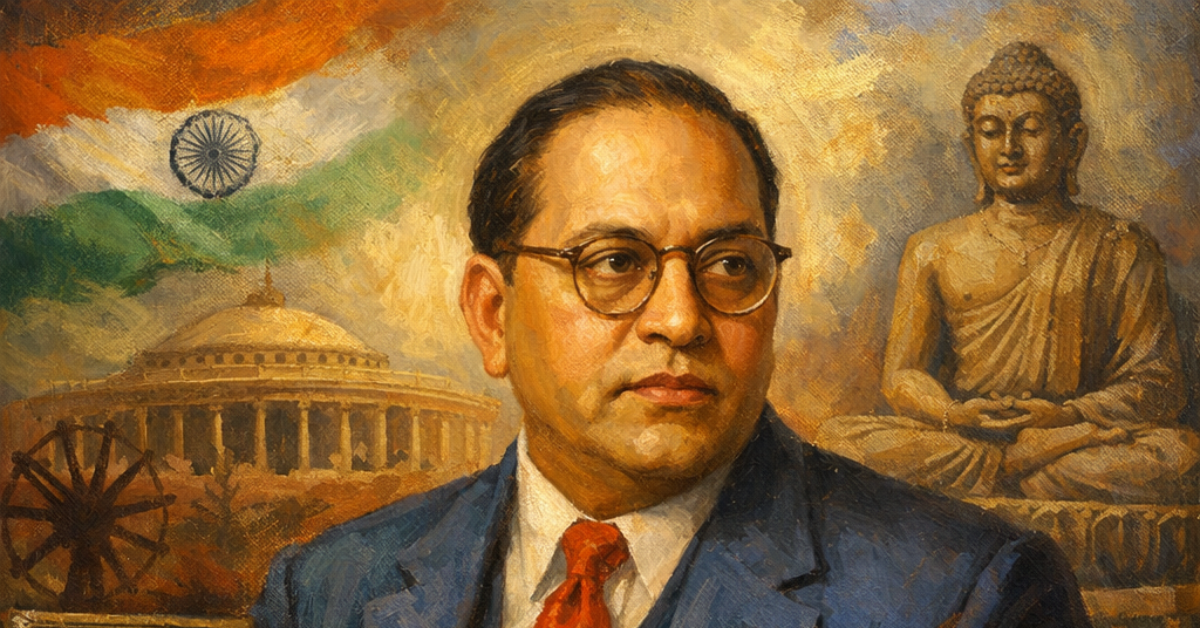
Bhimrao Ramji Ambedkar, widely known as Babasaheb Ambedkar, was one of the most important thinkers, reformers, and political leaders in modern India. He is remembered as the chief architect of the Indian Constitution and as a lifelong fighter against social discrimination, especially the caste system. His life journey, from a poor and oppressed background to becoming one of the most educated Indians of his time, remains both remarkable and complex.
While he is widely respected and honored, his ideas, methods, and political choices have also been debated and criticized. A complete understanding of Ambedkar requires looking at both his achievements and the criticisms surrounding his life and work.
Early Life and Background
Bhimrao Ambedkar was born on April 14, 1891, in Mhow, in present-day Madhya Pradesh. His family belonged to the Mahar caste, which was considered “untouchable” under the traditional Hindu caste system. This social position meant that he faced discrimination from a very young age.
His father, Ramji Maloji Sakpal, was a Subedar in the British Indian Army. Though disciplined and educated, the family still suffered from social exclusion. Young Bhimrao was often made to sit separately in school, denied water, and treated as inferior by both teachers and students.
These early experiences shaped his thinking deeply. They made him aware of the harsh realities of caste-based inequality and pushed him toward a lifelong struggle for justice.
Education: A Rare Achievement
Despite facing social barriers, Ambedkar showed exceptional academic ability. He completed his schooling in Bombay (now Mumbai) and went on to study at Elphinstone College. This itself was rare for someone from his background at that time.
He later received a scholarship from the Maharaja of Baroda to study abroad. He went to Columbia University in the United States, where he earned a Master’s degree and a PhD in economics. He also studied at the London School of Economics and qualified as a barrister.
His education exposed him to ideas of equality, democracy, and social justice from across the world. Thinkers like John Dewey influenced his thinking significantly.
Ambedkar’s educational achievements were extraordinary, especially considering the social barriers he had to overcome.
Return to India and Early Struggles
After completing his studies, Ambedkar returned to India and briefly worked in Baroda. However, he continued to face caste discrimination even in professional life. Colleagues refused to work with him, and he struggled to find accommodation.
These experiences convinced him that education alone was not enough to eliminate caste-based discrimination. Structural and social reforms were necessary.
He began writing and speaking about the condition of the so-called “Depressed Classes” and started organizing movements to demand rights and dignity.
Social Reform and Activism
Ambedkar became a leading voice against untouchability and caste oppression. He launched several movements to demand equal rights, including access to public water sources and temples.
One of his major campaigns was the Mahad Satyagraha in 1927, where he led Dalits to drink water from a public tank, asserting their right to access public resources.
He also publicly burned copies of the Manusmriti, an ancient Hindu text, which he believed supported caste hierarchy.
Unlike some other reformers, Ambedkar did not believe that caste could be reformed within Hinduism. He argued that the system was deeply rooted and required radical change.
Political Career and Differences with Gandhi
Ambedkar entered politics to secure legal and political rights for marginalized communities. He participated in the Round Table Conferences in London and demanded separate electorates for Dalits.
This demand brought him into conflict with Mahatma Gandhi. Gandhi opposed separate electorates, arguing that it would divide Hindu society.
The disagreement led to the Poona Pact of 1932, where Ambedkar agreed to reserved seats for Dalits within a joint electorate instead of separate electorates.
This compromise remains controversial. Some believe Ambedkar was forced into it under pressure, while others argue it was a practical decision.
Role in Drafting the Indian Constitution
After India gained independence in 1947, Ambedkar was appointed as the chairman of the Drafting Committee of the Constitution.
The Constitution of India, adopted in 1950, reflects many of his ideas. It guarantees fundamental rights, abolishes untouchability, and provides for affirmative action for disadvantaged communities.
Ambedkar emphasized equality before the law, individual liberty, and social justice. His work helped shape India’s democratic framework.
However, he later expressed disappointment, stating that political democracy had been achieved, but social and economic democracy remained incomplete.
Views on Religion and Conversion
Ambedkar was a strong critic of the caste system within Hinduism. He eventually concluded that social equality could not be achieved within its framework.
In 1956, he converted to Buddhism along with thousands of his followers. He chose Buddhism because he saw it as a religion based on equality and rational thinking.
This event marked the beginning of the Dalit Buddhist movement in India.
Major Works and Ideas
Ambedkar was also a prolific writer. Some of his important works include “Annihilation of Caste,” “The Problem of the Rupee,” and “Who Were the Shudras?”
In “Annihilation of Caste,” he argued strongly against the caste system and called for its complete destruction. This work remains widely discussed even today.
His economic writings focused on monetary policy, labor rights, and industrial development.
Criticism of Ambedkar
While Ambedkar is widely respected, his ideas and actions have also faced criticism from different groups.
Some critics argue that his demand for separate electorates could have divided Indian society further. Others believe his strong criticism of Hindu texts was too harsh and alienated many people.
His relationship with Gandhi is also debated. Some historians believe Ambedkar’s approach was confrontational, while Gandhi’s was more conciliatory. Others argue that Ambedkar’s firmness was necessary to bring real change.
Certain political critics claim that Ambedkar’s economic ideas were not fully practical for a developing country at that time.
There are also debates about the effectiveness of reservation policies. While many see them as necessary, some argue they have created new forms of inequality.
Support and Legacy
Despite criticism, Ambedkar’s influence remains strong. He is seen as a symbol of social justice and empowerment, especially among marginalized communities.
His ideas continue to influence debates on equality, rights, and democracy in India. His birthday, April 14, is celebrated as Ambedkar Jayanti across the country.
He was posthumously awarded the Bharat Ratna, India’s highest civilian award, in 1990.
Final Years and Death
Ambedkar’s health declined in his later years. He passed away on December 6, 1956, in Delhi.
Even after his death, his writings and ideas continue to inspire movements for equality and justice.
Ambedkar: A Complex Legacy
Dr. B. R. Ambedkar’s life cannot be understood in simple terms. He was a scholar, a reformer, a political leader, and a critic of social traditions.
He challenged deeply rooted systems and paid the price for it through opposition and controversy. At the same time, his work laid the foundation for many of the rights enjoyed in modern India.
His legacy is not only about praise or criticism. It is about understanding the problems he addressed, the solutions he proposed, and the debates he continues to shape.