


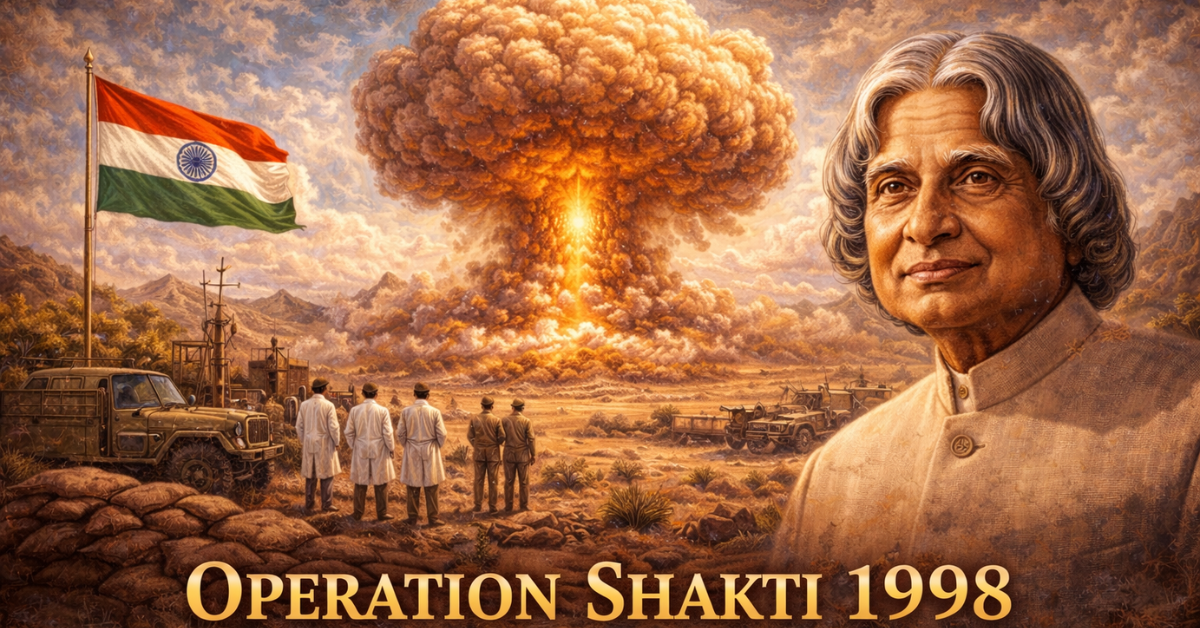
1998 Nuclear Tests That Declared India’s Weapons Status
- India conducted five underground nuclear tests under Operation Shakti between 11 and 13 May 1998 at Pokhran.
- The tests included fission, thermonuclear, and sub-kiloton devices, demonstrating a range of nuclear capabilities.
- Following the tests, India formally declared itself a nuclear weapons state, shifting from strategic ambiguity to open deterrence.
- The move triggered international sanctions and led to Pakistan conducting its own nuclear tests, establishing regional nuclear deterrence.
- Operation Shakti laid the foundation for India’s nuclear doctrine, including credible minimum deterrence and a No First Use policy.
Operation Shakti, conducted in May 1998, marked the moment when India moved from demonstrated nuclear capability to declared nuclear weapons status. While the 1974 test under Smiling Buddha had established technological competence, it remained officially framed as a peaceful experiment. In contrast, the 1998 tests were explicit, deliberate, and strategic. They were designed not only to validate weapon designs but to signal a clear shift in India’s national security doctrine.
Between 11 and 13 May 1998, India carried out a series of five underground nuclear detonations at the Pokhran Test Range in Rajasthan. Operation Shakti was the codename for this coordinated effort, also widely known as Pokhran-II.
From Capability to Declaration
The distinction between 1974 and 1998 is central to understanding Operation Shakti. The earlier test had demonstrated that India possessed the scientific and technical ability to build a nuclear device. However, it stopped short of declaring itself a nuclear weapons state.
By the late 1990s, the geopolitical context had changed. Nuclear deterrence had become a defining feature of global power structures. India faced a nuclear-armed China and an increasingly active nuclear program in Pakistan. At the same time, international pressure was mounting through treaties such as the Comprehensive Test Ban Treaty (CTBT), which sought to limit further nuclear testing.
India’s leadership chose to act before such frameworks could restrict its options. The tests of 1998 were therefore both a technological validation and a political declaration. Shortly after the detonations, the government publicly announced that India was now a nuclear weapons state.
Planning and Secrecy
Operation Shakti was executed with a level of secrecy comparable to, and in some respects exceeding, the 1974 test. The programme was coordinated by India’s key scientific and defense institutions, including the Bhabha Atomic Research Centre and the Defence Research and Development Organisation.
Among the central figures were A. P. J. Abdul Kalam and R. Chidambaram, who oversaw the scientific and technical aspects of the operation. The tests were prepared in a manner that avoided detection by foreign intelligence agencies, despite increasing satellite surveillance capabilities by the late 20th century.
Equipment was transported discreetly, and on-site preparations were carried out under strict operational discipline. The success of this secrecy was evident in the global reaction. The tests came as a surprise to most of the international community.
The Tests: Sequence and Technical Scope
Operation Shakti consisted of five nuclear detonations carried out in two phases.
On 11 May 1998, three devices were detonated simultaneously. These included a thermonuclear device, a fission bomb, and a sub-kiloton experimental device. Two additional sub-kiloton devices were tested on 13 May.
The devices were designated Shakti-I through Shakti-V. Together, they represented a range of nuclear technologies:
- A two-stage thermonuclear design (fusion-based)
- Standard fission weapons
- Low-yield experimental devices for tactical applications
The inclusion of a thermonuclear device was particularly significant. It indicated that India was not limited to basic fission weapons but was exploring more advanced nuclear designs.
All tests were conducted underground to contain radiation and minimize environmental impact. This also aligned with evolving global norms that discouraged atmospheric testing.
Strategic Objectives
The objectives of Operation Shakti extended beyond technical validation.
First, the tests demonstrated that India had the capability to design and build a range of nuclear weapons, including both fission and thermonuclear devices.
Second, they established credibility. In nuclear strategy, deterrence depends not only on possession but on demonstrated capability. By conducting multiple tests with varying yields, India signaled that its program was mature and diversified.
Third, the tests reinforced strategic autonomy. India had long resisted joining global non-proliferation regimes that it viewed as unequal. By conducting the tests, it asserted its right to define its own security framework.
Immediate Aftermath: Global Reaction
The international response to Operation Shakti was swift and largely critical. Major powers, including the United States and Japan, imposed economic sanctions.
The United Nations Security Council passed Resolution 1172, condemning the tests and calling for restraint in South Asia.
Pakistan responded within weeks by conducting its own nuclear tests in May 1998. This marked the beginning of overt nuclear deterrence between the two countries, fundamentally altering the strategic landscape of the region.
Despite initial tensions, the long-term impact of sanctions was limited. Over time, India engaged in diplomatic efforts that gradually normalized its position within the global nuclear order.
Domestic Impact and Political Significance
Within India, Operation Shakti was seen as a major technological and strategic achievement. It reinforced confidence in the country’s scientific institutions and its ability to operate independently in critical domains.
Prime Minister Atal Bihari Vajpayee’s announcement of the tests was framed as a moment of national assertion. The tests were not presented as an act of aggression but as a necessary step for national security.
The government later designated 11 May as National Technology Day, commemorating the scientific and technological achievements associated with the tests.
Doctrinal Evolution
Operation Shakti laid the foundation for India’s formal nuclear doctrine. In the years that followed, India articulated key principles that would govern its nuclear policy.
- A policy of credible minimum deterrence
- A commitment to No First Use
- Civilian political control over nuclear weapons
The tests made it possible to move from ambiguity to structured doctrine. They allowed India to define not only its capabilities but also the conditions under which those capabilities would be used.
Technological Legacy
Beyond strategy, Operation Shakti had lasting implications for India’s scientific and technological development.
The data collected from the tests contributed to advancements in nuclear design, simulation, and materials science. It also reduced dependence on further physical testing, as computational modeling became more advanced.
The operation demonstrated the integration of multiple scientific disciplines, including physics, engineering, electronics, and materials science. It highlighted the maturity of India’s indigenous research ecosystem.
Regional and Global Consequences
Operation Shakti reshaped the strategic environment in South Asia. With both India and Pakistan openly possessing nuclear weapons, deterrence became the central framework governing their relationship.
Globally, the tests challenged the existing non-proliferation regime. They raised questions about the effectiveness of treaties and the ability of established powers to control the spread of nuclear technology.
At the same time, India’s eventual integration into global nuclear frameworks, including civil nuclear agreements in the 2000s, reflected a shift in how the international community engaged with emerging nuclear states.
Historical Significance
Operation Shakti represents a clear transition point in India’s nuclear history. If 1974 was about proving capability, 1998 was about declaring intent.
The tests formalized India’s status as a nuclear weapons state. They transformed nuclear capability from a latent attribute into an explicit component of national policy.
More importantly, they did so on India’s own terms. The decision was shaped by regional realities, global pressures, and long-term strategic planning.
A Defining Moment
Operation Shakti was not merely a series of tests. It was a calibrated assertion of technological maturity and strategic independence.
By conducting five coordinated nuclear detonations and publicly declaring its status, India repositioned itself within the global order. It accepted the consequences, managed the fallout, and gradually reshaped its international relationships.
In the decades since, the legacy of Operation Shakti continues to influence India’s defense posture, diplomatic strategy, and technological ambitions. It remains one of the most consequential decisions in the country’s modern history, marking the point at which capability became doctrine, and potential became policy.