


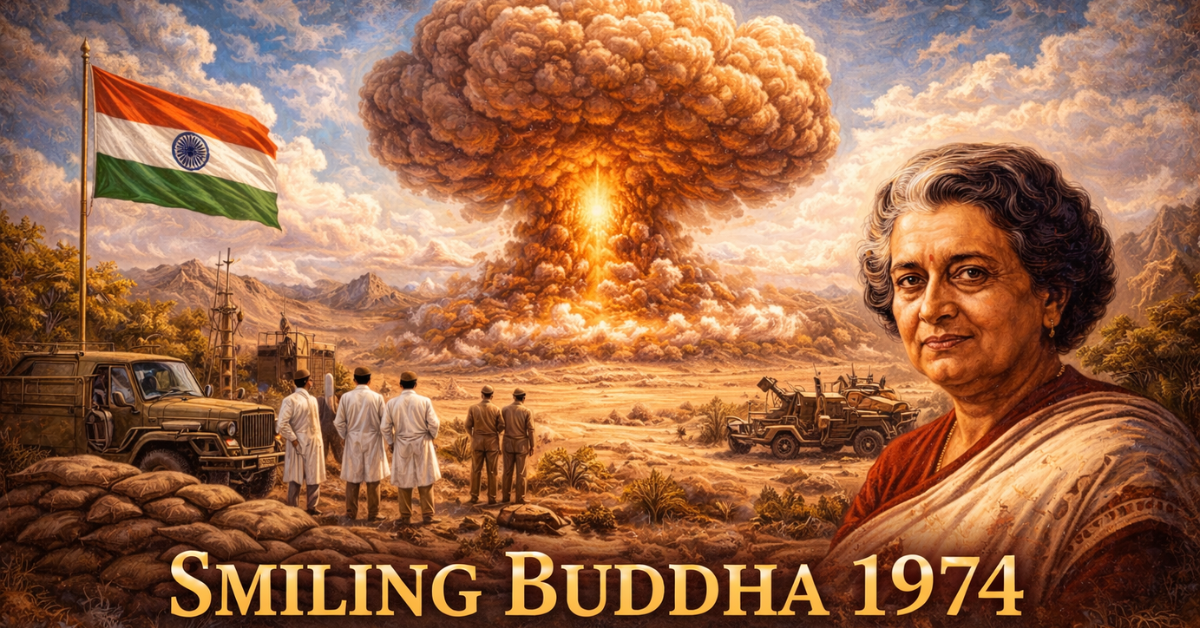
1974 Nuclear Test That Marked India’s Strategic Shift
- India conducted its first nuclear test, Smiling Buddha, on 18 May 1974 at Pokhran, establishing its nuclear capability.
- The test used a plutonium-based implosion device and was officially described as a “peaceful nuclear explosion.”
- It followed growing regional pressures, including China’s 1964 nuclear test and shifting global nuclear politics.
- The event triggered international sanctions and led to the creation of tighter nuclear export controls through the Nuclear Suppliers Group.
- Smiling Buddha laid the foundation for India’s later nuclear doctrine and its eventual declaration as a nuclear weapons state in 1998.
The event known as Smiling Buddha marked a decisive turning point in India’s strategic and technological history. Conducted on 18 May 1974 at the Pokhran Test Range in Rajasthan, it was India’s first successful nuclear explosion and the moment the country demonstrated its ability to design and detonate a nuclear device.
Although officially described as a “peaceful nuclear explosion,” the test established India as a nuclear-capable state outside the established nuclear powers, altering both regional and global strategic equations.
Historical Background: From Scientific Vision to Strategic Necessity
India’s nuclear journey began well before 1974. The foundations were laid in the 1940s and 1950s under Homi Jehangir Bhabha, who envisioned a long-term nuclear programme focused on energy independence. Institutions such as the Tata Institute of Fundamental Research and later the Department of Atomic Energy created the scientific base required for nuclear research.
In its early decades, India publicly emphasized peaceful uses of atomic energy. Prime Minister Jawaharlal Nehru supported nuclear research but remained cautious about weaponization. However, geopolitical developments gradually reshaped this position.
The 1962 war with China and China’s nuclear test in 1964 introduced new strategic pressures. India found itself in a region where nuclear capability was no longer theoretical. At the same time, global nuclear politics were being shaped by the Nuclear Non-Proliferation Treaty (NPT), which India chose not to sign, arguing that it created an unequal system between nuclear and non-nuclear states.
By the late 1960s and early 1970s, the idea of demonstrating nuclear capability had moved from theoretical discussion to active planning.
The Decision and Secrecy Behind the Test
The political decision to proceed came under Prime Minister Indira Gandhi. Approval for the test was reportedly given in 1972, after which development accelerated under strict secrecy.
Only a small circle of scientists, military officials, and political leaders were aware of the operation. Even senior cabinet members were informed only shortly before the test. The project was coordinated between the Bhabha Atomic Research Centre (BARC), the Defence Research and Development Organisation (DRDO), and the Indian Army.
The secrecy was deliberate. International scrutiny of nuclear activity was intense, and any premature disclosure could have triggered diplomatic or economic consequences before India was ready.
Technical Aspects of the Nuclear Device
The device tested during Smiling Buddha was a plutonium-based fission bomb using an implosion design. This design compresses a plutonium core using conventional explosives to achieve the critical mass required for a nuclear chain reaction.
- Type: Implosion-type fission device
- Fuel: Plutonium-239 produced in the CIRUS reactor
- Test Method: Underground shaft detonation
- Yield: Estimated between 6 and 10 kilotons of TNT equivalent
The plutonium used in the device was produced domestically, highlighting India’s growing capability in nuclear fuel processing. The design and assembly were carried out largely by Indian scientists, demonstrating a high level of indigenous technological development.
The Test: Execution at Pokhran
On the morning of 18 May 1974, at approximately 8:05 AM IST, the device was detonated in an underground shaft at Pokhran.
The test site was chosen for its remote desert location, which minimized risk to populated areas and allowed for secrecy. The explosion was contained underground, preventing the large-scale atmospheric fallout associated with earlier nuclear tests conducted by other countries.
The operation was named “Smiling Buddha” because it coincided with Buddha Purnima. After the successful detonation, the message conveyed to the Prime Minister was simple: “The Buddha has smiled.”
Immediate Impact: India Enters the Nuclear Club
With this test, India became the first country outside the five permanent members of the United Nations Security Council to conduct a nuclear explosion.
This had immediate symbolic and strategic consequences. It demonstrated that nuclear capability was no longer confined to a small group of global powers. It also marked India’s transition from a purely civilian nuclear program to one with clear strategic implications.
Domestically, the test was seen as a demonstration of scientific achievement and national capability. It reinforced confidence in India’s indigenous research institutions and technological capacity.
International Reaction and Sanctions
The global reaction was swift and largely critical. Countries such as the United States and Canada, which had previously cooperated with India on nuclear technology, expressed concern over the use of imported materials in the test.
One of the most significant outcomes was the formation of the Nuclear Suppliers Group (NSG), a coalition of countries aimed at controlling the export of nuclear materials and technology.
India faced restrictions on nuclear trade and technology access. These limitations slowed certain aspects of its nuclear programme but also pushed the country toward greater self-reliance in reactor design, fuel processing, and nuclear engineering.
Regional Consequences: Triggering a Strategic Shift
The test had a profound impact on South Asia. Pakistan, in particular, viewed the development as a direct strategic challenge. In the years that followed, it accelerated its own nuclear programme, eventually achieving nuclear capability.
This marked the beginning of a nuclearized regional security environment in South Asia, where deterrence became a central concept in military and strategic planning.
Civilian vs Military Debate
India consistently described Smiling Buddha as a “peaceful nuclear explosion.” This classification suggested that the technology could be used for civilian purposes such as mining, excavation, or scientific research.
However, many analysts and foreign governments viewed the test as a clear demonstration of weapons capability. The distinction between peaceful and military nuclear explosions was widely debated and remains contested even decades later.
In practical terms, the test established the technical foundation required for nuclear weapons development, regardless of how it was officially described.
Long-Term Significance
The true importance of Smiling Buddha lies not only in the event itself but in what followed.
First, it provided India with the technological confidence to continue developing nuclear systems. The knowledge gained from the test contributed to later advancements, including the series of tests conducted in 1998 under Operation Shakti.
Second, it reshaped India’s strategic doctrine. While India later adopted a policy of “No First Use,” the existence of nuclear capability became a central pillar of its national security framework.
Third, it reinforced the importance of indigenous development. Faced with international restrictions, India invested heavily in building domestic expertise across the nuclear fuel cycle, reactor technology, and missile delivery systems.
Legacy and Continuing Relevance
More than five decades later, Smiling Buddha remains a defining moment in India’s modern history. It represents the point at which scientific ambition, political decision-making, and strategic necessity converged.
The test did not immediately transform India into a declared nuclear weapons state. That formal declaration came only in 1998. However, 1974 was the moment when the capability was first demonstrated, and the trajectory was set.
Today, India’s nuclear policy, energy strategy, and deterrence posture all trace their roots back to this event. It stands as both a technical milestone and a geopolitical signal, reflecting a nation’s decision to operate on its own terms in a world structured by power and restraint.
In that sense, Smiling Buddha was not simply a test. It was a statement.