

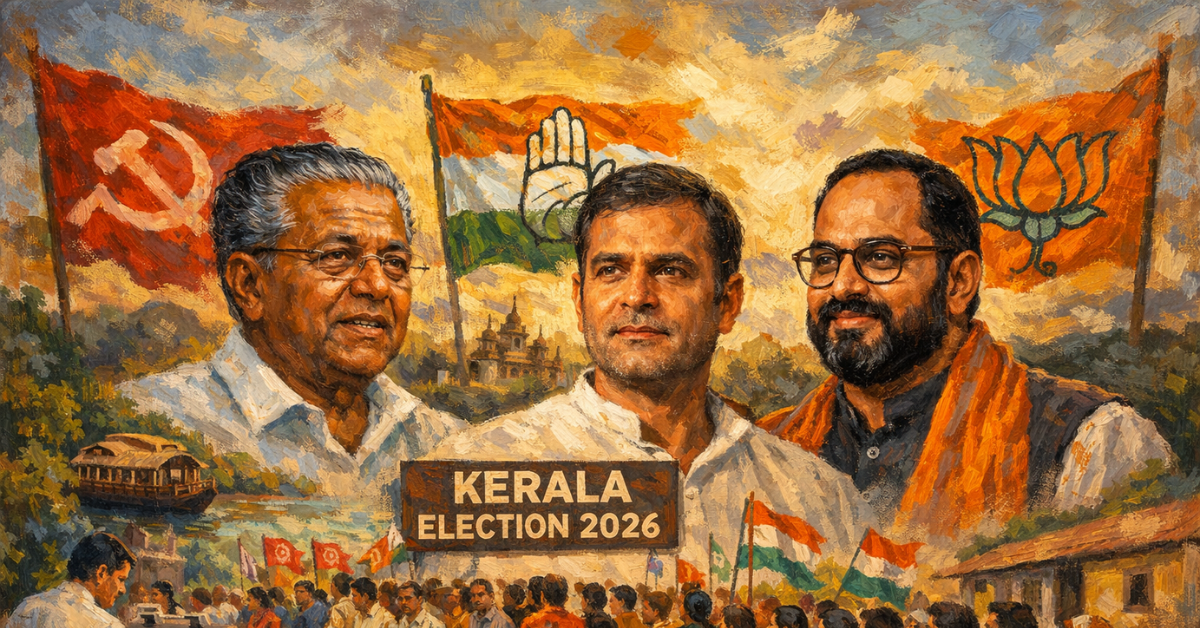
Kerala Assembly Election 2026: Continuity vs Shift
- Polling scheduled for April 9, 2026 across 140 constituencies.
- LDF seeks a historic third consecutive term.
- UDF attempts comeback on economic and governance issues.
- NDA looks to expand beyond marginal presence.
- Jobs, fiscal stability, and climate risks dominate voter concerns.
The 2026 election to the Kerala Legislative Assembly is scheduled for April 9, 2026, covering all 140 constituencies in the state. The current term of the Left Democratic Front government led by Pinarayi Vijayan concludes in May 2026, making this election a decisive test of whether Kerala’s long-standing pattern of alternating governments has truly been disrupted for the long term.
Kerala has historically followed a cyclical electoral pattern between two dominant coalitions. The 2021 election marked a structural break, with the LDF securing a second consecutive term, an outcome that shifted assumptions about voter behavior in the state. The 2026 contest therefore carries deeper significance than a routine election. It is, in effect, a referendum on continuity versus reversion.
Election Schedule and Structure
The election is being conducted in a single phase, consistent with Kerala’s relatively compact geography and strong administrative capacity.
- Polling Date: April 9, 2026
- Counting of Votes: May 4, 2026
- Completion of Process: May 6, 2026
A simple majority of 71 seats is required to form the government.
Kerala typically records among the highest voter turnouts in India, often exceeding 70 percent. This reflects both high political awareness and deeply rooted party loyalties at the grassroots level.
The Three-Front Contest
Left Democratic Front (LDF)
The Left Democratic Front, led by the Communist Party of India (Marxist), enters the election as the incumbent. Under Pinarayi Vijayan, the alliance is attempting to secure a third consecutive term, which would be historically unprecedented in Kerala.
Its campaign rests on three pillars. First, a strong welfare architecture including pension schemes, subsidised food distribution, and public healthcare expansion. Second, infrastructure development through agencies such as KIIFB, including roads, bridges, and digital connectivity. Third, crisis management, particularly during floods and the COVID-19 period, which the government continues to frame as evidence of administrative competence.
However, the LDF faces pressure on fiscal sustainability, with critics pointing to rising debt and questions over long-term economic planning.
United Democratic Front (UDF)
The United Democratic Front, led by the Indian National Congress, remains the principal challenger. After consecutive defeats in 2016 and 2021, the UDF is framing the election as an opportunity to restore balance in Kerala’s political cycle.
Their strategy combines three elements. They are emphasizing anti-incumbency, particularly around economic management and unemployment. They are also leveraging local leadership networks in districts like Malappuram and Wayanad, where the alliance traditionally performs strongly. Finally, they are attempting to consolidate minority and centrist voters who may be wary of both ideological polarization and economic uncertainty.
The UDF’s challenge lies in converting dissatisfaction into decisive seat gains, especially in closely contested constituencies.
National Democratic Alliance (NDA)
The National Democratic Alliance, led by the Bharatiya Janata Party, is attempting to transition from a marginal presence to a meaningful third force. Despite limited success in past assembly elections, the NDA sees Kerala as a long-term strategic frontier.
The entry of high-profile figures such as Rajeev Chandrasekhar into state politics signals a more aggressive approach. The NDA’s campaign focuses on development, governance efficiency, and alignment with the central government.
Its primary constraint remains structural. Kerala’s political landscape has historically been resistant to the BJP’s expansion, though incremental gains in vote share could influence tight contests.
Core Issues Driving the Election
Several structural concerns are shaping voter sentiment across the state.
Unemployment: Unemployment remains central. Kerala’s high literacy rates contrast with limited local job creation, leading to sustained outward migration, especially among youth.
Economic stability: Economic stability is under scrutiny. The balance between welfare spending and fiscal discipline has become a key debate, with competing narratives around sustainability versus social protection.
Infrastructure: Infrastructure development continues to be a visible marker of governance, particularly in urban regions and transport networks.
Environmental vulnerability: Environmental vulnerability has become more prominent. Recurrent flooding, landslides in the Western Ghats, and coastal erosion have made climate resilience a decisive policy area rather than a peripheral concern.
Pre-Poll Projections and Electoral Math
Early opinion polls suggest a competitive contest with a slight edge to the UDF, though margins remain narrow and regionally varied.
| Alliance | Projected Seats | Vote Share |
|---|---|---|
| UDF | 77 – 81 | 42% – 44% |
| LDF | 58 – 62 | 39% – 41% |
| NDA | 1 – 2 | 14% – 16% |
These projections indicate a potential shift but not a decisive wave. Kerala’s electoral behavior often produces tightly contested outcomes, and late swings can significantly alter final results.
Key Battleground: Nemom
The Nemom constituency has emerged as one of the most closely watched contests in the state. It represents a rare triangular battle involving prominent leaders from all three alliances.
- V. Sivankutty (LDF)
- Rajeev Chandrasekhar (NDA)
- K. S. Sabarinadhan (UDF)
Nemom is symbolically significant because it has previously been a breakthrough seat for the BJP in Kerala. A victory here for any alliance would carry narrative weight beyond its single seat value, shaping perceptions of momentum across the state.
Structural Significance of the 2026 Election
This election is not merely a contest for power but a test of Kerala’s evolving political equilibrium. If the LDF secures a third term, it would confirm a long-term shift away from alternating governments. If the UDF returns to power, it would reaffirm the resilience of Kerala’s traditional bipolar structure. If the NDA expands its footprint, even modestly, it could begin to reshape future electoral arithmetic.
The outcome will therefore influence not only governance for the next five years but also the underlying logic of electoral competition in Kerala.