


Jewar Airport Inaugurated: Western UP Gets a New Economic Gateway
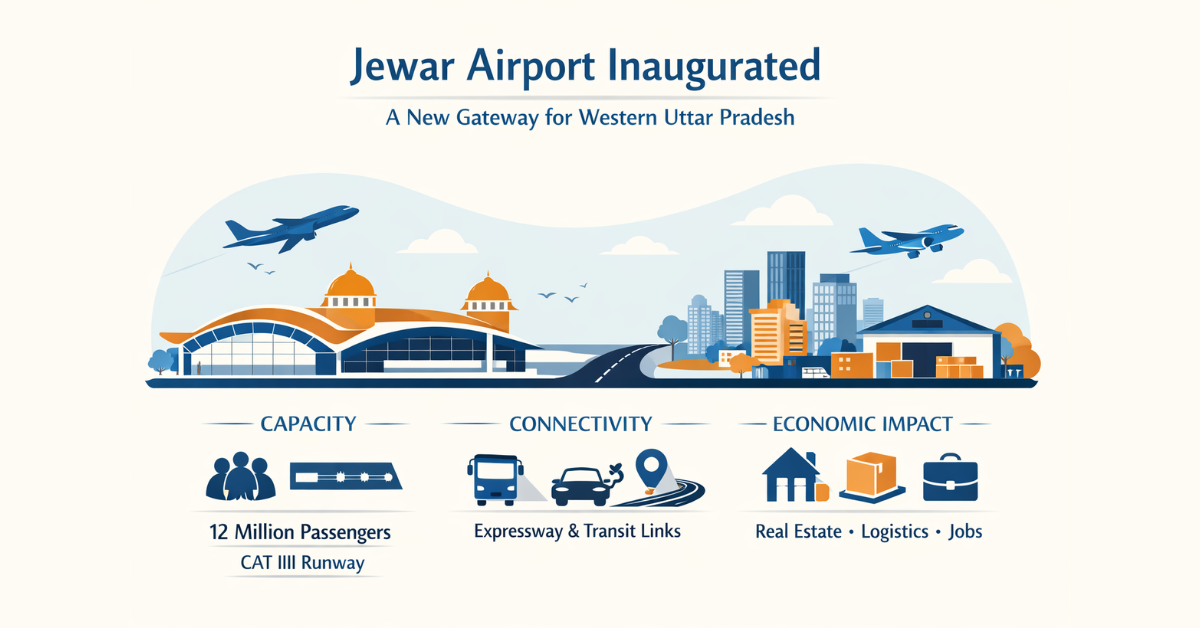
- Launch event: Phase I of Noida International Airport inaugurated on March 28, 2026.
- Capacity: Designed to handle 12 million passengers annually with CAT III runway capability.
- Operations timeline: Commercial flights expected between mid-April and May 2026.
- Connectivity: Direct expressway access and expanded regional transport network.
- Impact: Major boost expected for real estate, logistics, jobs, and regional growth.
The inauguration of Noida International Airport at Jewar on March 28, 2026 marks a turning point in the infrastructure landscape of northern India. Developed as a greenfield aviation hub, the airport is positioned not only as a relief point for Delhi NCR’s growing air traffic but also as a long-term economic anchor for western Uttar Pradesh. The project enters service at a time when the state is actively pushing infrastructure-led growth across expressways, industrial zones, and logistics networks.
Inauguration Day: High Security and Controlled Movement
The opening ceremony was conducted under tight security arrangements, with multiple agencies deployed across the airport zone and surrounding corridors. Movement restrictions were enforced along the Yamuna Expressway and Noida-Greater Noida routes, with diversions in place for heavy vehicles throughout the day. The event followed a structured schedule, including a site inspection and a formal public address.
Traffic advisories remained active until late evening, reflecting both the scale of the gathering and the sensitivity of the infrastructure being inaugurated. The level of coordination required offered an early glimpse into the operational complexity that will define the airport once passenger services begin.
Phase I Infrastructure: Capacity, Design and Technology
Phase I of the airport has been developed at an estimated cost of ₹11,200 crore, with an initial passenger handling capacity of 12 million annually. The infrastructure includes a 3,900-meter runway equipped with Category III Instrument Landing System, allowing aircraft to operate even under dense fog conditions, a recurring challenge in north India during winter months.
The terminal design incorporates elements inspired by Indian architectural traditions, including open courtyards and stepped layouts. At the same time, the facility is designed with sustainability targets, including energy-efficient systems and a long-term goal of achieving net-zero emissions. The combination of traditional design references with modern engineering reflects an attempt to balance identity with functionality.
Commercial Operations Timeline and Airline Plans
Despite the formal inauguration, passenger flights will begin only after a phased rollout. Current aviation notices indicate that the airport may become operational for commercial services after mid-April 2026, with some timelines extending into May depending on final clearances and readiness checks.
Initial operations will focus on domestic routes, with multiple low-cost and regional carriers preparing to commence services. International connectivity is expected to follow once domestic traffic stabilizes. This staggered approach is intended to reduce operational pressure during the early months and allow systems to scale gradually.
Connectivity and Mobility Integration
One of the defining features of the airport is its integration with regional transport infrastructure. A direct link road connects the airport to the Yamuna Expressway, reducing travel time to cities such as Agra, Mathura, and Vrindavan to roughly two hours. This positions the airport not only as an NCR facility but as a gateway for tourism and regional travel.
State-run bus services have been expanded to connect the airport with over two dozen cities, while electric taxi networks are being introduced to support last-mile connectivity. Over time, additional rail and metro links are expected to strengthen accessibility, which will be critical in determining passenger adoption rates.
Logistics and Cargo Potential
Beyond passenger travel, the airport has been designed with a significant focus on cargo operations. Phase I includes facilities capable of handling approximately 2.5 lakh metric tonnes of freight annually. This creates an opportunity to develop a logistics hub serving industries in Noida, Greater Noida, and adjoining regions.
Sectors such as electronics manufacturing, pharmaceuticals, perishables, and e-commerce stand to benefit from faster air cargo movement. However, the full realization of this potential will depend on parallel development of warehousing, cold storage, and customs infrastructure.
Economic Impact on Uttar Pradesh
The most immediate economic effect of the airport is visible in the real estate market along the Yamuna Expressway corridor. Land prices have already seen sustained growth, with projections indicating further appreciation over the next two years. Residential townships, commercial developments, and warehousing clusters are beginning to take shape around the airport zone.
Employment generation is expected to follow in both direct and indirect forms. Jobs in aviation operations, security, maintenance, and administration will be supplemented by opportunities in transport, hospitality, retail, and logistics. This diversification is particularly significant for a state where a large portion of the workforce remains tied to agriculture and informal sectors.
Social Impact and Changing Mobility Patterns
Improved air connectivity has broader social implications that extend beyond economics. Easier access to flights can reshape how people travel for education, employment, and business. For many residents of western Uttar Pradesh, the presence of a nearby airport reduces dependence on distant urban centers and brings new opportunities within reach.
The airport also contributes to a shift in regional identity. Cities like Noida and Greater Noida, already emerging as industrial and technology hubs, gain additional credibility as globally connected urban centers. This change influences both internal migration patterns and external investment interest.
Growth Outlook: A Long-Term Infrastructure Anchor
The airport aligns with Uttar Pradesh’s broader strategy of infrastructure-led development. Over the past decade, investments in expressways, industrial corridors, and logistics parks have laid the groundwork for higher economic activity. The Jewar airport acts as a convergence point for these investments, potentially increasing their overall efficiency.
Lower logistics costs, improved connectivity, and enhanced investor confidence could contribute to sustained economic growth in the region. However, this outcome will depend on timely expansion phases, efficient management, and the development of supporting infrastructure.
What has been inaugurated is only the first phase of a much larger vision. The coming years will determine how effectively this infrastructure translates into measurable economic and social gains. If execution remains consistent, the airport could evolve into one of the most influential growth drivers in northern India.