


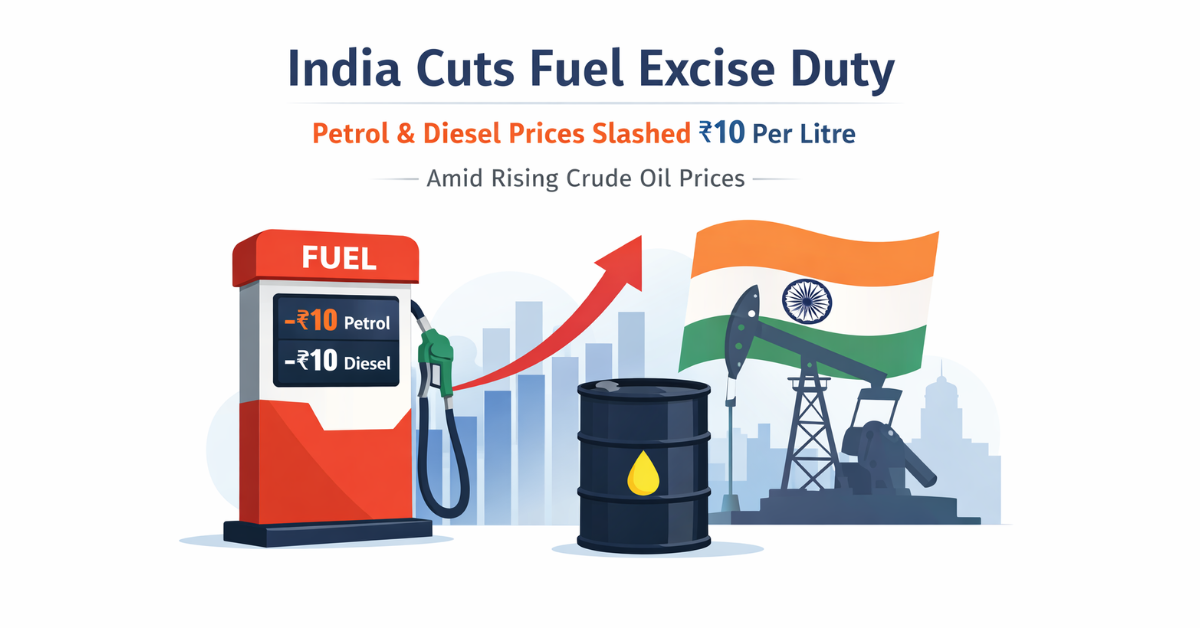
India Cuts Fuel Excise Duty Amid West Asia Crisis and Rising Crude Prices
- Centre reduces excise duty on petrol by ₹10 and diesel by ₹10, effective March 27, 2026.
- Petrol duty now stands at ₹3 per litre, while diesel duty has been reduced to zero.
- Move aims to shield consumers from global oil price shocks rather than reduce pump prices immediately.
- State-run oil companies expected to recover losses absorbed over recent months.
- Export duty imposed on diesel and ATF to prioritise domestic supply amid volatility.
The Union government has announced a significant reduction in central excise duty on petrol and diesel, effective March 27, 2026, in response to rising global crude oil prices and escalating geopolitical tensions in West Asia. The notification, issued by the Ministry of Finance late on March 26, signals a calibrated intervention aimed at stabilising domestic fuel markets rather than triggering an immediate drop in retail prices.
Extent of the Excise Duty Reduction
According to the official notification, the central excise duty on petrol has been reduced by ₹10 per litre, bringing it down from ₹13 to ₹3. Diesel has seen an equivalent cut of ₹10, effectively bringing the central excise duty to zero. This marks one of the most aggressive tax reductions on fuel in recent years and reflects the urgency of the situation faced by policymakers.
Fuel taxation in India is shared between the Centre and states, with the latter levying value-added tax (VAT). While the central excise component has been sharply reduced, state taxes remain unchanged for now, which limits the immediate pass-through of benefits to end consumers.
Global Crude Oil Context and West Asia Crisis
The duty cut comes against the backdrop of rising global crude oil prices, with Brent crude currently hovering between $100 and $107 per barrel. This surge is largely attributed to renewed instability in West Asia, a region critical to global energy supplies. Supply disruptions, shipping risks, and precautionary inventory build-ups have all contributed to the upward pressure on prices.
India, which imports over 80 percent of its crude oil requirements, remains highly sensitive to such global price fluctuations. Even a moderate increase in crude prices can have a cascading effect on inflation, fiscal balances, and the current account deficit.
Why Retail Fuel Prices May Not Drop Immediately
Despite the scale of the tax reduction, consumers are unlikely to see an immediate drop in petrol and diesel prices at state-run outlets operated by Indian Oil Corporation (IOCL), Bharat Petroleum (BPCL), and Hindustan Petroleum (HPCL). The primary reason lies in the financial position of these oil marketing companies.
Over the past several months, state-run firms have absorbed substantial under-recoveries to keep retail fuel prices stable despite rising global costs. This was done to contain inflationary pressures, particularly ahead of key economic cycles. The excise duty cut is therefore designed to ease the financial burden on these companies rather than reduce prices further.
Officials have indicated that without this intervention, oil companies would have been forced to increase retail prices significantly. In that sense, the move acts as a preventive measure, protecting consumers from future price hikes rather than delivering immediate relief.
Private Retailers and Diverging Price Trends
The divergence between public and private fuel retailers has also become more visible in recent weeks. Private player Nayara Energy, which operates a growing network of fuel stations across India, recently raised petrol prices by ₹5 per litre and diesel by ₹3 to reflect higher procurement costs.
Unlike state-run companies, private firms typically adjust prices more dynamically in response to global trends, which can result in visible differences at the pump. This contrast highlights the balancing act between market-linked pricing and administrative intervention in India’s fuel sector.
Current Fuel Prices in Major Cities
| City | Petrol (₹/litre) | Diesel (₹/litre) |
|---|---|---|
| New Delhi | ₹94.77 | ₹87.67 |
| Mumbai | ₹103.54 | ₹90.03 |
| Bengaluru | ₹102.92 | ₹90.99 |
| Chennai | ₹100.84 | ₹92.39 |
Prices at most state-owned fuel stations have remained stable as of March 27, reflecting the government’s directive to avoid immediate revisions. However, these levels are being maintained at the cost of oil company margins, which the duty cut now seeks to restore.
Export Duty and Supply Management Measures
In addition to the excise duty reduction, the government has imposed an export tax on diesel and aviation turbine fuel (ATF). This step is intended to ensure adequate domestic availability of key petroleum products during a period of heightened global uncertainty.
India has, in recent years, emerged as a significant exporter of refined petroleum products. However, during periods of global shortage or price spikes, there is a risk that domestic supply could tighten as refiners prioritise exports for higher margins. The export duty acts as a deterrent against such shifts, ensuring that domestic demand is met first.
Fiscal Impact and Policy Trade-offs
The reduction in excise duty will have a direct impact on government revenues. Fuel taxes have historically been a major source of income for the Centre, particularly during periods of elevated consumption. A ₹10 per litre cut on both petrol and diesel is expected to result in a substantial revenue loss over the coming months.
However, policymakers appear to have prioritised macroeconomic stability over short-term fiscal considerations. By containing fuel prices, the government aims to keep inflation under control, which in turn supports consumption and economic growth. This trade-off reflects a broader shift in fiscal strategy during periods of external shocks.
Inflation, Consumption, and Economic Outlook
Fuel prices play a critical role in shaping inflation trends in India, given their direct and indirect impact on transportation, logistics, and production costs. A sustained rise in fuel prices can quickly translate into higher food prices and broader cost-of-living pressures.
By absorbing part of the price shock through tax cuts, the government is attempting to break this transmission cycle. While the immediate effect may not be visible at the pump, the policy helps anchor inflation expectations and reduces the likelihood of a broader price spiral.
Economists suggest that the effectiveness of this measure will depend on the trajectory of global crude prices in the coming weeks. If prices stabilise or decline, there may be room for partial pass-through to consumers. However, if geopolitical tensions persist and crude continues to rise, the current relief may only serve as a buffer against further increases.
Policy Direction in a Volatile Energy Market
The latest excise duty cut underscores the government’s flexible approach to fuel taxation in response to global developments. Over the past decade, fuel taxes have been adjusted multiple times to balance revenue needs with market conditions.
This episode highlights the structural vulnerability of India’s energy framework, which remains heavily dependent on imports. While efforts are ongoing to diversify energy sources and expand domestic production, crude oil continues to dominate the country’s energy mix.
In the near term, the focus remains on managing volatility and ensuring supply stability. The combination of tax cuts and export restrictions reflects a coordinated strategy to navigate a complex and rapidly evolving global energy landscape.
What Comes Next for Fuel Prices
The immediate outlook for fuel prices in India remains tied to international crude movements and the financial position of oil marketing companies. While the excise duty cut provides breathing room, it does not eliminate underlying cost pressures.
Consumers may not see a reduction in prices in the short term, but the policy significantly lowers the risk of sharp increases. In effect, the government has chosen to prioritise stability over visibility, cushioning the system from external shocks while keeping inflation in check.
As the situation in West Asia evolves and global markets respond, further policy adjustments cannot be ruled out. For now, the excise duty cut stands as a pre-emptive measure, designed less as immediate relief and more as a safeguard against an uncertain energy future.