


India’s LPG–PNG Transition: Policy Push Meets Ground Reality
- No mandatory switch order: No official notification confirms a 90-day deadline to shift from LPG to PNG.
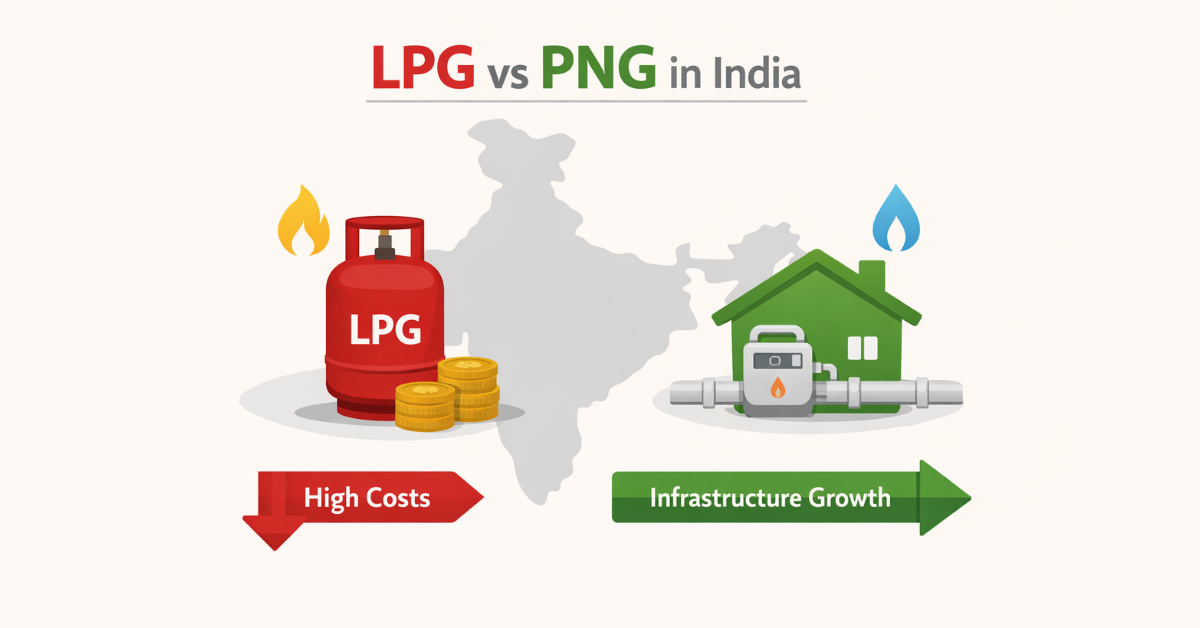
- Prices under pressure: LPG remains costlier due to global factors, while PNG stays relatively stable in major cities.
- Infrastructure-led transition: Expansion of city gas networks continues, but coverage remains uneven.
- Global supply diversification: India is gradually reducing dependence on Gulf LPG through diversified imports.
- Urban-rural divide persists: PNG growth is limited to cities, while LPG remains essential in rural India.
India’s household fuel ecosystem is undergoing a gradual but notable shift as policymakers push for wider adoption of piped natural gas (PNG). The transition is being shaped by global energy uncertainties, rising LPG costs, and long-term domestic energy goals. However, several claims circulating about compulsory conversion and supply restrictions do not align with verified government policy.
Policy Direction and Misinterpretation of Recent Claims
Concerns around global supply disruptions, particularly involving the Strait of Hormuz, have drawn attention to India’s dependence on imported LPG. While this maritime route is critical to global energy flows, there is no confirmed official record of a complete closure triggering emergency domestic fuel rationing.
Similarly, there is no verified notification from the Ministry of Petroleum and Natural Gas under the Essential Commodities Act mandating a forced switch from LPG to PNG within a fixed timeframe. No directive authorizes oil marketing companies to permanently discontinue LPG supply for households that do not adopt PNG.
These claims appear to be overstated interpretations of broader policy efforts aimed at expanding PNG infrastructure and encouraging cleaner fuel adoption.
LPG Supply and Pricing Trends
LPG pricing in India is influenced by international benchmarks, currency fluctuations, and freight costs. Public sector oil marketing companies such as Indian Oil Corporation, Bharat Petroleum Corporation Limited, and Hindustan Petroleum Corporation Limited revise prices periodically based on these factors.
As of early 2026, LPG prices have seen upward pressure compared to previous years. However, there is no officially mandated nationwide restriction on booking intervals or supply rationing. Delivery timelines may vary due to logistical factors, but not as part of a formal policy.
Commercial LPG prices also fluctuate depending on market conditions, though there is no confirmed policy directing large-scale diversion of supply toward specific sectors such as community kitchens.
PNG Expansion and Urban Adoption
The expansion of PNG infrastructure is being overseen by the Petroleum and Natural Gas Regulatory Board as part of India’s broader strategy to increase the share of natural gas in its energy mix. City gas distribution networks have been expanding steadily across urban regions.
In cities such as Delhi and Mumbai, PNG has emerged as a cost-effective alternative to LPG for many households. Companies like Indraprastha Gas Limited and Mahanagar Gas Limited continue to extend pipeline connectivity to residential areas.
PNG offers continuous supply, eliminates the need for cylinder storage, and often provides cost advantages over non-subsidized LPG. These factors are encouraging voluntary adoption rather than enforced transition.
Regulatory Framework and Infrastructure Reforms
There is no confirmed nationwide rule banning dual LPG and PNG connections. Many households continue to maintain LPG as a backup even after adopting PNG.
Claims suggesting that housing societies must grant pipeline access within three days or face legal override are not supported by any published central regulation. Pipeline installation still requires coordination with municipal authorities, safety clearances, and local consent processes.
That said, the government has taken steps to streamline approvals. These include standardizing procedures for pipeline laying, rationalizing road-cutting charges, and expanding authorized areas for gas distribution. Such measures are intended to reduce delays rather than impose coercive mandates.
Global Supply Strategy and Import Diversification
India has been working to diversify its LPG import sources over the past decade. The United States has become an increasingly important supplier due to its shale gas production, and long-term contracts have been part of this strategy.
However, there is no verified data confirming a sudden shift to large-scale imports from Argentina or a complete transition away from Gulf suppliers. While domestic refineries, including facilities operated by Reliance Industries Limited, contribute to LPG production, India continues to rely significantly on imports.
The broader trend is one of gradual diversification rather than abrupt realignment of supply chains.
Urban–Rural Divide in Fuel Access
The transition toward PNG is largely limited to urban and semi-urban regions where pipeline infrastructure exists. In rural areas, LPG remains the primary clean cooking fuel.
Government schemes such as the Pradhan Mantri Ujjwala Yojana continue to play a crucial role in providing LPG access to economically weaker households. Infrastructure limitations make any immediate nationwide transition to PNG impractical.
As a result, India’s fuel landscape remains dual in nature, with LPG dominating rural usage and PNG gradually expanding in cities.
Economic and Structural Implications
From an economic perspective, PNG offers long-term efficiency benefits. It reduces logistical costs associated with cylinder distribution and provides more stable pricing in many cases.
However, the expansion of PNG infrastructure requires substantial capital investment. The transition must therefore be phased and aligned with infrastructure readiness to avoid disruption.
For households, the decision to switch is currently driven by cost, convenience, and availability rather than regulatory compulsion.
Current Consumer Reality
For most consumers across India, LPG continues to be available without any mandatory restrictions. Prices may fluctuate, but supply remains consistent.
PNG is an option primarily in urban areas, and adoption is increasing where infrastructure permits. There is no verified deadline requiring households to abandon LPG connections.
The situation reflects a gradual transition rather than an immediate structural shift.
Outlook: Gradual Transition, Not Sudden Shift
India’s long-term energy strategy clearly favors increased use of natural gas, including PNG for households. This shift is being driven by infrastructure expansion, pricing dynamics, and energy security considerations.
However, there is no evidence of abrupt or compulsory measures forcing households to transition within a fixed timeline. The evolution of India’s household fuel system is expected to remain incremental, balancing urban modernization with rural accessibility.