


Government Advances 8th Pay Commission Framework
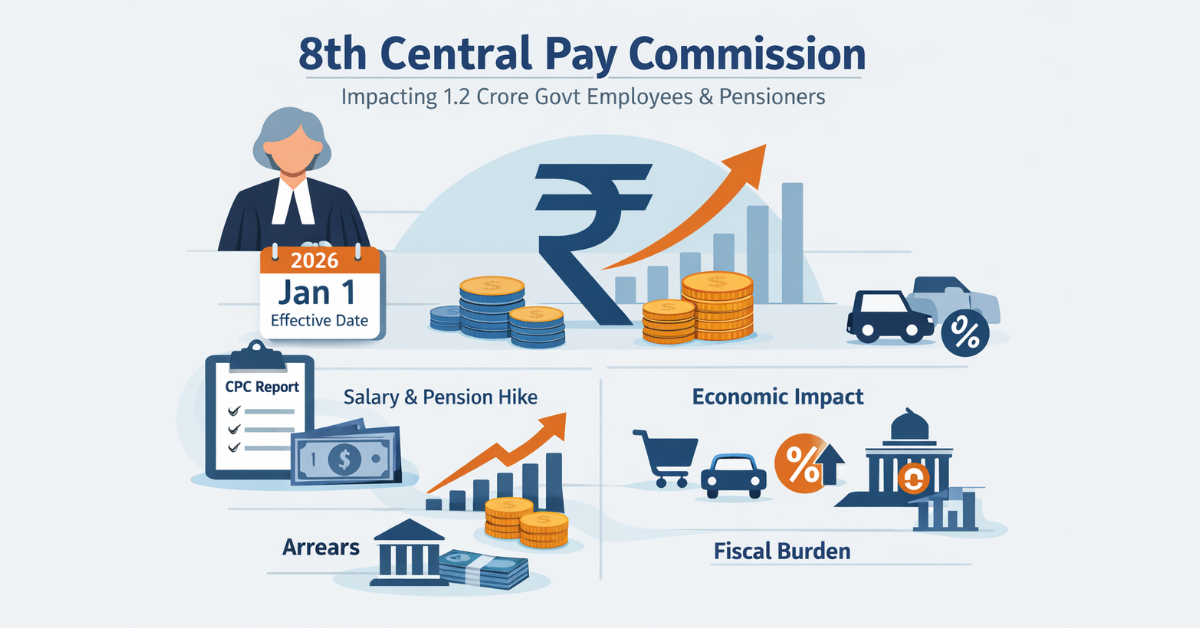
- The Government of India constituted the 8th Central Pay Commission in November 2025.
- Over 1.2 crore employees and pensioners will be affected.
- Revised pay is expected to be effective from January 1, 2026, with arrears.
- Consultations are underway, with stakeholder inputs closing by April 30, 2026.
- Final recommendations are expected by May 2027, with significant economic implications.
The Government of India has initiated the 8th Central Pay Commission (CPC), setting in motion a major revision of salaries, pensions, and allowances for more than 1.2 crore central government employees and pensioners. The exercise follows the conclusion of the 7th CPC cycle on December 31, 2025, and arrives at a time when India is managing steady growth alongside inflation concerns and fiscal constraints.
Chaired by Justice Ranjana Prakash Desai, the commission has begun consultations with stakeholders across departments, unions, and pensioner groups. The recommendations, once finalized, are expected to influence not only government compensation structures but also broader economic activity.
Formation, Leadership, and Timeline
The government formally notified the constitution of the 8th Central Pay Commission on November 3, 2025. This follows the established pattern of periodic pay revisions intended to align public sector wages with current economic conditions and cost of living.
The commission has been given 18 months to submit its report, placing the expected timeline around May 2027. Despite this extended process, the revised pay structure is expected to be implemented retrospectively from January 1, 2026.
This retrospective structure is consistent with past commissions and results in accumulated arrears that are paid once implementation begins. The eventual payout is therefore expected to include both revised salaries and pending dues.
Consultation Phase and Stakeholder Participation
As of March 2026, the commission is in its consultation phase. A structured questionnaire has been released on the MyGov portal, inviting feedback from employees, pensioners, and the public. Responses are being accepted until March 31, 2026.
In addition, formal memoranda from employee unions and associations are being collected until April 30, 2026. These submissions are expected to shape key recommendations, particularly around salary structure and pension revisions.
Employee unions have actively raised demands regarding minimum pay and fitment factors, indicating strong expectations of substantial revisions.
Expected Salary and Pension Revisions
The fitment factor remains central to the revision process. It determines how existing salaries are multiplied to arrive at new pay levels. While the 7th CPC used a factor of 2.57, current demands range between 2.86 and 3.25.
Based on these projections, the minimum basic pay could rise from ₹18,000 to approximately ₹54,000 to ₹57,000. This would represent a significant increase, particularly for entry-level employees.
Similarly, minimum pensions could increase from ₹9,000 to around ₹25,000 per month. These figures are not yet finalized but reflect the scale of expected revisions under the new commission.
Implementation Timeline and Arrears
Although the revised pay will be effective from January 1, 2026, actual implementation is likely to take place later. Based on previous pay commission cycles, employees may begin receiving revised salaries between late 2026 and mid-2027.
The delay between effective date and disbursement leads to the accumulation of arrears. These arrears, covering the period from January 2026 until implementation, are expected to be paid either in lump sums or installments.
Such payouts often result in a temporary increase in household liquidity, influencing spending patterns across sectors.
Impact on the Indian Economy
Consumption and Demand Growth
An increase in salaries and pensions typically leads to higher disposable income, which in turn boosts consumption. Sectors such as housing, automobiles, consumer goods, and services tend to see increased demand following pay commission implementations.
Given the scale of beneficiaries, the 8th CPC is expected to create a broad-based consumption effect, particularly in tier-2 and tier-3 cities where a large number of government employees reside.
Inflation Considerations
Higher consumption levels may contribute to inflationary pressures, especially if supply does not keep pace with demand. This is particularly relevant for essential goods and housing markets.
The Reserve Bank of India may need to monitor these developments and adjust monetary policy if necessary to maintain price stability.
Fiscal Impact
The implementation of the 8th CPC will increase government expenditure significantly. Higher salary and pension commitments could widen the fiscal deficit unless offset by increased revenue or expenditure adjustments elsewhere.
The final fiscal burden will depend on the approved fitment factor and extent of revisions. Past pay commissions have added considerable pressure on government finances in the short term.
Spillover to Private Sector Wages
Public sector pay revisions often influence wage expectations in the private sector. Companies, particularly in sectors competing for skilled labor, may face pressure to adjust compensation structures.
This indirect effect can lead to broader wage inflation across the economy, especially in urban employment markets.
Long-Term Economic Context
While the 8th CPC is expected to stimulate demand in the short term, its long-term impact will depend on how effectively the government balances increased expenditure with fiscal discipline.
If managed carefully, the revisions could support economic growth by strengthening consumption. However, if not aligned with revenue growth, they could strain public finances and limit future policy flexibility.
What Comes Next
The commission will continue its consultations through April 2026, after which it will begin detailed analysis and drafting of recommendations. The final report, expected by May 2027, will then be reviewed by the government before implementation.
For employees and pensioners, the process represents a significant opportunity for income revision. For the broader economy, it marks a critical moment that will influence consumption, inflation, and fiscal policy over the coming years.