


Shift in Law: Lok Sabha Passes Transgender Rights Amendment
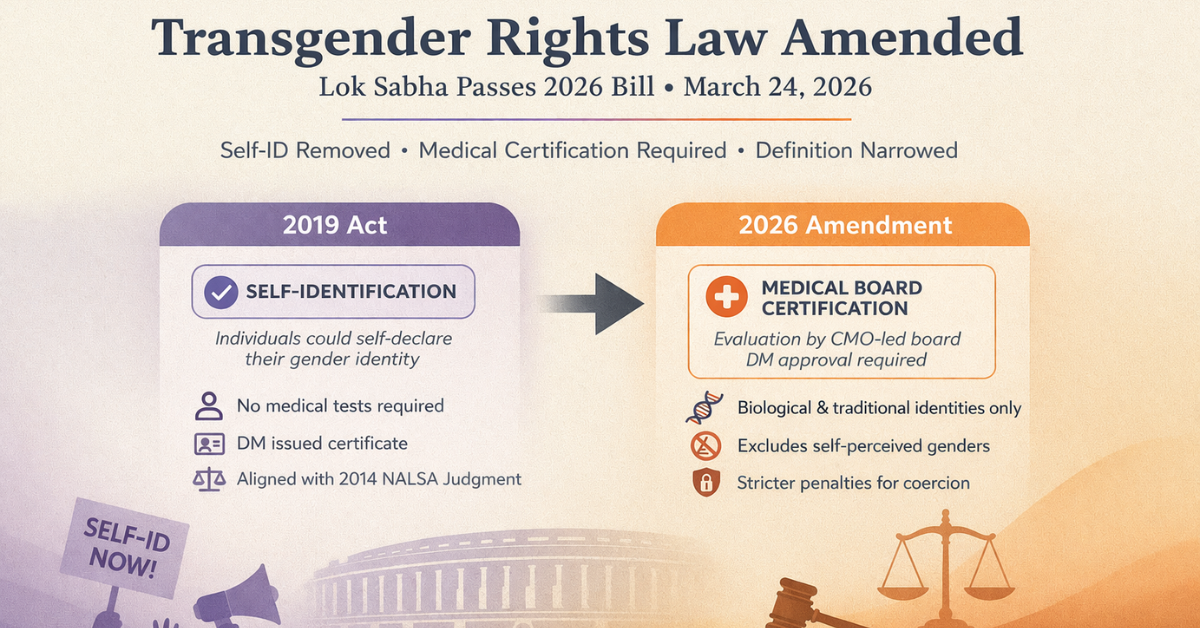
- Lok Sabha Passage: The Transgender Persons (Protection of Rights) Amendment Bill, 2026 was passed on March 24, 2026, by voice vote.
- End of Self-Identification: The amendment removes the earlier provision allowing individuals to self-declare their gender identity.
- Medical Certification Introduced: Identity recognition now requires evaluation by a Medical Board before approval by the District Magistrate.
- Definition Narrowed: The law focuses on biological conditions and traditional transgender communities while excluding self-perceived identities.
- Opposition and Protests: Critics cite conflict with the 2014 NALSA judgment and lack of consultation with the transgender community.
On March 24, 2026, the Lok Sabha passed the Transgender Persons (Protection of Rights) Amendment Bill, 2026, introducing a revised legal framework that alters key aspects of the 2019 law governing transgender rights in India. The bill was passed by voice vote during a session marked by an Opposition walkout, and it has since generated public debate and criticism from activists, legal experts, and members of the transgender community.
Background: The 2019 Legal Framework
The Transgender Persons (Protection of Rights) Act, 2019 was enacted to provide legal recognition and protection to transgender individuals in India. One of its central features was the principle of self-identification, which allowed a person to declare their gender identity without mandatory medical intervention. This provision was widely seen as aligned with the Supreme Court’s 2014 judgment in the National Legal Services Authority (NALSA) v. Union of India case, which affirmed that gender identity is an integral part of personal autonomy and dignity under Article 21 of the Constitution.
The 2019 Act also outlined measures related to non-discrimination, welfare schemes, and access to education, healthcare, and employment. However, it faced criticism from sections of the community for procedural gaps and implementation challenges.
Removal of Self-Identification Provision
The 2026 amendment marks a significant departure from the earlier framework by removing the provision that allowed individuals to self-perceive and declare their gender identity. Under the revised structure, gender identity is no longer treated solely as a matter of personal declaration. Instead, recognition is tied to institutional verification processes.
This change has become the most debated aspect of the amendment. Supporters argue that it introduces clarity and prevents misuse of benefits, while critics view it as a reversal of a rights-based approach that recognized individual autonomy.
Introduction of Medical Certification Process
The amendment introduces a formal procedure requiring individuals to undergo examination by a Medical Board to obtain a certificate of identity. This board is typically headed by a Chief Medical Officer and is responsible for evaluating the applicant before making a recommendation.
Following this recommendation, the District Magistrate may issue the certificate of identity. Without approval from the Medical Board, the certificate cannot be granted. This system places administrative and medical authorities at the centre of the recognition process.
Critics have described this approach as creating institutional barriers, while the government maintains that it ensures proper verification and safeguards the integrity of welfare measures.
Revised Definition of Transgender Person
The amendment redefines the term “transgender person” with a focus on biological characteristics and established socio-cultural identities. It explicitly includes traditional communities such as Kinner, Hijra, Aravani, and Jogta, which have long-standing social recognition in India.
It also includes individuals with intersex variations or congenital biological conditions involving chromosomal, hormonal, or physical differences. At the same time, the amendment excludes categories based on sexual orientation or self-perceived gender identity and clarifies that the law is not intended to cover gender fluid identities.
This narrowing of the definition has raised concerns among activists who argue that it may exclude individuals who were previously covered under the broader framework of the 2019 Act.
Stricter Penal Provisions for Coercion
The amendment introduces new criminal provisions addressing coercion related to transgender identity. It creates a category of offences for forcing an individual into a transgender identity through medical procedures, deception, or pressure.
For adults, such acts may attract imprisonment ranging from ten years to life. In cases involving minors, the punishment includes rigorous life imprisonment along with a minimum fine of ₹5 lakh. The amendment also prescribes stricter penalties for forcing individuals into begging under the guise of transgender identity, with imprisonment ranging from five to fourteen years.
These provisions have been presented by the government as safeguards against exploitation and abuse.
Government’s Position and Rationale
The government has defended the amendment as a necessary step to protect individuals who face social exclusion due to biological conditions and traditional marginalisation. Union Minister for Social Justice and Empowerment Dr. Virendra Kumar stated during the parliamentary discussion that the earlier definition was too broad and could lead to misuse of welfare schemes and reservations.
According to the government, the revised framework aims to ensure that benefits reach those who are historically disadvantaged and part of recognized transgender communities. The minister described the amendment as an effort to bring clarity, structure, and targeted support within the legal system.
Opposition Concerns and Legal Questions
Opposition parties, including members from the Congress, Trinamool Congress, and DMK, raised concerns during the parliamentary proceedings. The bill was passed amid a walkout, limiting extended debate within the House.
A central argument from critics is that the amendment may conflict with the Supreme Court’s NALSA judgment of 2014, which recognized self-determined gender identity as a fundamental right. Legal experts have noted that requiring medical certification could be interpreted as inconsistent with that ruling.
Another concern relates to the lack of consultation. Activists and advocacy groups have stated that the government did not adequately engage with transgender communities or the National Council for Transgender Persons before introducing the amendment.
Concerns Over Exclusion and Recognition
One of the most widely expressed concerns is the potential exclusion of individuals who do not fall within the revised definition. Activists argue that trans men, trans women, and non-binary individuals who do not belong to traditional socio-cultural groups or do not meet biological criteria may face difficulties in obtaining legal recognition.
This could affect access to identity documents, welfare schemes, and legal protections. Critics have described this as a risk of erasing segments of the transgender community from formal recognition under the law.
Public Response and Protests
Following the passage of the bill, protests were reported in several cities, with activists and community members expressing concern over the changes. Demonstrators have called for the restoration of self-identification rights and greater consultation in policymaking processes.
Advocacy groups have also indicated that they may pursue legal remedies if the amendment is enacted in its current form. Public discussions have continued across legal, academic, and social platforms, reflecting the broader implications of the changes.
Next Legislative Steps
After its passage in the Lok Sabha, the Transgender Persons (Protection of Rights) Amendment Bill, 2026 is expected to be taken up by the Rajya Sabha for further consideration. The Upper House may debate, amend, or approve the bill before it can proceed to the final stages of enactment.
The outcome of these deliberations will determine the final shape of the law and its implementation across the country. The amendment has already become a focal point in discussions around rights, recognition, and the balance between administrative regulation and individual autonomy.