


ChatGPT Platform Updates: Models, Tools, and Ads Test
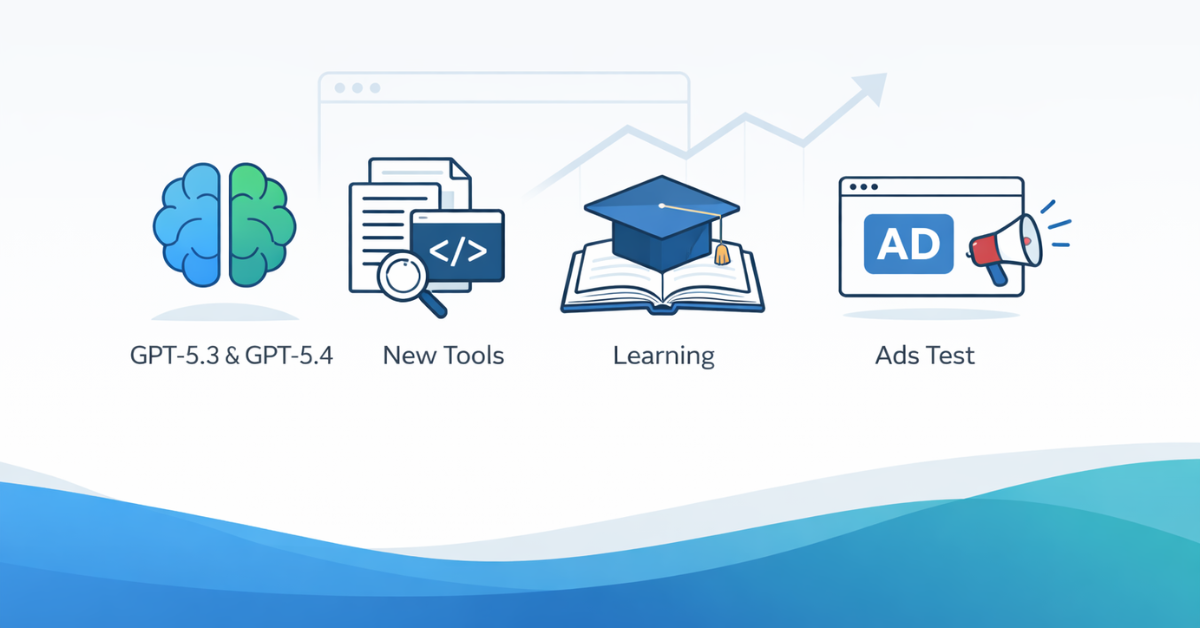
- OpenAI introduced new reasoning models including GPT-5.3 Instant and GPT-5.4 Thinking between February and March 2026.
- The Thinking mode context window expanded to 256,000 tokens, allowing ChatGPT to process significantly larger documents and projects.
- Major product updates added interactive code blocks, expanded file uploads, and project-based workflows.
- ChatGPT launched interactive science and mathematics learning modules covering more than 70 topics.
- OpenAI also began testing advertisements in ChatGPT for Free and Go users in the United States.
Between February and March 2026, OpenAI rolled out one of the most significant update cycles for ChatGPT since the launch of the GPT-5 series. The updates introduced new reasoning models, expanded document handling capabilities, and added development and research tools that move the platform beyond a conversational chatbot.
The period also marked the first real-world test of advertisements inside ChatGPT. While paid subscriptions remain ad-free, the experiment signals a potential shift in how large AI systems may be funded in the future.
Together, these changes affect a wide range of users including students, developers, researchers, and everyday users who rely on ChatGPT for information and productivity.
New ChatGPT Models Introduced and Retired
The most visible changes during the period were updates to OpenAI’s GPT-5 model family. The company upgraded its everyday conversation model while also introducing a new reasoning-focused system designed for complex work.
On March 3, OpenAI upgraded GPT-5.3 Instant. The model is designed for everyday interactions and received improvements in answer accuracy, web search integration, and conversational tone. The update also reduced overly cautious responses and unnecessary disclaimers that previously interrupted answers.
Two days later, on March 5, OpenAI introduced GPT-5.4 Thinking. This model focuses on tasks that require deeper reasoning such as research, coding, and complex problem solving. GPT-5.4 Thinking can generate a structured plan for solving a problem and allows users to adjust that plan while the response is being produced.
At the same time, OpenAI began simplifying its model lineup. On March 11, the company retired the GPT-5.1 model family, including Instant, Thinking, and Pro versions. Older chats were automatically migrated to newer models such as GPT-5.3 Instant or GPT-5.4 Thinking.
| Date | Update | Impact for Users |
|---|---|---|
| Feb 10, 2026 | GPT-5.2 Instant style update | Clearer advice answers and calmer response tone |
| Feb 20, 2026 | Thinking mode context expanded to 256k tokens | Improved handling of long documents and complex projects |
| Mar 3, 2026 | GPT-5.3 Instant upgrade | More accurate answers and better web search integration |
| Mar 5, 2026 | GPT-5.4 Thinking launched | Stronger reasoning, coding support, and research planning |
| Mar 11, 2026 | GPT-5.1 models retired | Chats automatically moved to newer models |
Longer Context Window Enables Larger Projects
One of the most technically significant changes during the update cycle was the expansion of the Thinking model context window to 256,000 tokens. This includes 128,000 tokens for input and 128,000 tokens for output.
In practical terms, this allows ChatGPT to read and reason across much larger amounts of text in a single conversation. Users can upload long documents, combine multiple reports, or analyze entire research papers without losing context earlier in the discussion.
The improvement is especially useful for journalists, analysts, students, and researchers who often work with large sets of documents or long research material.
ChatGPT Expands Into a Full Workspace
OpenAI also introduced several product upgrades that transform ChatGPT into a workspace designed for ongoing projects rather than short conversations.
Expanded file handling
Users can now attach up to 20 files in a single message, double the previous limit of 10 attachments. The update also added support for additional text and code formats, making document analysis and coding workflows easier.
Projects feature for knowledge management
The Projects feature received a major update allowing ChatGPT to ingest sources from external tools such as Slack conversations and Google Drive links. Users can also add past chats or pasted documents to a project.
This turns ChatGPT into a persistent knowledge workspace where documents, notes, and discussions remain connected within a single project environment.
Interactive Code Blocks
Another major addition is the introduction of Interactive Code Blocks. These allow developers to write, edit, and preview code directly inside the chat interface.
Users can test scripts, render diagrams, and build small applications using a split-screen editor within the ChatGPT interface. The feature is designed to reduce the need for switching between development tools.
Codex Desktop App Expands to Windows
OpenAI also expanded the availability of its coding assistant Codex during this period.
After launching the Codex desktop app for macOS earlier in February, the company released a Windows version on March 4. The application provides a multi-agent development environment connected to a user’s ChatGPT account.
The system can work with isolated coding workspaces, review changes to files, and generate code suggestions while showing clear diffs for review.
For developers, this represents a shift toward AI-assisted development workflows rather than simple code completion.
Interactive Learning Modules Added for Students
In March 2026, ChatGPT also introduced interactive learning modules covering more than 70 topics in mathematics and science.
Topics include well-known concepts such as the Pythagorean theorem, circle area calculations, gas laws, and optics equations. These modules allow users to manipulate variables and observe how graphs or calculations change in real time.
The feature aims to turn ChatGPT into a more interactive learning environment for students rather than a system that only produces static answers.
Deep Research Tools Receive Upgrades
Earlier in February, OpenAI also upgraded its Deep Research capability. The updated system allows users to guide the research process more directly.
Users can now specify trusted websites or connected applications as research sources. The interface also displays a structured research plan and allows adjustments while the research task is running.
The results can be exported as detailed research reports, making the tool useful for professional analysis and investigative work.
Advertisements Begin Testing Inside ChatGPT
Another development during the period was the first limited test of advertising inside ChatGPT.
OpenAI began showing advertisements to logged-in adult users on the Free and Go subscription tiers in the United States. Paid plans such as Plus, Pro, Business, Enterprise, and Education do not display advertisements.
The company states that sponsored messages appear separately from the main response and are clearly labeled as advertisements. According to OpenAI, the ads do not influence the answers generated by the AI system.
The test reflects the high cost of running large AI models and may indicate how free access to AI services could be supported financially in the future.
What the Changes Mean for Users
For everyday users, the improvements mainly appear in the form of clearer answers and more reliable responses from GPT-5.3 Instant.
Students benefit from interactive educational tools and the ability to analyze larger study materials in one conversation.
Developers gain access to integrated coding tools and the Codex desktop application, which allows deeper integration between software development workflows and AI assistance.
Researchers and writers benefit from larger context windows, document uploads, and project-based knowledge management tools.
For the broader technology industry, the introduction of advertisements inside ChatGPT may represent an early step toward new monetization models for large AI platforms.
The February to March 2026 updates therefore represent more than routine feature improvements. They reflect a shift in how AI assistants are evolving, moving from simple chat interfaces toward full productivity platforms capable of supporting research, development, learning, and daily work.