


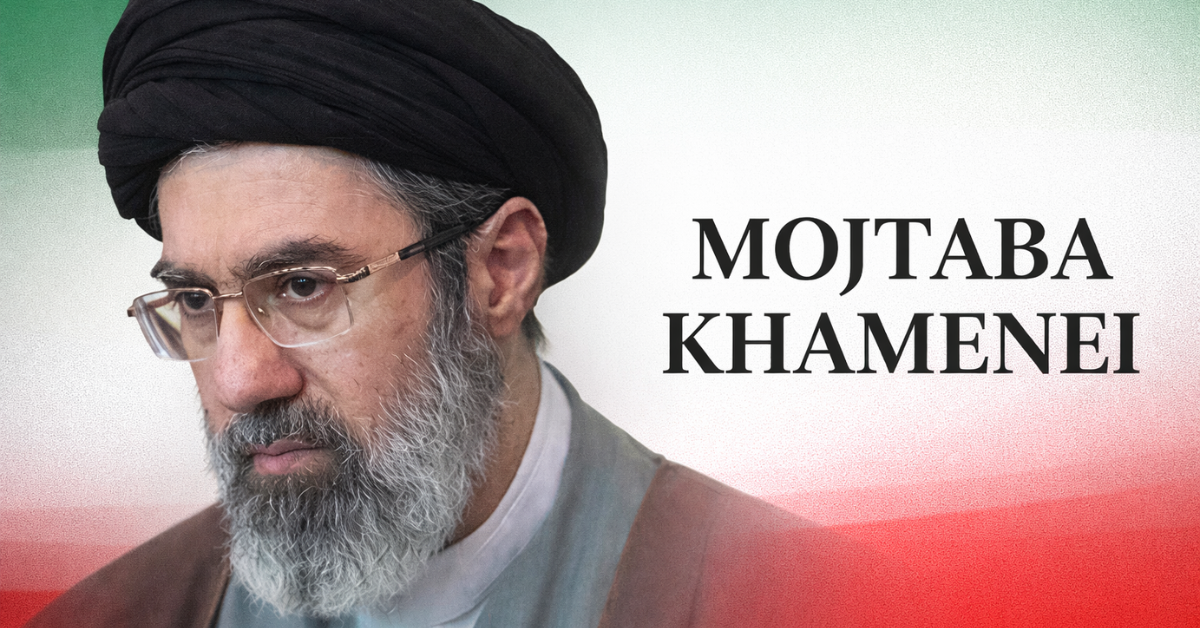
A Short Brief on Mojtaba Khamenei
- Mojtaba Hosseini Khamenei became Iran’s third Supreme Leader in March 2026 following the death of his father, Ali Khamenei.
- Born in 1969 in Mashhad, he grew up within the clerical establishment that shaped the Islamic Republic after the 1979 revolution.
- He served with Iranian forces during the Iran–Iraq War and later studied Islamic theology in the Qom seminary.
- For decades he operated largely behind the scenes, maintaining close ties with the Islamic Revolutionary Guard Corps and the Office of the Supreme Leader.
- His appointment during the 2026 regional war marks one of the most controversial leadership transitions in modern Iranian history.
Introduction
Mojtaba Hosseini Khamenei is an Iranian Shiite cleric and political figure who became the Supreme Leader of Iran in March 2026. He is the second son of Ayatollah Ali Khamenei, who ruled the Islamic Republic from 1989 until his death during a joint U.S.–Israeli strike amid regional conflict. The appointment of Mojtaba marked a dramatic and controversial moment in Iran’s political history, as critics inside and outside the country questioned whether the transition resembled hereditary succession within a system founded on revolutionary ideology.
For years before his rise to power, Mojtaba Khamenei was regarded as one of the most influential yet least visible figures inside Iran’s ruling structure. Though he rarely appeared in public and held no formal elected office, analysts often described him as a key gatekeeper within the Office of the Supreme Leader and a figure closely aligned with Iran’s powerful security institutions.
Early Life and Family Background
Mojtaba Khamenei was born on 8 September 1969 in the northeastern Iranian city of Mashhad, a major religious center for Shiite Islam. His father, Ali Khamenei, was a prominent cleric and revolutionary activist who opposed the rule of Shah Mohammad Reza Pahlavi in the years leading up to the 1979 Islamic Revolution.
The Khamenei family belonged to a religious lineage that traced its roots to clerical scholarship. Mojtaba grew up during the turbulent years when the monarchy collapsed and the Islamic Republic emerged under the leadership of Ayatollah Ruhollah Khomeini. The political transformation of Iran during his childhood deeply shaped his worldview and placed him inside the inner circles of the new revolutionary establishment.
Education and Religious Training
After completing his early schooling in Tehran, Mojtaba Khamenei pursued Islamic studies in the seminaries of Qom, Iran’s most important center of Shiite theological education. These seminaries train clerics in Islamic jurisprudence, theology, philosophy, and Qur’anic interpretation.
His studies included instruction from senior clerics and scholars, including figures closely associated with the Iranian state’s religious institutions. Although he advanced through the clerical system and became recognized as a religious scholar, he did not attain the high clerical rank of ayatollah that many previous political leaders in Iran held.
Military Service and the Iran–Iraq War
In the late 1980s, Mojtaba joined Iranian forces during the final years of the Iran–Iraq War. He served in units connected to the Islamic Revolutionary Guard Corps (IRGC), participating in several operations during the conflict.
His wartime experience helped establish connections with military and intelligence networks that later became central pillars of Iran’s political system. These relationships with Revolutionary Guard commanders would later strengthen his influence within the country’s security establishment.
Influence Behind the Scenes
During the decades of his father’s leadership, Mojtaba Khamenei remained largely out of public view while building a reputation as a powerful insider within the Islamic Republic’s political structure. Analysts frequently described him as a key figure within the Office of the Supreme Leader, acting as an intermediary between political factions, clerical networks, and security institutions. :contentReference[oaicite:9]{index=9}
His influence became particularly visible during Iran’s disputed presidential election of 2009, when protests erupted across the country. Critics accused him of supporting hardline factions and helping coordinate the response to the demonstrations, though the extent of his role remains debated among observers. :contentReference[oaicite:10]{index=10}
He also maintained close ties with the Islamic Revolutionary Guard Corps, an organization that wields enormous influence across Iran’s military, intelligence, and economic sectors. Many analysts believe these relationships were crucial in shaping his eventual rise to power.
Sanctions and International Attention
Mojtaba Khamenei drew international attention in 2019 when the United States imposed sanctions against him as part of broader measures targeting individuals associated with the Iranian leadership. American officials accused him of representing the interests of his father’s office and supporting policies linked to Iran’s regional strategy.
The sanctions underscored his growing prominence within the Islamic Republic’s internal power structure despite his relatively limited public profile.
The 2026 Leadership Crisis and Succession
In February 2026, a major escalation in regional tensions led to airstrikes by the United States and Israel against targets in Iran. During the strikes, Supreme Leader Ali Khamenei was killed, triggering an immediate leadership crisis within the country.
The Assembly of Experts, the clerical body responsible for selecting the Supreme Leader, convened to choose a successor. Mojtaba Khamenei was ultimately selected as Iran’s third Supreme Leader, a decision widely interpreted as reflecting the influence of hardline factions and the support of the Revolutionary Guard.
The choice generated controversy both domestically and internationally. Critics argued that the elevation of the previous leader’s son resembled dynastic succession and challenged the ideological foundations of the Islamic Republic, which originally rejected hereditary monarchy.
Leadership During the 2026 Regional War
Mojtaba Khamenei assumed leadership during one of the most volatile periods in the Middle East in decades. In his first public message after becoming Supreme Leader, he vowed to continue Iran’s military resistance and maintain pressure against the United States and Israel.
He also signaled support for keeping the Strait of Hormuz closed, a strategic waterway through which a large share of global oil exports passes. The move was widely interpreted as a geopolitical warning to Western powers and regional rivals.
Iranian officials later stated that Mojtaba had been injured during the strikes that killed his father but remained active in directing the country’s leadership during the conflict.
Political Ideology and Governance Style
Mojtaba Khamenei is widely viewed as a hardline figure within Iran’s political establishment. His alliances with conservative clerics and the Revolutionary Guard suggest continuity with the ideological framework that has guided the Islamic Republic since the late twentieth century.
Analysts believe his leadership is likely to emphasize resistance to Western pressure, support for regional allied groups, and a strong role for security institutions in domestic governance.
Legacy and Global Significance
The rise of Mojtaba Khamenei marks a pivotal moment in Iran’s modern political history. His leadership represents both continuity with the system created after the 1979 revolution and a transformation shaped by new geopolitical realities.
As the third Supreme Leader of the Islamic Republic, Mojtaba now holds ultimate authority over Iran’s military, judiciary, media, and political institutions. His decisions will influence not only Iran’s internal political trajectory but also the broader balance of power across the Middle East.
With the region facing ongoing conflict and global energy markets closely tied to events in the Persian Gulf, Mojtaba Khamenei’s leadership will remain a central focus for international observers and policymakers.