


Article Summary
- Sarvam Edge is an on-device artificial intelligence platform developed by Sarvam AI.
- The system enables speech recognition, translation, and text-to-speech directly on smartphones and laptops.
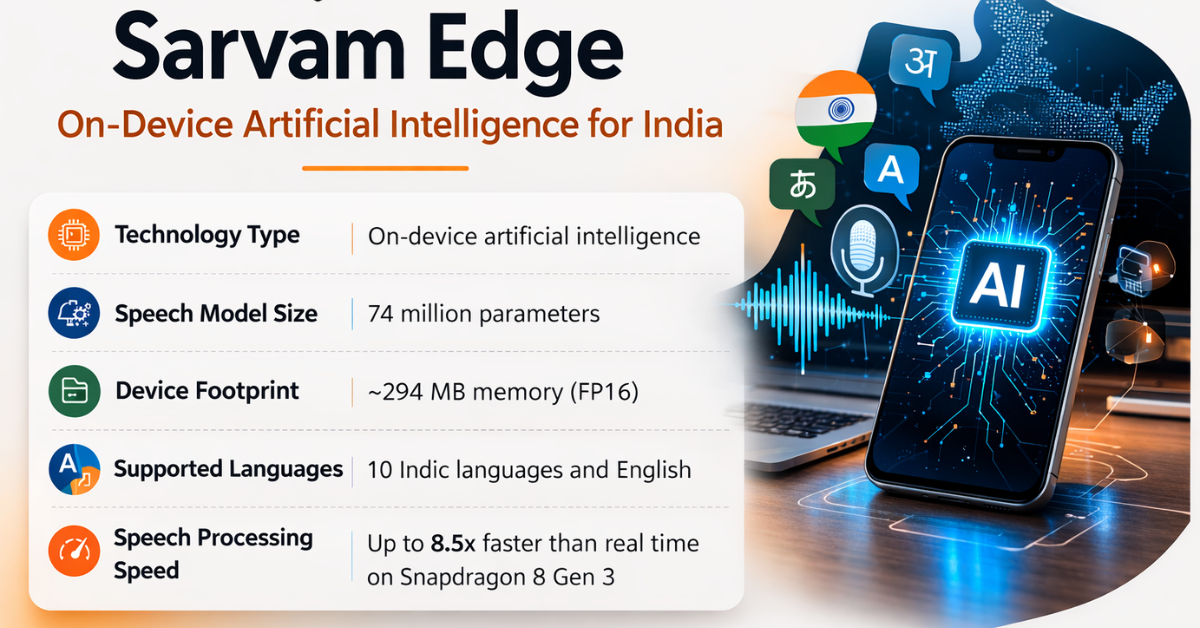
- The speech recognition model contains about 74 million parameters and occupies roughly 294 MB of device memory.
- The platform supports ten Indian languages and English, aiming to improve multilingual AI accessibility.
- Edge computing allows AI tools to work offline while reducing latency and improving privacy.
Artificial intelligence systems have traditionally depended on distant cloud servers where large models process user requests. A growing shift in the industry, however, is moving intelligence closer to the device itself. Sarvam Edge, introduced by Indian AI company Sarvam AI, represents one such attempt to place advanced AI capabilities directly inside smartphones, laptops, and other everyday hardware.
The system focuses on what researchers call on-device or edge AI. Instead of sending user inputs to remote data centers, the model processes speech and language tasks locally on the device. This design allows applications to function even when internet connectivity is unreliable and can also reduce the time required for responses.
In practical terms, Sarvam Edge is designed to power several language technologies that are central to modern digital services. These include speech recognition, text-to-speech synthesis, and multilingual translation systems optimized for Indian languages. The platform supports ten major Indic languages alongside English, reflecting a broader effort to expand AI accessibility beyond English-dominant systems.
| Key Feature | Details |
|---|---|
| Technology Type | On-device artificial intelligence |
| Speech Model Size | 74 million parameters |
| Device Footprint | ~294 MB memory (FP16) |
| Supported Languages | 10 Indic languages and English |
| Speech Processing Speed | Up to 8.5× faster than real time on Snapdragon 8 Gen 3 |
A Shift Toward Edge Computing
Edge AI has become an increasingly discussed approach in artificial intelligence research. Instead of relying entirely on centralized infrastructure, models are compressed and optimized so they can run on smaller hardware environments such as smartphones or embedded systems.
Sarvam Edge follows this approach by developing compact models capable of running directly on consumer devices. The speech recognition engine used in the system contains roughly 74 million parameters, a scale designed to balance capability with efficiency for mobile deployment.
Despite its reduced size compared with cloud-based language models, the system is designed to deliver production-grade transcription for multilingual speech processing. Developers behind the platform state that the model occupies about 294 megabytes of memory when deployed on a device using FP16 precision, allowing it to function on modern mobile hardware without cloud infrastructure.
This architectural approach allows speech-to-text processing to operate locally rather than relying on server-side APIs.
Performance and Latency
One of the technical advantages of running AI locally is reduced latency. When a request does not need to travel to a distant data center, responses can be delivered almost instantly.
The speech system used in Sarvam Edge maintains a time-to-first-token latency of under 300 milliseconds, enabling near real-time transcription during conversations or voice commands.
Testing conducted on Qualcomm’s Snapdragon 8 Gen 3 mobile processor indicates the system can process audio at roughly eight and a half times faster than real-time speed, a performance metric that suggests the model can keep up with continuous speech input without delays.
Such performance characteristics are essential for voice assistants, transcription tools, and real-time translation applications.
Multilingual Speech Systems
A defining aspect of Sarvam Edge is its focus on multilingual speech technology tailored to Indian language environments. Instead of maintaining separate models for each language, the platform uses a unified multilingual architecture that supports ten widely spoken Indian languages within a single model footprint.
The system also includes a text-to-speech component designed for on-device deployment. This speech synthesis model contains approximately 24 million parameters and supports ten Indian languages along with eight multilingual speaker voices.
By consolidating multiple languages and voices into a single architecture, developers aim to reduce the computational overhead that often accompanies multilingual systems.
Such capabilities could allow devices to switch between languages automatically without requiring separate downloads or manual configuration.
Testing and Benchmarking
To evaluate accuracy across different environments, the speech recognition system has been tested using the Vistaar dataset, a benchmark suite that includes fifty-nine testing scenarios across domains such as news broadcasting, educational content, and tourism information.
Benchmarks like these attempt to simulate real-world speech conditions rather than laboratory audio recordings. The dataset includes varying accents, background noise levels, and conversational settings, helping researchers measure how models perform outside controlled environments.
Such testing is particularly relevant for multilingual speech systems, which must account for regional variations and mixed-language speech patterns common in India.
Privacy and Offline Use
Another notable aspect of on-device AI systems is how they handle user data. When processing occurs locally, speech recordings or text inputs do not necessarily need to be transmitted to external servers.
Sarvam Edge is designed to operate entirely on the device, meaning user data can remain local during processing. This approach can help reduce privacy risks associated with cloud storage and centralized data logging.
Offline capability is also a key advantage. Voice recognition and translation tools built on on-device models can continue functioning even when connectivity is limited or unavailable. In regions where mobile networks are inconsistent, this capability could make AI-powered tools more accessible.
Potential Applications
If adopted widely by developers, on-device AI platforms could support a wide range of applications. Voice-driven interfaces may become more practical in multilingual environments where typing in regional languages remains difficult.
Education technology platforms could use local speech recognition to provide transcription and translation services for students without constant internet access. Government information systems could deploy voice interfaces capable of operating in rural areas where connectivity is intermittent.
Consumer devices also represent a major area of opportunity. Smartphones, smart appliances, and wearable devices increasingly rely on embedded intelligence to interpret voice commands or contextual information.
Running AI locally may allow these devices to respond faster and operate independently from cloud services.
A Broader Direction for AI Development
Sarvam Edge reflects a broader trend within the artificial intelligence industry. For much of the past decade, AI development centered around large models running on powerful cloud infrastructure. As models have matured, researchers have begun exploring ways to distribute intelligence across smaller devices.
Edge computing offers one pathway toward this goal. By designing models that operate efficiently on local hardware, developers hope to extend AI capabilities to environments where cloud access is limited or expensive.
For countries with large multilingual populations and uneven network infrastructure, such as India, locally deployed AI systems may offer a practical path toward wider adoption.
Whether Sarvam Edge becomes widely integrated into consumer devices will depend on developer adoption and real-world performance. Still, the project signals a growing interest in artificial intelligence systems designed not only for scale, but also for accessibility and local deployment.