


Article Summary
- The Maharashtra government presented the 2026–27 state budget with a long-term development roadmap aligned with the “Viksit Maharashtra 2047” vision.
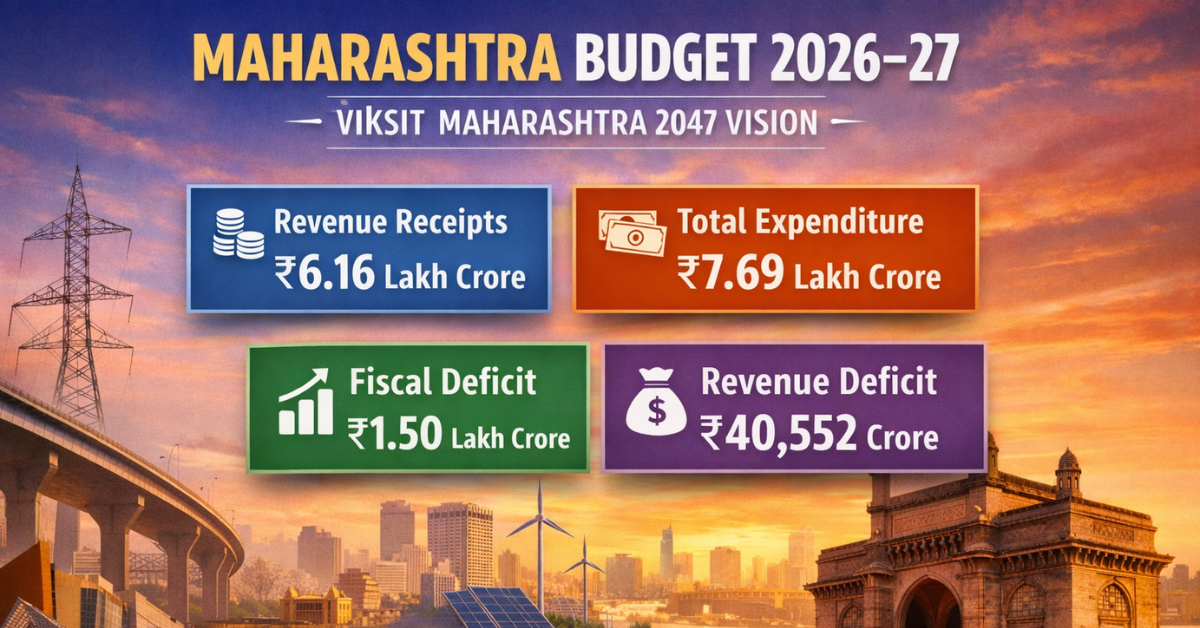
- The budget estimates revenue receipts of ₹6,16,099 crore and revenue expenditure of ₹6,56,651 crore, resulting in a revenue deficit of ₹40,552 crore.
- Total expenditure for the financial year is projected at ₹7,69,467 crore, while the fiscal deficit is estimated at ₹1,50,491 crore.
- The government aims to expand the state economy to $5 trillion by 2047 through balanced regional development, infrastructure investment, and economic growth.
- Agriculture modernization remains a priority, with initiatives such as Agristack farmer IDs, AI-based digital farming platforms, and schemes to strengthen rural infrastructure.
- The budget also proposes vehicle tax concessions for replacing older vehicles and higher environmental taxes on polluting vehicles to improve air quality.
The Maharashtra government on 6 March 2026 presented the state budget for the financial year 2026–27 in the Legislative Assembly, outlining a development roadmap aligned with the long-term vision of building a “Viksit Maharashtra” by 2047. Chief Minister Devendra Fadnavis, who delivered the budget speech, said the financial plan seeks to balance economic expansion, infrastructure investment, and social welfare while maintaining fiscal discipline.
The budget estimates place the state’s revenue receipts at ₹6,16,099 crore for 2026–27, while revenue expenditure is projected at ₹6,56,651 crore. This leaves a revenue deficit of ₹40,552 crore. The government has estimated total expenditure at ₹7,69,467 crore, with the fiscal deficit projected at ₹1,50,491 crore for the year.
Officials said the state has managed to keep the fiscal deficit within the limits prescribed under the Fiscal Responsibility and Budget Management framework. The revenue deficit has also remained below one percent of the state’s gross domestic product in recent years, indicating relative stability in the state’s financial position.
Vision of a $5 Trillion State Economy
Presenting the budget, the Chief Minister linked the financial proposals with the state’s broader development strategy titled “Viksit Maharashtra 2047.” The government aims to expand the state economy to $5 trillion by 2047, coinciding with the centenary of India’s independence.
The development framework rests on four pillars: progressive growth, sustainability, inclusive development, and good governance. According to the budget speech, future state budgets will continue to reflect these principles as Maharashtra seeks balanced regional development and stronger economic output.
Agriculture and Rural Development Initiatives
Agriculture and allied sectors remain a central focus of the government’s policy agenda. The state has set an ambitious target to increase its agricultural GDP from about $55 billion to $500 billion by 2047 through technological integration and value chain development.
Digital platforms are expected to play a key role in this strategy. More than 30 lakh farmers are already receiving weather forecasts, crop advisories, and market information through the Maha-Vistaar digital platform, which the government describes as a digital companion for farmers.
The government also reported progress in implementing the Agristack system, under which 1.31 crore farmer identification numbers have been issued as of February 2026. The system is designed to streamline the delivery of government schemes and improve transparency in agricultural support programmes.
Several new or expanded programmes have been announced in this sector. These include the Krishi Samruddhi Yojana aimed at strengthening agricultural infrastructure, and initiatives to promote agri-startups through artificial intelligence and agricultural data platforms. The government also plans to expand natural farming to five lakh hectares of farmland in the coming years.
Infrastructure and Sectoral Spending
Department-wise expenditure plans indicate that infrastructure and social development will continue to receive substantial funding. Among the major allocations are energy, public works and roads, water resources, women and child development, and rural development, which together account for a significant portion of the state’s development outlay.
The annual plan outlay for 2026–27 has also been increased, with funds allocated across general state programmes as well as scheduled caste, tribal, and district sub-plans. The government said the spending priorities reflect an attempt to address regional disparities while sustaining economic growth.
Vehicle Tax Changes and Environmental Measures
The budget also introduces changes in motor vehicle taxation aimed at reducing pollution and encouraging vehicle replacement. The government has proposed a 16 percent concession in motor vehicle tax when purchasing a new vehicle after scrapping a BS-4 vehicle, while a 30 percent concession is proposed for replacing older BS-3 vehicles.
At the same time, environmental tax on older non-transport private vehicles will be increased. According to the proposal, the tax on such vehicles will be doubled, a move intended to discourage the continued use of highly polluting vehicles and improve air quality.
Social and Administrative Announcements
The budget also includes several social initiatives and commemorative projects. The government announced that the year 2026–27 will be observed as the “Year of Social Equality and Harmony,” marking important anniversaries related to social reformers such as Mahatma Jyotirao Phule and Sant Gadge Baba.
Development initiatives connected with these commemorations include infrastructure plans at historically significant locations and programmes aimed at improving rural livelihoods and social inclusion.
Maharashtra Budget 2026–27 — Sector-wise Spending
| Sector / Department | Allocation (₹ crore) |
|---|---|
| Women and Child Development | 24,231 |
| Energy | 27,963 |
| Public Works & Roads | 26,218 |
| Water Resources | 16,569 |
| Rural Development | 13,651 |
| Urban Development | 11,054 |
| Agriculture | 9,583 |
| Planning Department | 9,697 |
| Public Health | 5,980 |
| Other Backward & Bahujan Welfare | 4,543 |
| Soil & Water Conservation | 4,417 |
| Water Supply & Sanitation | 4,030 |
| Social Justice | 3,840 |
| Home Department (Transport) | 3,754 |
| School Education | 3,077 |
| Public Works (Buildings) | 3,022 |
| Medical Education & Drugs | 2,618 |
| Forest Department | 2,607 |
| Home Department (Police) | 2,326 |
| Employment Guarantee Scheme | 2,293 |
| Tourism | 2,052 |
| Divyang Welfare | 2,287 |
Looking Ahead
The Maharashtra Budget for 2026–27 signals a continued emphasis on infrastructure expansion, agricultural modernization, and long-term economic growth. While fiscal pressures remain due to rising expenditure and borrowing requirements, the government maintains that disciplined financial management and targeted investments will support the state’s development ambitions over the coming decades.
With Maharashtra already one of India’s largest economic contributors, the government’s challenge will be translating these policy proposals into sustained growth, improved public services, and balanced regional development across the state.