


Article Summary
- The military capabilities of Iran, Israel, and the United States differ widely in scale, technology, and global reach, with the United States remaining the most powerful military force in the world.
- Iran maintains large manpower and the biggest ballistic missile arsenal in the Middle East, while Israel relies on advanced military technology, strong intelligence systems, and a highly capable air force.
- The United States leads in nearly every category of modern warfare, including aircraft carriers, stealth aircraft, global military bases, and nuclear weapons.
- Israel holds a technological advantage over Iran, particularly in air power, missile defence systems such as Iron Dome, and precision military operations.
- Iran compensates for weaker conventional air and naval forces by focusing on missiles, drones, naval tactics in the Persian Gulf, and a network of regional allied militias.
- In a direct conventional war, the United States would possess overwhelming military superiority, while a conflict between Israel and Iran would likely involve missile attacks, cyber operations, and proxy battles across the Middle East.
The military balance between Iran, Israel, and the United States differs greatly in scale, technology, and strategic capability. Iran has large manpower and missile forces. Israel relies on advanced technology, intelligence systems, and a strong air force. The United States possesses the largest and most technologically advanced military in the world.
The following comparison uses widely cited defence data and global military rankings.
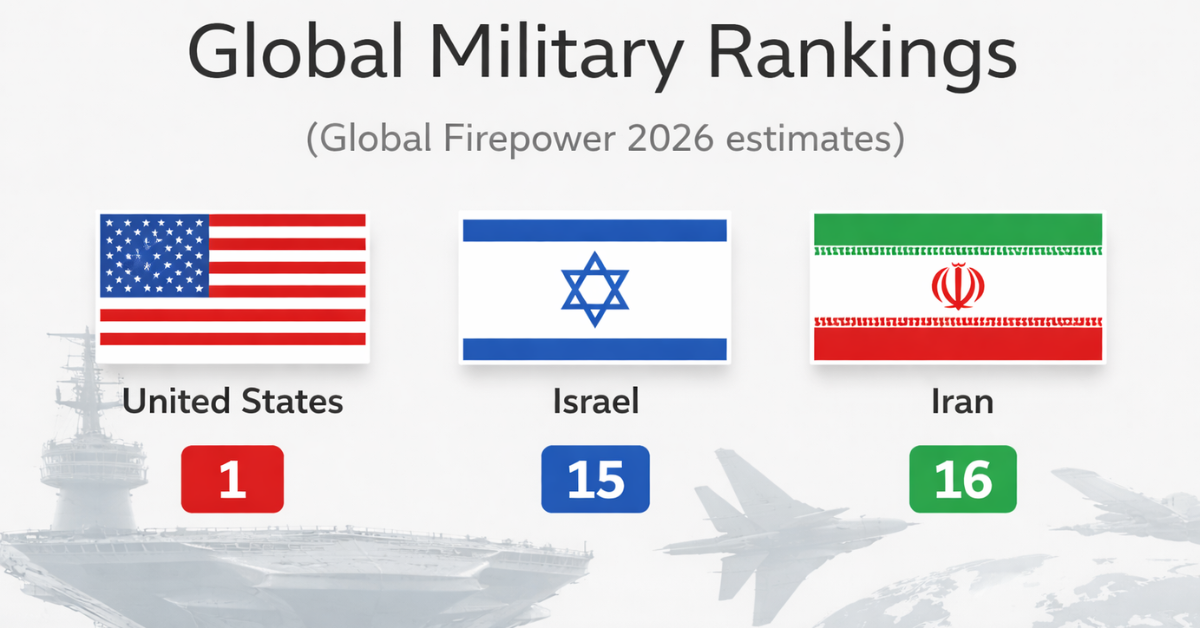
Overall Global Military Ranking
(Global Firepower 2026 estimates)
| Country | Global Military Rank |
|---|---|
| United States | 1 |
| Israel | 15 |
| Iran | 16 |
Israel and Iran are relatively close in conventional strength rankings, though their capabilities differ significantly. The United States remains far ahead of both.
Military Personnel
| Country | Active Personnel | Reserve Forces |
|---|---|---|
| United States | ~1.3 million active | ~800,000 reserve |
| Iran | ~610,000 active | ~350,000 reserve |
| Israel | ~170,000 active | ~465,000 reserve |
Iran has the largest active army among the three. Israel compensates with a large reserve system due to mandatory military service. The United States has the largest overall military manpower.
Air Power
| Country | Combat Aircraft |
|---|---|
| United States | ~13,000 total aircraft |
| Israel | ~600 aircraft |
| Iran | ~300 aircraft |
The United States Air Force is by far the most powerful in the world. Israel also maintains one of the most advanced air forces, equipped with modern fighters such as the F-35.
Iran’s air force is significantly weaker and relies largely on older aircraft from the 1970s and 1980s.
Missile Capabilities
Missiles are central to Iran’s military strategy.
| Country | Missile Capability |
|---|---|
| Iran | Over 3,000 ballistic missiles, largest arsenal in Middle East |
| Israel | Advanced missile forces including Jericho ballistic missiles |
| United States | Thousands of cruise and ballistic missiles worldwide |
Iran’s missiles can reach 2,000–2,500 km, allowing them to strike Israel and U.S. bases across the Middle East.
Israel has smaller missile numbers but more advanced precision systems. The United States maintains global long-range strike capabilities from land, sea, and air.
Naval Power
| Country | Aircraft Carriers | Major Warships |
|---|---|---|
| United States | 11 aircraft carriers | Largest navy in the world |
| Iran | 0 | Mostly small missile boats and submarines |
| Israel | 0 | Small but technologically advanced navy |
The United States Navy dominates global maritime power. Iran’s naval strategy relies on smaller vessels and asymmetric tactics in the Persian Gulf. Israel maintains a small but capable navy with advanced submarines.
Nuclear Weapons
| Country | Nuclear Weapons |
|---|---|
| United States | ~5,200 nuclear warheads |
| Israel | ~80–90 estimated warheads |
| Iran | No confirmed nuclear weapons |
Israel maintains an undeclared but widely recognized nuclear arsenal. The United States possesses the second largest nuclear arsenal in the world. Iran is believed not to have nuclear weapons, though its nuclear program has been a major source of international concern.
Military Technology
The United States
The United States leads in nearly every category of modern warfare. These include stealth aircraft, aircraft carriers, nuclear submarines, satellite systems, cyber warfare, and global logistics. Its defence budget alone exceeds that of the next several countries combined.
Israel
Israel is one of the most technologically advanced militaries in the world. It operates advanced fighter jets, missile defence systems such as Iron Dome, and powerful intelligence capabilities. Israeli forces emphasize rapid response and high-precision operations.
Iran
Iran focuses on asymmetric warfare. Its strategy relies heavily on ballistic missiles, drones, naval mines, and allied militias across the Middle East. This approach compensates for weaker conventional air and naval forces.
Strategic Advantages
Iran
- Large manpower
- Extensive missile arsenal
- Regional proxy networks
Israel
- Advanced technology
- Highly trained military
- Powerful intelligence agencies
The United States
- Largest defence budget in the world
- Global military bases
- Dominant air and naval power
Strategic Reality
In a direct conventional war:
- The United States holds overwhelming military superiority
- Israel has technological advantages over Iran, particularly in air power and intelligence
- Iran’s strength lies in missiles, geography, and regional allied groups, which could prolong a conflict
Because of these factors, any war involving all three powers would likely extend beyond traditional battlefield fighting into missile exchanges, cyber warfare, and proxy conflicts across the Middle East.