


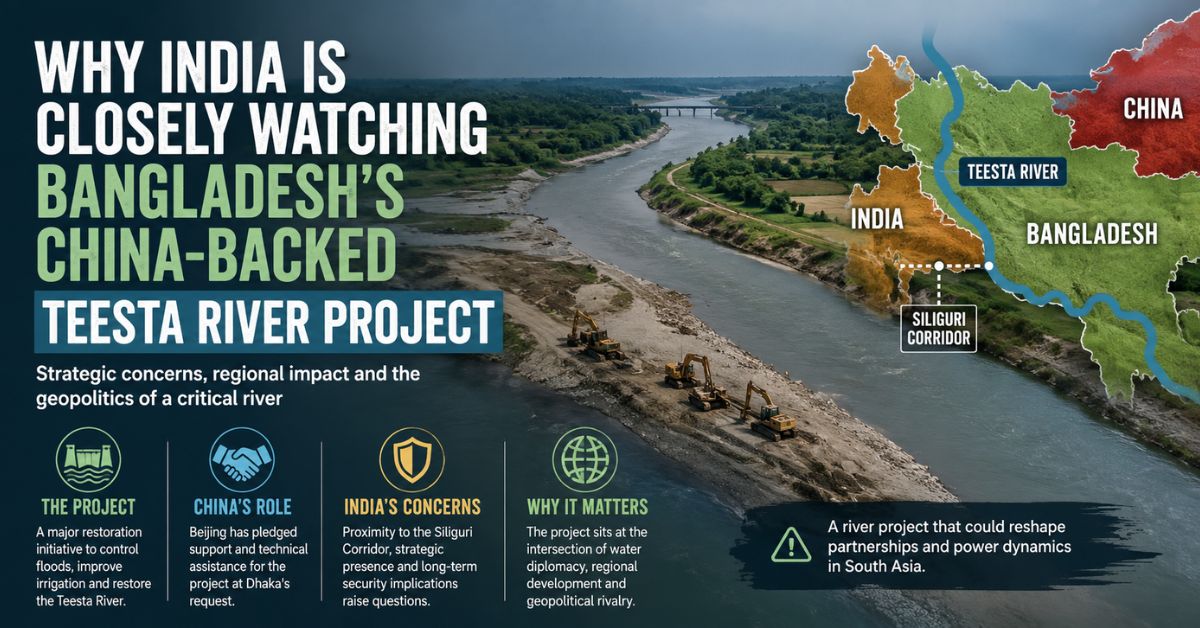
India Watches Bangladesh-China Teesta Project: Key Highlights
- India has maintained a measured public stance on Bangladesh’s Teesta River Comprehensive Management and Restoration Project despite China’s growing involvement.
- According to Reuters, Bangladesh has sought Chinese support for the river restoration initiative aimed at flood control, irrigation and livelihood improvement.
- Analysts believe the project has evolved into a strategic issue because of its proximity to India’s Siliguri Corridor.
- India has not officially opposed the project, and no public statement from the Ministry of External Affairs has described it as a security threat.
- China has stated that its cooperation with Bangladesh on the Teesta project is not directed at any third country.
- Experts say the project’s future significance will depend on regional diplomacy, transparency and progress on the long-pending India-Bangladesh Teesta water-sharing negotiations.
India is maintaining a measured public stance on Bangladesh’s proposed Teesta River Comprehensive Management and Restoration Project (TRCMRP) even as reports indicate that New Delhi is closely monitoring China’s expanding role in a river basin located near one of India’s most strategically sensitive regions.
According to a Reuters report, Bangladesh has sought Chinese support for the restoration of the Teesta River, with Beijing stating that it is willing to assist “to the best of its ability” in a project that Dhaka considers critical for flood control, irrigation and livelihoods in northern Bangladesh.
While neither India nor Bangladesh has officially described the project as a source of bilateral tension, analysts believe the initiative has become another important chapter in the evolving geopolitical competition between New Delhi and Beijing across South Asia.
What is the Teesta River Comprehensive Management and Restoration Project?
According to reports from Reuters, The Times of India and Bangladeshi media, the TRCMRP is designed to restore sections of the Teesta River through river dredging, embankment strengthening, improved flood management, irrigation upgrades and ecological restoration. The project is intended to address recurring floods during the monsoon while improving water availability during the dry season.
The Teesta River originates in India’s Sikkim before flowing through West Bengal and entering Bangladesh, making it one of the major transboundary rivers shared by the two countries. For decades, both sides have discussed a separate water-sharing agreement, although negotiations have remained unresolved.
| Project Aspect | Details |
|---|---|
| Project Name | Teesta River Comprehensive Management and Restoration Project (TRCMRP) |
| Primary Objectives | River dredging, embankment strengthening, flood management, irrigation upgrades and ecological restoration |
| River Origin | Sikkim, India |
| Countries Involved | India, Bangladesh and China |
Why is China involved?
As per Reuters, Bangladesh formally requested Chinese support during Prime Minister Tarique Rahman’s visit to Beijing in June 2026. Following bilateral discussions, China said it was prepared to support the Teesta River restoration project and described it as a “livelihood project” that Bangladesh considers important.
According to reports from The Times of India, Bangladesh had earlier sought China’s involvement and technical assistance for the project after years of uncertainty surrounding the proposed India-Bangladesh Teesta water-sharing agreement.
China has also maintained that its cooperation with Bangladesh “does not target any third party,” a statement that many observers interpreted as an attempt to reassure India amid growing regional sensitivities.
Why is India watching the project closely?
India has not officially opposed the restoration project.
No public statement from the Ministry of External Affairs has described the project as a security threat or criticised Bangladesh’s sovereign decision to undertake river management within its own territory.
However, according to reports published by The Times of India, Reuters and several strategic affairs publications, Indian policymakers are believed to be concerned about the long-term implications of sustained Chinese technical and engineering presence in the Teesta basin.
One of the primary reasons frequently cited by strategic analysts is the river’s proximity to the Siliguri Corridor, often referred to as the “Chicken’s Neck.”
This narrow land corridor connects mainland India with its eight northeastern states and is regarded as one of the country’s most strategically important transport and military links.
According to strategic assessments cited by multiple publications, any long-term presence of Chinese state-owned enterprises or technical personnel in areas near this corridor naturally attracts close attention from Indian security planners. These assessments, however, represent expert analysis rather than official government statements.
| India’s Reported Concerns | Current Status |
|---|---|
| Official Opposition to TRCMRP | No official opposition has been announced |
| Strategic Monitoring | Reported by Reuters and Indian media citing strategic concerns |
| Siliguri Corridor | Frequently cited by strategic analysts as a key factor |
| Official Security Statement | No public statement from the Ministry of External Affairs describing the project as a security threat |
The larger diplomatic picture
The Teesta issue extends beyond infrastructure.
For more than a decade, India and Bangladesh have attempted to finalise a Teesta water-sharing agreement. Reports indicate that the proposed 2011 arrangement did not move forward because of political objections from the West Bengal government, leaving the broader river-sharing issue unresolved.
Against this backdrop, Bangladesh’s decision to seek Chinese support is being viewed by several analysts as part of Dhaka’s broader effort to diversify development partnerships while continuing engagement with India.
Reuters reported that China and Bangladesh also discussed wider cooperation in infrastructure, water management and economic connectivity during Prime Minister Rahman’s visit, alongside agreements covering several sectors.
Bangladesh says the project is a national priority
According to The Times of India, Prime Minister Tarique Rahman recently said that Bangladesh would implement the Teesta Barrage Master Plan “at any cost,” describing it as a national priority.
The report added that Bangladeshi authorities continue to present the initiative primarily as a development project intended to improve water management, reduce flood risks and support agriculture in northern districts.
Bangladesh has consistently maintained that the restoration work falls within its sovereign territory and is aimed at addressing domestic environmental and economic challenges rather than altering regional strategic dynamics.
| Bangladesh’s Official Position | Reported Objective |
|---|---|
| National Priority | Implement the Teesta Barrage Master Plan |
| Flood Management | Reduce recurring monsoon flooding |
| Agriculture | Improve irrigation and support farming communities |
| Sovereign Right | River restoration within Bangladesh’s own territory |
What remains uncertain?
Although China has publicly expressed its willingness to support the project, several important details remain unavailable in the public domain.
There is no publicly released final financing agreement detailing the value, repayment terms or structure of any Chinese loan connected with the project. Likewise, detailed engineering plans and environmental assessments have not been fully disclosed through official sources.
There is also no verified public evidence indicating that the project includes Chinese military facilities or intelligence infrastructure. Such claims have appeared in commentary and strategic discussions but have not been supported by official documents or government statements available so far.
What happens next?
The Teesta restoration project is expected to remain closely watched because it sits at the intersection of water diplomacy, regional development and South Asian geopolitics.
As reported by Reuters, China has signalled continued support for Bangladesh’s river restoration efforts, while India has continued to rely on bilateral engagement rather than public confrontation.
Whether the project ultimately becomes a model of regional cooperation or another point of strategic competition is likely to depend on future diplomatic engagement, the transparency of project implementation and progress on the long-pending India-Bangladesh discussions over Teesta water sharing.
| Key Development | Current Position |
|---|---|
| China’s Role | Has expressed willingness to support Bangladesh’s river restoration project |
| India’s Public Stance | Continues bilateral engagement without publicly opposing the project |
| Bangladesh’s Position | Considers the project a national development priority |
| Future Outlook | Will depend on diplomacy, project transparency and progress on Teesta water-sharing talks |