


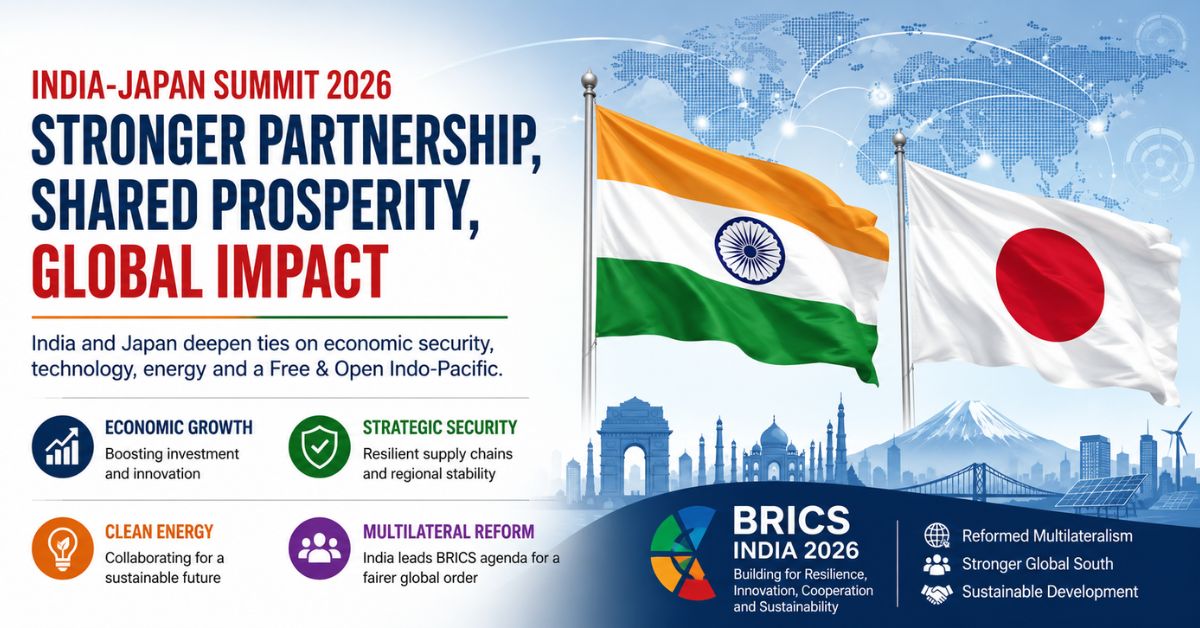
India-Japan Summit and BRICS Diplomacy: Key Highlights
- Prime Minister Narendra Modi is hosting Japanese Prime Minister Sanae Takaichi for the 16th India-Japan Annual Summit in New Delhi.
- The summit focuses on economic security, investment, technology partnerships, energy cooperation, and a Free and Open Indo-Pacific.
- India is also advancing its 2026 BRICS Chairship with an agenda centered on resilience, innovation, cooperation, and sustainability.
- The BRICS Foreign Ministers’ Meeting brought together ministers and senior representatives to discuss global security, economic cooperation, and multilateral reforms.
- India continues to advocate reforms in international financial institutions and greater representation for developing economies.
- The official India-Japan joint statement and further BRICS outcomes are expected to shape regional and global cooperation in the coming months.
India’s diplomatic calendar entered one of its busiest phases this week as Prime Minister Narendra Modi hosted Japanese Prime Minister Sanae Takaichi for the 16th India-Japan Annual Summit in New Delhi, while the government continued preparations under India’s 2026 BRICS chairship aimed at strengthening cooperation among emerging economies. The developments underline New Delhi’s effort to deepen strategic partnerships in the Indo-Pacific while simultaneously pushing for reforms in global governance and international financial institutions.
Key Diplomatic Events Timeline
| Event | Date |
|---|---|
| Japanese Prime Minister Sanae Takaichi’s Official Visit to India Begins | July 1, 2026 |
| 16th India-Japan Annual Summit | July 2, 2026 |
| Official Visit Concludes | July 3, 2026 |
| India’s 2026 BRICS Chairship Activities Continue | Throughout 2026 |
The India-Japan summit, taking place during Prime Minister Takaichi’s official visit from July 1 to July 3, is expected to shape bilateral cooperation for the coming decade. According to India’s Ministry of External Affairs, discussions are focused on strengthening economic security, expanding investment, accelerating technology partnerships, enhancing energy cooperation, and reinforcing a shared commitment to a Free and Open Indo-Pacific. Reuters also reported that the annual summit reflects the growing importance of the India-Japan strategic partnership amid changing geopolitical conditions in Asia.
Why the India-Japan Summit Matters
The annual summit comes at a time when both countries are seeking to diversify supply chains, strengthen semiconductor cooperation, and reduce strategic vulnerabilities. India has emerged as a key manufacturing and investment destination for Japanese companies looking to expand beyond traditional production hubs, while Japan continues to be one of India’s largest sources of foreign investment and infrastructure financing.
Economic security is expected to remain a central pillar of the talks. Both governments have increasingly emphasized resilient supply chains, trusted technology partnerships, clean energy collaboration, and innovation-led growth. Officials are also expected to review progress on existing infrastructure projects and discuss new opportunities in digital technologies, advanced manufacturing, artificial intelligence, and green energy.
Another important objective of the summit is strengthening cooperation in maintaining a Free and Open Indo-Pacific. India and Japan have consistently supported freedom of navigation, respect for international law, secure maritime trade routes, and greater regional connectivity across the Indo-Pacific region.
India’s BRICS Chairship Gains Momentum
Alongside its bilateral engagements, India continues to advance its agenda as the BRICS Chair for 2026. The official BRICS India 2026 platform outlines the presidency’s theme as “Building for Resilience, Innovation, Cooperation and Sustainability,” reflecting New Delhi’s effort to place resilience, inclusive growth, digital innovation, sustainability, and institutional reform at the centre of the grouping’s work.
The BRICS agenda under India’s leadership spans political and security cooperation, economic and financial collaboration, and people-to-people exchanges. India has also indicated that it intends to build on its earlier G20 presidency by highlighting the priorities of the Global South and advocating reforms to international institutions.
Earlier this year, New Delhi hosted the BRICS Foreign Ministers’ Meeting under India’s chairship. The meeting brought together foreign ministers and senior representatives from BRICS member countries and partner nations to exchange views on global and regional developments. External Affairs Minister Dr. S. Jaishankar chaired the discussions, which included deliberations on international security, economic cooperation, multilateral institutions, and development priorities.
India’s Push for Multilateral Reform
A recurring theme in India’s diplomatic engagements has been the call for reform of global governance institutions. Prime Minister Narendra Modi has repeatedly argued that institutions created after the Second World War should better reflect current geopolitical and economic realities. During India’s BRICS chairship, New Delhi has reiterated support for more representative global institutions and greater participation of developing economies in international decision-making.
India’s official BRICS agenda also highlights reforms in international financial architecture, expanded cooperation among emerging economies, and stronger policy coordination on issues including trade, climate, digital public infrastructure, and sustainable development.
Strategic Balancing Through Multiple Partnerships
The parallel focus on Japan and BRICS illustrates India’s broader foreign policy approach of maintaining strong partnerships across multiple geopolitical platforms. While cooperation with Japan supports India’s Indo-Pacific strategy and economic modernization, BRICS provides a forum for engaging emerging economies on issues ranging from development finance to multilateral governance.
Analysts have noted that India’s diplomacy increasingly seeks to combine strategic partnerships with advanced economies and constructive engagement with developing nations, allowing New Delhi to pursue economic growth while maintaining strategic autonomy.
What to Watch Next
The most closely watched outcome of the India-Japan summit will be the official joint statement expected after the leaders’ discussions. Observers will look for announcements related to investment commitments, semiconductor cooperation, clean energy initiatives, infrastructure projects, digital technologies, defence collaboration, and supply chain resilience.
Attention will also remain on India’s BRICS presidency as additional ministerial meetings and working-group discussions continue ahead of the 18th BRICS Leaders’ Summit, which India will host later in 2026. The government has already identified resilience, innovation, cooperation, and sustainability as the four guiding pillars of its presidency, with an emphasis on strengthening the voice of the Global South in international institutions.
For businesses, investors, and policymakers, these parallel diplomatic initiatives are significant because they have the potential to shape future trade, investment, technology partnerships, and regional security cooperation. As geopolitical competition intensifies across the Indo-Pacific and global institutions face increasing calls for reform, India’s engagement with Japan and its leadership within BRICS will remain key indicators of the country’s evolving foreign policy priorities.