


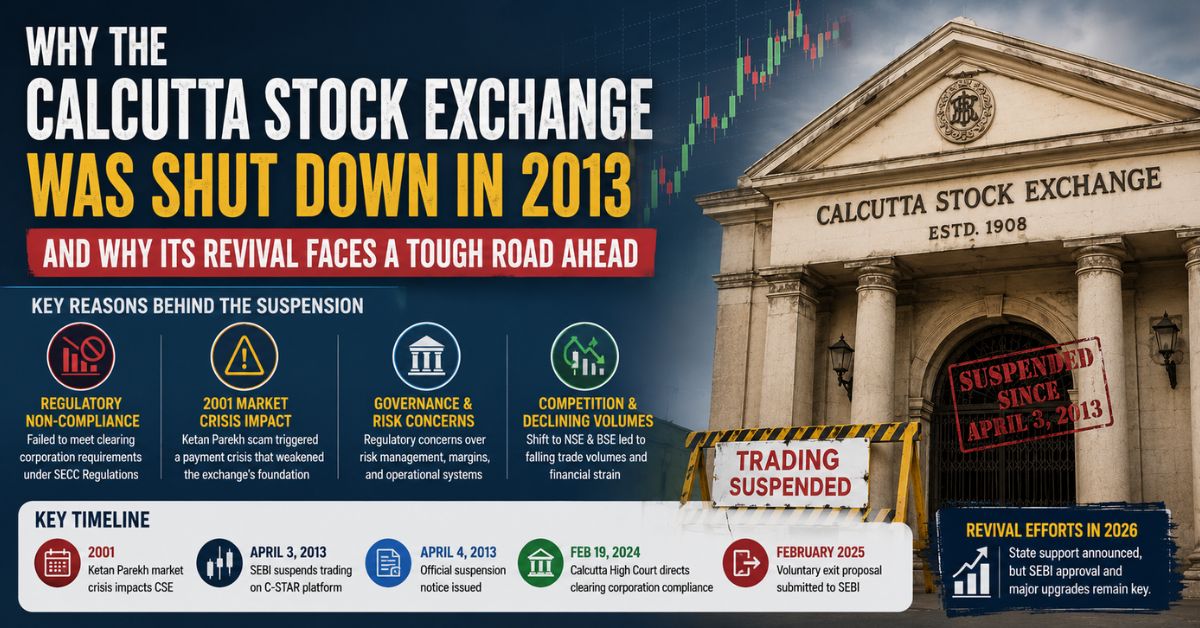
Why the Calcutta Stock Exchange Was Shut Down in 2013: Key Highlights
- The Calcutta Stock Exchange’s trading operations were suspended on April 3, 2013, following regulatory action by SEBI.
- The immediate trigger was non-compliance with clearing corporation requirements under the SECC Regulations.
- CSE’s troubles can be traced back to the 2001 market crisis linked to the Ketan Parekh stock manipulation scandal.
- Court records and exchange disclosures confirm that trading has remained suspended since April 2013.
- The exchange later submitted a voluntary exit proposal to SEBI in February 2025.
- Despite recent revival efforts backed by the West Bengal government, significant regulatory and operational hurdles remain.
KOLKATA, India, June 2026 — The proposed revival of the Calcutta Stock Exchange (CSE) has brought renewed attention to one of India’s oldest financial institutions. While the West Bengal government has publicly supported efforts to revive the exchange, the discussion has also raised a fundamental question: why did the Calcutta Stock Exchange stop functioning in the first place?
Official records, court documents, regulatory filings, and exchange disclosures show that the shutdown was not caused by a single event. Instead, it resulted from a combination of regulatory non-compliance, unresolved operational issues, and the long-term consequences of a financial crisis that hit the exchange more than a decade earlier.
The Calcutta Stock Exchange, established in 1908, was once among India’s most important regional stock exchanges. However, by April 2013, trading on its electronic platform had been suspended following action by the Securities and Exchange Board of India (SEBI). The exchange has remained non-operational since then.
Regulatory Changes Triggered the 2013 Suspension
The immediate cause of the suspension was linked to new regulatory requirements introduced under the Securities Contracts (Regulation) (Stock Exchanges and Clearing Corporations) Regulations, commonly known as the SECC Regulations.
These regulations required stock exchanges to either establish a recognized clearing corporation or enter into an arrangement with an approved clearing corporation. Clearing corporations play a critical role in securities markets because they guarantee settlement of trades and help reduce systemic risk.
Court records indicate that SEBI determined that the Calcutta Stock Exchange had not complied with the requirements of the SECC Regulations. As a result, the regulator directed the closure of the exchange’s clearing operations, leading to the suspension of trading on its C-STAR platform on April 3, 2013.
An official notice issued by the exchange on April 4, 2013, confirmed that trading on the C-STAR system had been suspended with immediate effect following SEBI’s directions.
The exchange’s later annual reports continued to acknowledge that trading operations had remained suspended since April 3, 2013, pursuant to SEBI’s instructions.
Key Timeline of Events
| Event | Date |
|---|---|
| Ketan Parekh Market Crisis Impacts CSE | 2001 |
| Trading Suspended on C-STAR Platform | April 3, 2013 |
| Official Suspension Notice Issued | April 4, 2013 |
| Calcutta High Court Clearing Corporation Direction | February 19, 2024 |
| Voluntary Exit Proposal Submitted to SEBI | February 2025 |
| West Bengal Government Supports Revival | June 2026 |
The Shadow of the 2001 Market Crisis
While the 2013 regulatory action was the immediate trigger, the roots of the exchange’s troubles stretch back to the market turmoil of 2001.
That year, Indian markets were shaken by the stock market manipulation scandal associated with broker Ketan Parekh. The crisis affected several market participants and exposed weaknesses across parts of the financial system.
Parliamentary records and historical investigations confirm that the Calcutta Stock Exchange was among the institutions impacted by the events surrounding the 2001 market crisis. The exchange experienced a payment crisis that significantly damaged its reputation and financial position.
The fallout from that episode continued for years. Regulatory scrutiny increased, and concerns emerged regarding the exchange’s operational resilience and ability to meet evolving market standards.
Although recent commentary often links the 2001 crisis directly to the exchange’s eventual suspension, available records indicate that the 2013 shutdown was formally connected to regulatory non-compliance under the SECC framework rather than a direct consequence of the earlier scandal. However, the earlier crisis contributed to challenges that the exchange struggled to overcome in subsequent years.
Governance and Compliance Concerns
Historical reports and regulatory proceedings have repeatedly referenced concerns regarding governance, risk management, and operational systems at the exchange.
However, not all widely circulated claims have been independently verified through primary regulatory orders currently available in the public domain.
For example, some accounts state that the exchange failed to adequately enforce broker exposure limits, suffered from weak margin management practices, and faced significant administrative dysfunction. While such concerns have appeared in historical reporting, many of the detailed allegations require confirmation through specific SEBI inspection reports or enforcement orders before they can be presented as established facts.
Similarly, claims that the exchange’s Settlement Guarantee Fund was completely depleted during the 2001 crisis remain difficult to verify through publicly available primary documents.
What is clear from court proceedings and regulatory actions is that SEBI remained concerned about the exchange’s ability to comply with evolving market infrastructure requirements over an extended period.
Competition From Larger Exchanges
The Calcutta Stock Exchange’s difficulties also coincided with a major transformation in India’s capital markets.
During the 1990s and 2000s, electronic trading platforms enabled nationwide exchanges such as the National Stock Exchange and the Bombay Stock Exchange to attract increasing volumes of trading activity.
As investors and listed companies migrated toward larger exchanges, regional exchanges across India struggled to maintain relevance.
The Calcutta Stock Exchange was not alone in facing these pressures. Several regional exchanges either became inactive or sought exit from stock exchange operations as trading volumes declined.
Industry observers note that reduced trading activity can make it harder for exchanges to invest in technology, compliance systems, and market infrastructure, creating additional challenges in meeting regulatory standards.
Legal Battles Continued for Years
The dispute between the Calcutta Stock Exchange and regulators did not end in 2013.
Court records show that litigation concerning the exchange’s future continued for years after trading was suspended.
A significant development occurred in February 2024 when the Calcutta High Court directed the exchange to either establish a clearing corporation or enter into an arrangement with an existing clearing corporation in accordance with applicable regulations. The court’s observations underscored the continuing importance of the clearing corporation issue that originally led to the suspension.
Despite these developments, the exchange remained unable to resume trading.
Exit Application and Revival Efforts
In February 2025, the Calcutta Stock Exchange submitted a voluntary exit proposal to SEBI, according to government statements and subsequent reporting. The proposal remains under examination by the regulator.
The situation changed again in 2026 when the exchange’s leadership reportedly approached the West Bengal government seeking support for a revival instead of a permanent exit.
Finance Minister Swapan Dasgupta subsequently announced during the 2026-27 state budget that the government would support efforts to revive the exchange and help restore Kolkata’s position as a financial center.
The announcement generated optimism among supporters of the exchange. However, regulatory approval remains essential before any return to active trading can occur.
Significant Challenges Remain
Even with political support, reopening a stock exchange in 2026 presents significant challenges.
Modern exchanges must operate sophisticated trading systems, maintain strong cybersecurity protections, implement market surveillance mechanisms, and ensure robust clearing and settlement arrangements.
The Calcutta Stock Exchange would need to satisfy current regulatory requirements in all of these areas before trading could resume.
In addition, no detailed public roadmap has yet been released explaining how the exchange intends to finance required technology upgrades, establish clearing arrangements, or rebuild market participation.
There is also no public indication that SEBI has approved the withdrawal of the exchange’s voluntary exit application or endorsed a revival plan.
As a result, the future of the exchange remains uncertain.
Risk Alert
Several claims circulating online regarding the Calcutta Stock Exchange should be treated cautiously.
There is verified evidence that SEBI suspended trading in April 2013 because of non-compliance with regulatory requirements related to clearing arrangements. However, some widely repeated allegations concerning governance failures, depleted guarantee funds, and specific management decisions have not yet been fully verified through publicly available primary records.
Likewise, claims that the exchange’s revival is imminent, guaranteed, or likely to produce substantial economic benefits remain speculative. No regulator has publicly approved a reopening plan, and no detailed financial or operational blueprint has been released.
Readers should distinguish between documented regulatory actions, ongoing legal proceedings, and projections about future outcomes.
Also Read
Calcutta Stock Exchange Revival Gets State Backing Amid SEBI Hurdles in June 2026
The Calcutta Stock Exchange revival has gained support from the West Bengal government, but regulatory approval from SEBI, technology upgrades, and clearing corporation requirements remain major challenges before trading can resume.
Sources & Verification Notes
Primary Sources
- Securities and Exchange Board of India (SEBI) regulations governing stock exchanges and clearing corporations.
- Official Calcutta Stock Exchange notices and annual reports confirming suspension of trading from April 3, 2013.
- Calcutta High Court records concerning CSE’s compliance obligations and clearing corporation requirements.
- Parliamentary and Joint Parliamentary Committee records relating to the 2001 stock market crisis.
Supporting Reporting
- Recent reporting on the CSE revival initiative, the February 2025 voluntary exit application, and the West Bengal government’s 2026 support announcement.
- Coverage of Calcutta High Court proceedings and regulatory developments involving the exchange.
Verification Status
- Verified: Trading suspension in April 2013, SECC regulatory compliance issues, clearing corporation requirements, long-term inactivity of the exchange, impact of the 2001 market crisis, and the 2025 voluntary exit application.
- Partially verified: Detailed governance allegations, margin-management failures, and claims regarding the depletion of guarantee funds.
- Not verified: Any claim that SEBI has approved a revival plan or that trading will resume in the near future.