


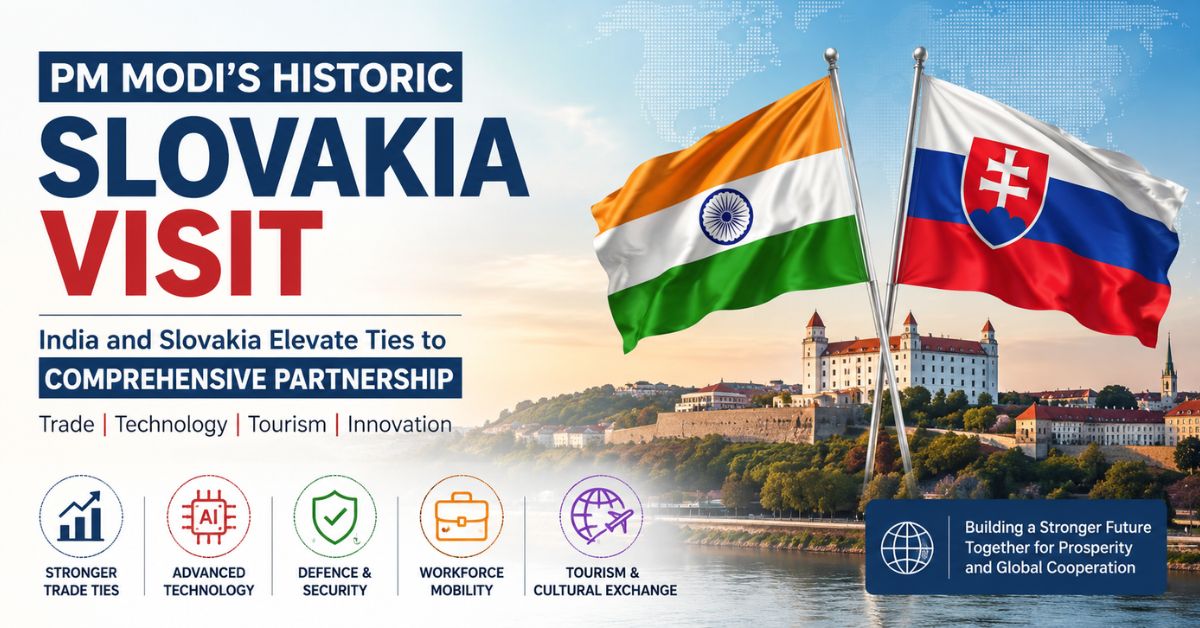
Key Highlights of PM Modi’s Historic Slovakia Visit
- Prime Minister Narendra Modi became the first Indian Prime Minister to visit Slovakia since the country’s independence in 1993.
- India and Slovakia upgraded their bilateral relationship to a Comprehensive Partnership covering trade, technology, security, and cultural cooperation.
- PM Modi received the Order of the White Double Cross, First Class, Slovakia’s highest state honor.
- Both countries expanded cooperation in artificial intelligence, advanced manufacturing, clean energy, defence, and innovation.
- The visit reinforced Slovakia’s growing role as a strategic gateway for India’s engagement with Central Europe and the European Union.
Prime Minister Narendra Modi’s visit to Slovakia has marked a historic moment in the relationship between India and the Central European nation. The three-day visit, held from June 14 to June 16, was the first by an Indian Prime Minister to Slovakia since the country gained independence in 1993.
The visit resulted in a series of agreements and strategic understandings covering trade, technology, defence, education, energy, workforce mobility, and cultural cooperation. Most importantly, India and Slovakia decided to elevate their bilateral relationship to a “Comprehensive Partnership,” signaling a long-term commitment to deeper cooperation across multiple sectors.
The trip is being viewed as an important step in India’s efforts to strengthen its presence in Central Europe while expanding economic and strategic ties with members of the European Union.
A Historic First Visit to Slovakia
Although India and Slovakia have maintained friendly relations for decades, no Indian Prime Minister had previously visited the country after its peaceful separation from former Czechoslovakia in 1993.
The visit therefore carried both symbolic and practical significance. It reflected India’s growing engagement with European nations beyond the continent’s larger economies and highlighted Slovakia’s increasing importance in India’s European strategy.
Prime Minister Modi held extensive discussions with Slovak Prime Minister Robert Fico and met senior government leaders during his stay in Bratislava. The meetings focused on identifying new areas of cooperation while building on existing economic and cultural connections.
Both leaders described the discussions as productive and forward-looking, emphasizing shared interests in economic growth, technological development, energy security, and global stability.
India and Slovakia Upgrade Ties to a Comprehensive Partnership
One of the most significant outcomes of the visit was the decision to upgrade India-Slovakia relations to a Comprehensive Partnership.
Such partnerships typically involve broader cooperation across political, economic, technological, cultural, and strategic fields. The move provides a stronger framework for regular dialogue between the two governments and creates opportunities for increased collaboration between businesses, universities, research institutions, and government agencies.
Officials from both countries noted that the upgraded relationship reflects the growing importance of bilateral ties and the shared desire to expand cooperation in the coming years.
The decision is expected to encourage more frequent high-level visits and facilitate progress on future agreements.
Global Cooperation and International Support
The visit also highlighted cooperation on international matters.
Slovakia expressed support for stronger India-European Union relations and maintained a positive approach toward reforms of international institutions. Discussions included the need for a more representative global governance system and greater cooperation between democratic nations in addressing global challenges.
For India, support from European partners remains important as New Delhi continues to advocate reforms in international organizations, including the United Nations.
The two leaders also exchanged views on regional security developments, economic challenges, and the evolving international order.
PM Modi Receives Slovakia’s Highest Civilian Honor
A major highlight of the visit came when Prime Minister Modi received the Order of the White Double Cross, First Class, Slovakia’s highest state decoration.
The award was presented in recognition of his contributions toward strengthening relations between India and Slovakia and promoting cooperation between the two countries.
The honor adds Slovakia to a growing list of countries that have recognized Modi’s role in advancing diplomatic engagement and international partnerships.
The award ceremony received significant attention in both countries and was viewed as a symbol of the growing warmth in bilateral relations.
Trade and Economic Cooperation Take Center Stage
Economic cooperation emerged as one of the main themes of the visit.
India and Slovakia have witnessed steady growth in bilateral trade over recent years. Trade between the two countries has reportedly doubled during the past three years, reflecting increased business activity and stronger commercial ties.
Leaders from both sides discussed ways to sustain this momentum and create new opportunities for investment.
The talks focused on expanding cooperation in manufacturing, automotive production, engineering, transportation systems, and green technologies.
Slovakia has established itself as one of Europe’s leading automobile manufacturing hubs. This creates opportunities for Indian companies looking to participate in European supply chains while also providing Slovak businesses with access to India’s large and rapidly growing market.
Both governments expressed confidence that stronger institutional cooperation would help businesses identify new investment opportunities and increase trade volumes further.
Growing Presence of Indian Companies in Slovakia
Indian companies already have a visible presence in Slovakia.
The Tata Group has significant connections with the Slovak economy through its global automotive operations. Tata AutoComp and other Indian firms have also expanded activities in the country.
During the visit, both sides emphasized the importance of encouraging additional investments and supporting partnerships between Indian and Slovak companies.
Business leaders accompanying the visit explored opportunities in sectors such as advanced manufacturing, engineering services, mobility solutions, clean energy technologies, and industrial innovation.
The discussions reflected a shared understanding that economic cooperation can become a major pillar of the bilateral relationship.
Support for the India-European Union Free Trade Agreement
The India-European Union Free Trade Agreement was another key topic during the meetings.
Negotiations on the proposed agreement have gained momentum in recent years. If finalized, the deal could reduce trade barriers, improve market access, and increase investment flows between India and EU member states.
Prime Minister Modi thanked Slovak leaders for supporting efforts to advance the negotiations.
For Indian businesses, a successful agreement could make it easier to export products and services to European markets. European companies would similarly benefit from greater access to India’s expanding economy.
Analysts believe that the agreement could significantly boost trade not only between India and the European Union but also between India and countries such as Slovakia that serve as gateways to wider regional markets.
Artificial Intelligence and Technology Collaboration
Technology cooperation emerged as another major focus area.
India and Slovakia agreed to deepen collaboration in advanced technologies, particularly artificial intelligence, digital innovation, research, and academic exchanges.
One of the notable proposals discussed during the visit involved the establishment of an India-focused initiative on artificial intelligence within Slovak academic institutions. The goal is to promote joint research and encourage cooperation between scientists, researchers, and students from both countries.
Both governments stressed the importance of developing human-centric technology that serves society while maintaining ethical standards and public trust.
Artificial intelligence has become a major area of global competition and cooperation. By expanding collaboration in this field, India and Slovakia aim to strengthen innovation ecosystems and support future economic growth.
Quantum Technologies and Cyber Security Cooperation
The discussions also covered advanced scientific research.
Officials explored opportunities for cooperation in quantum technologies, secure communications systems, cyber security, and digital infrastructure.
These fields are becoming increasingly important as governments and businesses seek stronger protection against cyber threats and invest in next-generation technologies.
Experts believe that collaboration between research institutions can help accelerate innovation while creating new opportunities for commercial applications.
For both countries, technological cooperation represents an area with significant long-term potential.
Expanding Cooperation in Clean Energy
Energy security and sustainability featured prominently during the meetings.
India and Slovakia discussed collaboration in clean energy solutions and emerging nuclear technologies, including Small Modular Reactors (SMRs).
SMRs are a newer type of nuclear reactor designed to be smaller, more flexible, and potentially more cost-effective than traditional nuclear power plants.
Many countries are exploring the technology as part of efforts to reduce carbon emissions while meeting growing energy demands.
Although discussions remain at an early stage, both sides expressed interest in sharing expertise and exploring future cooperation.
The focus on clean energy reflects broader global efforts to balance economic development with environmental sustainability.
Defence and Security Cooperation Deepens
Security cooperation also gained attention during the visit.
India and Slovakia signed a Letter of Intent aimed at strengthening defence cooperation. The agreement is expected to support exchanges between defence institutions and create opportunities for future collaboration.
Both countries also discussed broader security challenges, including terrorism, cyber threats, and regional stability.
Counter-terrorism cooperation was identified as an area where closer coordination could benefit both sides.
As global security challenges become increasingly complex, governments around the world are expanding partnerships to improve information sharing and strengthen collective responses.
Labour Mobility and Skilled Workforce Cooperation
Another important outcome involved workforce mobility and labour cooperation.
India’s large pool of skilled professionals has become a valuable resource for countries facing workforce shortages in specialized sectors.
The two sides discussed mechanisms that could facilitate the movement of skilled workers while ensuring legal protections and fair employment opportunities.
Labour mobility agreements can help address workforce needs in sectors such as information technology, engineering, healthcare, manufacturing, and research.
Officials are also exploring a Social Security Agreement that could benefit professionals working in each other’s countries.
Such measures could make it easier for Indian professionals to pursue opportunities in Slovakia while contributing to economic growth in both nations.
Education and Research Partnerships
Education emerged as another promising area of cooperation.
Both governments emphasized the importance of strengthening connections between universities, research institutions, and students.
Academic exchanges can help build long-term relationships while encouraging innovation and cultural understanding.
In recent years, educational cooperation has become an increasingly important component of international diplomacy. Students often become bridges between countries, creating networks that support future business, scientific, and cultural collaboration.
The proposed initiatives in artificial intelligence and advanced technology research are expected to contribute to these goals.
Cultural Ties Continue to Grow
While trade and technology dominated many discussions, cultural diplomacy also played an important role.
Prime Minister Modi highlighted the translation of India’s ancient Upanishads into the Slovak language as an example of growing cultural ties.
The translation project reflects a broader interest in Indian philosophy, spirituality, and literature among Slovak audiences.
During discussions, Slovak leaders also noted the growing popularity of Yoga, Ayurveda, and Indian cinema within the country.
These cultural connections help strengthen people-to-people relationships and create greater understanding between societies.
Cultural engagement often serves as an important foundation for broader diplomatic and economic partnerships.
Tourism and Film Industry Opportunities
Tourism was another area identified for future growth.
Slovakia’s natural landscapes, historical sites, and modern infrastructure make it an attractive destination for international visitors.
Officials discussed ways to increase tourism flows between the two countries and improve awareness of travel opportunities.
Slovak leaders also expressed interest in attracting Indian film productions.
Indian cinema has become a powerful global cultural force, and film shoots often generate tourism interest in featured locations. Encouraging Indian filmmakers to use Slovak locations could provide economic benefits while strengthening cultural visibility.
Why Slovakia Matters for India’s European Strategy
Although Slovakia is a relatively small country compared to some of Europe’s major economies, its strategic importance should not be underestimated.
Located in the heart of Central Europe, Slovakia provides access to key European markets and transportation networks. Its strong manufacturing base, especially in the automotive sector, makes it an important participant in regional supply chains.
For India, deeper engagement with Slovakia supports broader efforts to strengthen relations across Central and Eastern Europe.
The country can serve as a valuable partner in trade, technology, manufacturing, research, and innovation.
As India continues to expand its global economic footprint, partnerships with strategically located European nations are becoming increasingly important.
Looking Ahead
Prime Minister Modi’s visit to Slovakia may be remembered as a turning point in bilateral relations.
The elevation of ties to a Comprehensive Partnership, the expansion of cooperation across multiple sectors, and the strong political support demonstrated during the visit have created a foundation for future growth.
Many of the agreements and understandings reached in Bratislava will require continued follow-up and implementation. However, both governments appear committed to maintaining the momentum generated during the visit.
For India, the trip strengthens its engagement with Central Europe while supporting broader economic and strategic goals across the European continent.
For Slovakia, closer ties with one of the world’s fastest-growing major economies offer new opportunities in trade, investment, technology, and innovation.
As both countries move forward, the visit has established a clear message: India and Slovakia are seeking a deeper, broader, and more ambitious partnership for the years ahead.