


Key Points
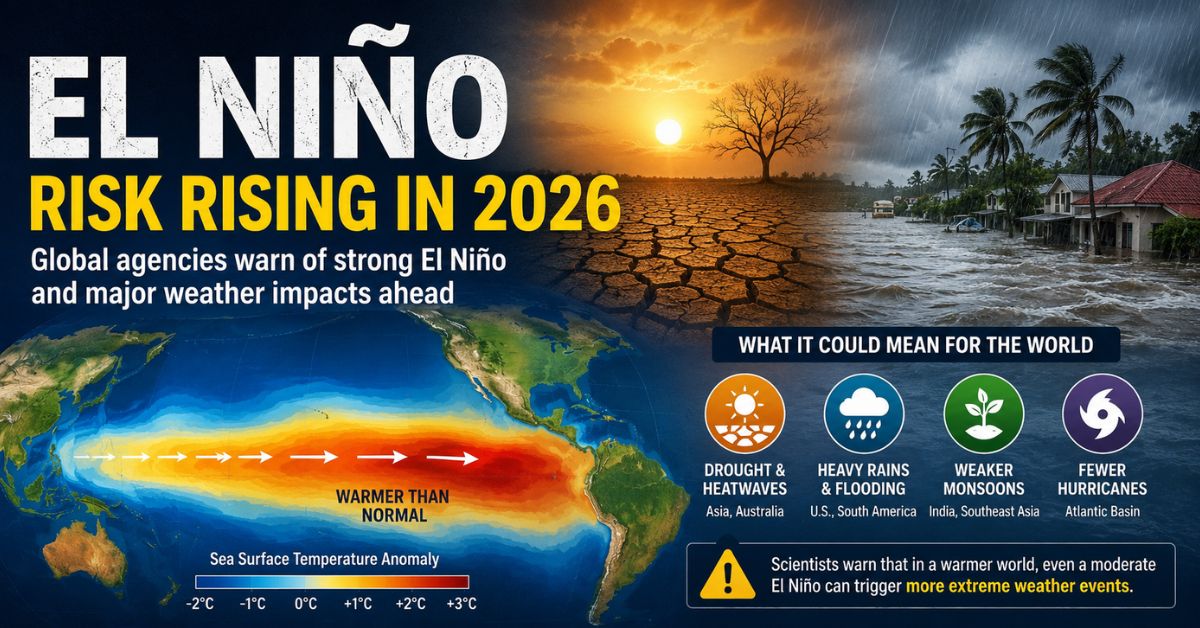
- Global climate agencies say El Niño conditions are likely to develop and strengthen during 2026.
- NOAA and WMO have warned that Pacific Ocean temperatures are rising rapidly.
- Scientists say a strong El Niño could affect monsoons, hurricanes, droughts, and heatwaves worldwide.
- India may face weaker monsoon conditions and higher agricultural stress during the 2026 rainy season.
- Experts caution that climate change could make El Niño impacts more severe than in previous decades.
Global climate agencies are warning that the Pacific Ocean is rapidly moving toward El Niño conditions, raising concerns about extreme weather events across several parts of the world later this year and into 2027.
The U.S. National Oceanic and Atmospheric Administration (NOAA), the World Meteorological Organization (WMO), and the International Research Institute for Climate and Society (IRI) have all reported increasing signs of warming in the tropical Pacific Ocean during recent weeks. Scientists say the warming trend has accelerated faster than expected since April.
According to NOAA’s latest forecast, there is an 82% chance that El Niño conditions will develop between May and July 2026. The agency also estimates a 96% probability that the climate pattern will continue through the Northern Hemisphere winter.
El Niño is a natural climate phenomenon that occurs when sea surface temperatures in the central and eastern Pacific Ocean rise above normal levels. The warming changes global wind patterns and can affect rainfall, storms, droughts, and temperatures across many regions.
Climate scientists are closely monitoring a large buildup of warm water below the Pacific surface, often called “subsurface heat.” Experts say this hidden ocean heat acts as fuel for El Niño and can lead to rapid strengthening once atmospheric conditions align.
Several international forecast models now suggest the event could become strong by late 2026. Some climate researchers have even raised the possibility of a “Super El Niño,” similar to the powerful events recorded in 1997-98 and 2015-16. However, official agencies have not yet confirmed that such an extreme outcome is certain.
NOAA has stated that there is currently about a one-in-four chance that Pacific warming could cross the threshold associated with a very strong El Niño event later this year.
Scientists expect the warming to intensify gradually through the coming months. During May to July, weakening trade winds are likely to allow warm ocean water to spread eastward toward South America. Forecast models indicate the ocean-atmosphere system may become more tightly linked between August and October, increasing the strength of the event.
El Niño events usually reach their peak during the Northern Hemisphere winter, meaning late 2026 and early 2027 could become the most active phase if warming continues.
Experts also warn that the climate impacts of El Niño may become stronger in today’s warmer world. Rising global temperatures caused by climate change are increasing the intensity of heatwaves and extreme rainfall events in many regions.
“Even a moderate El Niño now operates in a much warmer climate system than it did decades ago,” climate researchers have noted in recent international assessments.
India is among the countries watching the forecasts carefully because El Niño is often linked to weaker monsoon rainfall. Although El Niño does not always cause drought conditions in India, it can reduce seasonal rainfall and increase pressure on agriculture, reservoirs, and power demand.
Meteorologists say the full impact on India’s 2026 southwest monsoon will depend on several other climate factors, including conditions in the Indian Ocean. However, concerns over below-normal rainfall have already started to grow among agricultural experts and policymakers.
Elsewhere in Asia and Australia, forecasters are warning about increased risks of drought, wildfires, and prolonged heatwaves if the Pacific warming strengthens further during the second half of the year.
In the United States, El Niño is expected to influence winter weather patterns during 2026-27. Southern parts of the country may receive above-normal rainfall, raising the possibility of flooding in some regions. At the same time, the Atlantic hurricane season could become less active because El Niño tends to create stronger wind shear that disrupts tropical storm formation.
Along the western coast of South America, warmer Pacific waters may lead to heavy rainfall events and disruptions to fishing industries, especially near Peru and Ecuador.
Climate scientists say 2027 could eventually become one of the hottest years ever recorded globally because El Niño releases large amounts of stored ocean heat into the atmosphere. Historically, global temperature records often peak in the year after El Niño reaches maximum strength.
Despite growing concern, researchers caution that uncertainty still remains regarding the final intensity of the event. Forecast models can change over time, especially during the early stages of El Niño development.
For now, global weather agencies say the evidence clearly points toward a strengthening El Niño pattern that could shape weather conditions across much of the world over the next 18 months.